Application
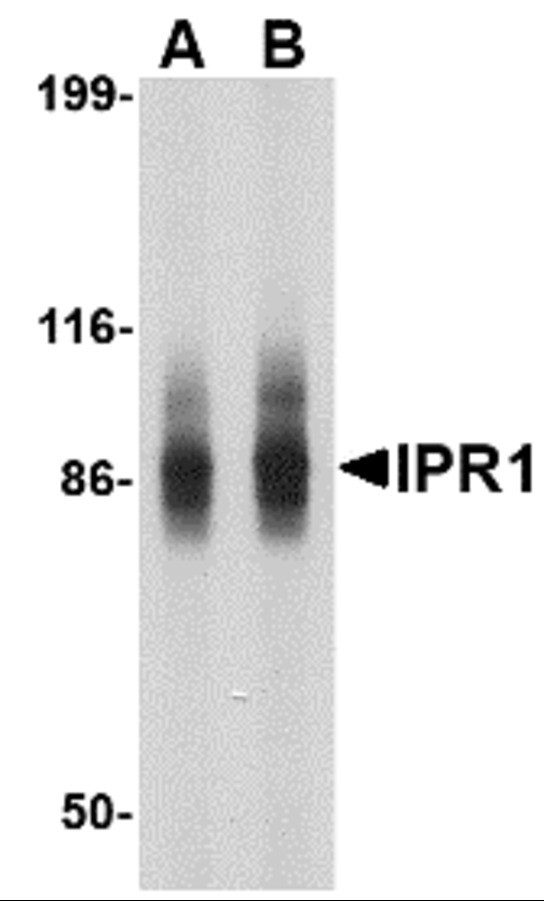
Western blot analysis of IPR1 in SW480 cell lysate with IPR1 antibody at (A) 1 and (B) 2 μg/mL.| Product Name | IPR1 Antibody |
|---|---|
| Antibody Type | Primary Antibodies |
| Product description | IPR1 Antibody: Susceptibility to tuberculosis (TB) in mice has recently been attributed to the IPR1 gene. IPR1 is a member of the SP100/SP140 family of nuclear body proteins and encodes a leukocyte-specific nuclear body component. The protein can function as an activator of gene transcription and may serve as a nuclear hormone receptor coactivator. Alternative splicing has been observed for this gene and three transcript variants, encoding distinct isoforms, have been identified. SP110 is the closest homolog of the IPR1 protein in humans. The IPR1/Sp110 gene product might play a role in integrating signals generated by intracellular pathogens with mechanisms controlling innate immunity, cell death, and pathogenesis. IPR1/Sp110 is up-regulated after infection with M. tuberculosis and required by Anaplasma phagocytophilum for infection of human promyelocytic cells. Defects in Sp110 are a cause of severely impaired resistance to infection by M. tuberculosis.1) Pan H, Yan BS, Rojas M, et al. Ipr1 gene mediates innate immunity to tuberculosis. Nature2005; 434:767-72. |
| Immunogen | IPR1 antibody was raised against a 16 amino acid synthetic peptide near the amino terminus of the human IPR1. The immunogen is located within amino acids 70 - 120 of IPR1. |
| Clonality | Polyclonal |
|---|---|
| Isotype | IgG |
| Host Species | Rabbit |
| Tested Applications | ELISAWB |
| Ipr1 antibody can be used for detection of Ipr1 by Western blot at 1 - 2 μg/mL. | |
| Species Reactivity | HumanMouseRat |
| Concentration | 1mg/ml |
| Purification | Affinity purified |
| Gene Symbol | SP110 |
|---|---|
| Alternative Names | IPR1 Antibody: IPR1 VODI IFI41 IFI75 Sp110 nuclear body protein Speckled 110 kDa |
Application
Western blot analysis of IPR1 in SW480 cell lysate with IPR1 antibody at (A) 1 and (B) 2 μg/mL.| Positive Control | 1) Cat. No. 1221 - SW480 Cell Lysate |
|---|---|
| Application Notes | Ipr1 antibody can be used for detection of Ipr1 by Western blot at 1 - 2 μg/mL. |
| Form | Liquid |
|---|---|
| Storage Instructions | IPR1 antibody can be stored at 4˚C for three months and -20˚C, stable for up to one year. As with all antibodies care should be taken to avoid repeated freeze thaw cycles. Antibodies should not be exposed to prolonged high temperatures. |
| Storage Buffer | IPR1 Antibody is supplied in PBS containing 0.02% sodium azide. |


