Application
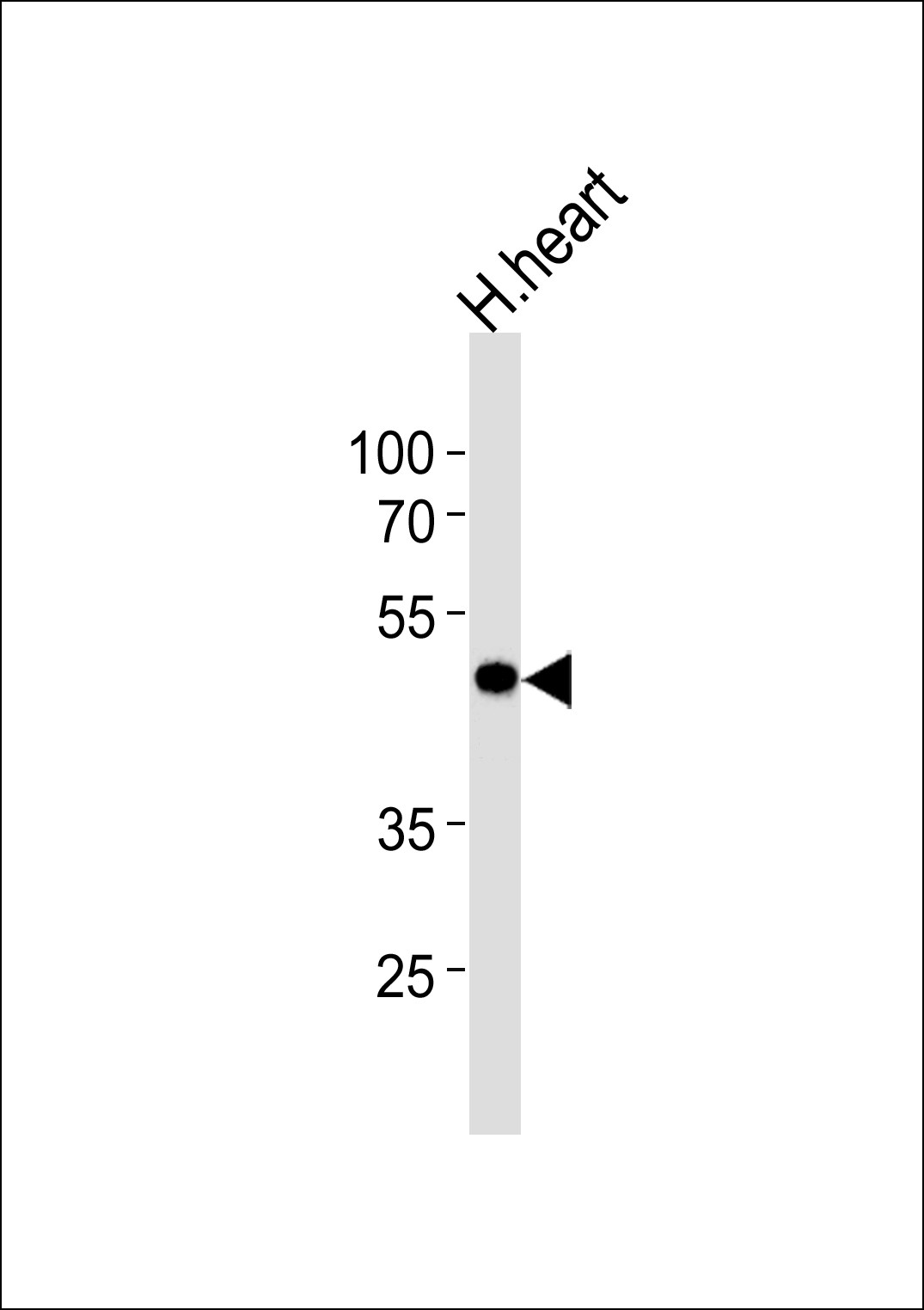
Western blot analysis of lysate from human heart tissue lysate, using KCNAB1 Antibody at 1:1000 at each lane.| Product Name | KCNAB1 Antibody |
|---|---|
| Antibody Type | Primary Antibodies |
| Antigen Alias | Voltage-gated potassium channel subunit beta-1, K(+) channel subunit beta-1, Kv-beta-1, KCNAB1, KCNA1B |
| Product description | Potassium channels represent the most complex class of voltage-gated ion channels from both functional and structural standpoints. Their diverse functions include regulating neurotransmitter release, heart rate, insulin secretion, neuronal excitability, epithelial electrolyte transport, smooth muscle contraction, and cell volume. Four sequence-related potassium channel genes - shaker, shaw, shab, and shal - have been identified in Drosophila, and each has been shown to have human homolog(s). This gene encodes a member of the potassium channel, voltage-gated, shaker-related subfamily. This member includes three distinct isoforms which are encoded by three alternatively spliced transcript variants of this gene. These three isoforms are beta subunits, which form heteromultimeric complex with alpha subunits and modulate the activity of the pore-forming alpha subunits.1) Rose, J.E., et al. Mol. Med. 16 (7-8), 247-253 (2010) : |
| Immunogen | This KCNAB1 antibody is generated from rabbits immunized with a KLH conjugated synthetic peptide between 15-44 amino acids from the N-terminal region of human KCNAB1. |
| Clonality | Polyclonal |
|---|---|
| Isotype | Ig |
| Host Species | Rabbit |
| Tested Applications | WB |
| For WB starting dilution is: 1:1000: |
|
| Species Reactivity | Human |
| Concentration | 1mg/ml |
| Purification | Affinity purified |
| Gene Symbol | KCNAB1 |
|---|---|
| Alternative Names | Voltage-gated potassium channel subunit beta-1 K(+) channel subunit beta-1 Kv-beta-1 KCNAB1 KCNA1B |
| Molecular Weight(MW) | 47 kDa |
Application
Western blot analysis of lysate from human heart tissue lysate, using KCNAB1 Antibody at 1:1000 at each lane.| Application Notes | For WB starting dilution is: 1:1000: |
|---|
| Form | Liquid |
|---|---|
| Storage Instructions | Store at 4˚C for three months and -20˚C, stable for up to one year. As with all antibodies care should be taken to avoid repeated freeze thaw cycles. Antibodies should not be exposed to prolonged high temperatures. |
| Storage Buffer | Supplied in PBS with 0.09% (W/V) sodium azide. |


