Application
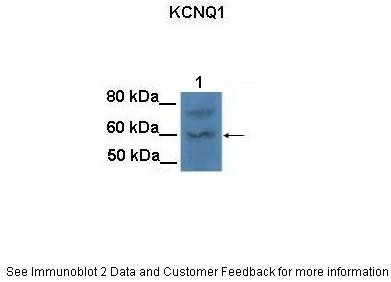
Antibody used in WB on Hamster at: 1:1000.Application
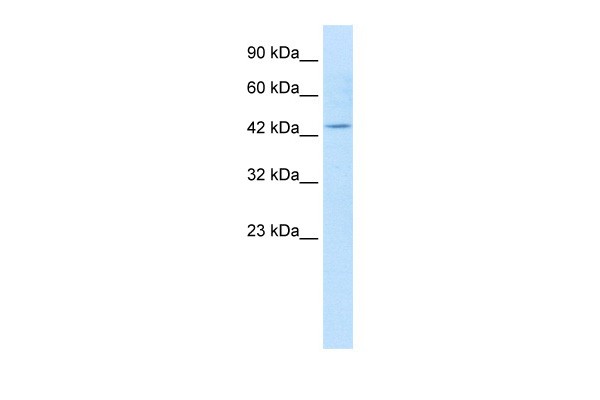
Antibody used in WB on Human Jurkat 1.25 ug/ml.| Product Name | KCNQ1 Antibody |
|---|---|
| Antibody Type | Primary Antibodies |
| Product description | KCNQ1 encodes a protein for a voltage-gated potassium channel required for the repolarization phase of the cardiac action potential. The gene product can form heteromultimers with two other potassium channel proteins, KCNE1 and KCNE3. Mutations in KCNQ1 are associated with hereditary long QT syndrome, Romano-Ward syndrome, Jervell and Lange-Nielsen syndrome and familial atrial fibrillation.1) Du, LP., et al., (2005) Biochem Biophys Res Commun. 332(3), 677-87. |
| Immunogen | Antibody produced in rabbits immunized with a synthetic peptide corresponding a region of human KCNQ1. |
| Clonality | Polyclonal |
|---|---|
| Host Species | Rabbit |
| Tested Applications | ELISAWB |
| KCNQ1 antibody can be used for detection of KCNQ1 by ELISA at 1:62500. KCNQ1 antibody can be used for detection of KCNQ1 by western blot at 1.25 μg/mL, and HRP conjugated secondary antibody should be diluted 1:50,000 - 100,000. | |
| Species Reactivity | DogHumanMouseRat |
| Concentration | 1mg/ml |
| Purification | Protein A |
| Gene Symbol | KCNQ1 |
|---|---|
| Alternative Names | KCNQ1 LQT RWS WRS LQT1 SQT2 ATFB1 ATFB3 JLNS1 KCNA8 KCNA9 Kv1.9 Kv7.1 KVLQT1 |
| Molecular Weight(MW) | 60 kDa |
Application
Antibody used in WB on Hamster at: 1:1000.
Application
Antibody used in WB on Human Jurkat 1.25 ug/ml.| Positive Control | 1) Cat. No. 1205 - Jurkat Cell Lysate |
|---|---|
| Application Notes | KCNQ1 antibody can be used for detection of KCNQ1 by ELISA at 1:62500. KCNQ1 antibody can be used for detection of KCNQ1 by western blot at 1.25 μg/mL, and HRP conjugated secondary antibody should be diluted 1:50,000 - 100,000. |
| Form | Liquid |
|---|---|
| Storage Instructions | For short periods of storage (days) store at 4˚C. For longer periods of storage, store KCNQ1 antibody at -20˚C. As with any antibody avoid repeat freeze-thaw cycles. |
| Storage Buffer | IgG in phosphate buffered saline , pH 7.4, 150mM NaCl, 0.02% sodium azide and 50% glycerol.Store at -20 °C.Stable for 12 months from date of receipt |


