Application
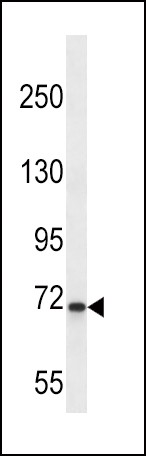
Western blot analysis in K562 cell line lysates (35ug/lane).| Product Name | KLKB1 Antibody |
|---|---|
| Antibody Type | Primary Antibodies |
| Product description | Plasma prekallikrein is a glycoprotein that participates in the surface-dependent activation of blood coagulation, fibrinolysis, kinin generation and inflammation. It is synthesized in the liver and secreted into the blood as a single polypeptide chain. Plasma prekallikrein is converted to plasma kallikrein by factor XIIa by the cleavage of an internal Arg-Ile bond. Plasma kallikrein therefore is composed of a heavy chain and a light chain held together by a disulphide bond. The heavy chain originates from the amino-terminal end of the zymogen and contains 4 tandem repeats of 90 or 91 amino acids. Each repeat harbors a novel structure called the apple domain. The heavy chain is required for the surface-dependent pro-coagulant activity of plasma kallikrein. The light chain contains the active site or catalytic domain of the enzyme and is homologous to the trypsin family of serine proteases. Plasma prekallikrein deficiency causes a prolonged activated partial thromboplastin time in patients.1) MacKenzie, J.A., et al. Appl Physiol Nutr Metab 35(4):518-525(2010) |
| Immunogen | This KLKB1 antibody is generated from rabbits immunized with a KLH conjugated synthetic peptide between 508-537 amino acids from the C-terminal region of human KLKB1. |
| Clonality | Polyclonal |
|---|---|
| Isotype | Ig |
| Host Species | Rabbit |
| Tested Applications | WB |
| For WB starting dilution is: 1:1000 | |
| Species Reactivity | Human |
| Concentration | 1mg/ml |
| Purification | Affinity purified |
| Gene Symbol | KLKB1 |
|---|---|
| Alternative Names | Plasma kallikrein Fletcher factor Kininogenin Plasma prekallikrein Plasma kallikrein heavy chain Plasma kallikrein light chain KLKB1 KLK3 |
| Molecular Weight(MW) | 71 kDa |
Application
Western blot analysis in K562 cell line lysates (35ug/lane).| Application Notes | For WB starting dilution is: 1:1000 |
|---|
| Form | Liquid |
|---|---|
| Storage Instructions | Store at 4˚C for three months and -20˚C, stable for up to one year. As with all antibodies care should be taken to avoid repeated freeze thaw cycles. Antibodies should not be exposed to prolonged high temperatures. |
| Storage Buffer | Supplied in PBS with 0.09% (W/V) sodium azide. |


