Application
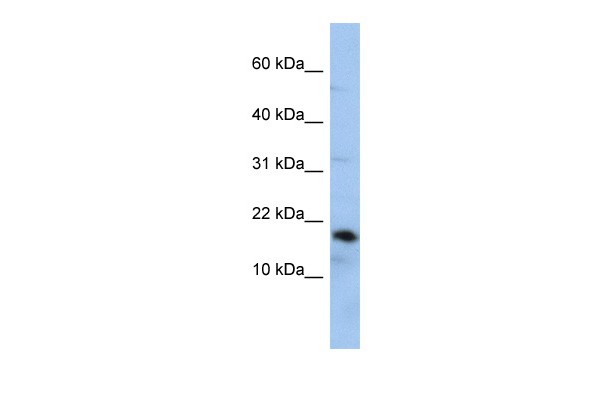
Antibody used in WB on Human HepG2 at 0.2-1 ug/ml.| Product Name | LCN1 Antibody |
|---|---|
| Antibody Type | Primary Antibodies |
| Antigen Alias | LCN1, MGC71975, PMFA, TP, VEGP, TLC |
| Product description | LCN1 could play a role in taste reception. LCN1 could be necessary for the concentration and delivery of sapid molecules in the gustatory system. LCN1 can bind various ligands, with chemical structures ranging from lipids and retinoids to the macrocyclic antibiotic rifampicin and even to microbial siderophores. LCN1 exhibits an extremely wide ligand pocket.The protein encoded by this gene belongs to the lipocalin family. Lipocalins are a group of extracellular proteins that are able to bind lipophiles by enclosure within their structures to minimize solvent contact. This protein may bind hydrophobic ligands and inhibit cysteine proteinases. It may also play a role in taste reception.1) Yusifov, T.N., (er) Mol. Vis. 14, 180-188 (2008) . |
| Immunogen | Antibody produced in rabbits immunized with a synthetic peptide corresponding a region of human LCN1. |
| Clonality | Polyclonal |
|---|---|
| Host Species | Rabbit |
| Tested Applications | ELISAWB |
| LCN1 antibody can be used for detection of LCN1 by ELISA at 1:312500. LCN1 antibody can be used for detection of LCN1 by western blot at 1 μg/mL, and HRP conjugated secondary antibody should be diluted 1:50,000 - 100,000.: |
|
| Species Reactivity | Human |
| Concentration | 1mg/ml |
| Purification | Affinity purified |
| Gene Symbol | LCN1 |
|---|---|
| Alternative Names | LCN1 MGC71975 PMFA TP VEGP TLC |
| Molecular Weight(MW) | 17 kDa |
Application
Antibody used in WB on Human HepG2 at 0.2-1 ug/ml.| Positive Control | 1) Cat. No. 1211 - HepG2 Cell Lysate |
|---|---|
| Application Notes | LCN1 antibody can be used for detection of LCN1 by ELISA at 1:312500. LCN1 antibody can be used for detection of LCN1 by western blot at 1 μg/mL, and HRP conjugated secondary antibody should be diluted 1:50,000 - 100,000.: |
| Form | Liquid |
|---|---|
| Storage Instructions | For short periods of storage (days) store at 4˚C. For longer periods of storage, store LCN1 antibody at -20˚C. As with any antibody avoid repeat freeze-thaw cycles. |
| Storage Buffer | Antibody is lyophilized in PBS buffer with 2% sucrose. Add 50 μL of distilled water. Final antibody concentration is 1 mg/mL. |


