Application
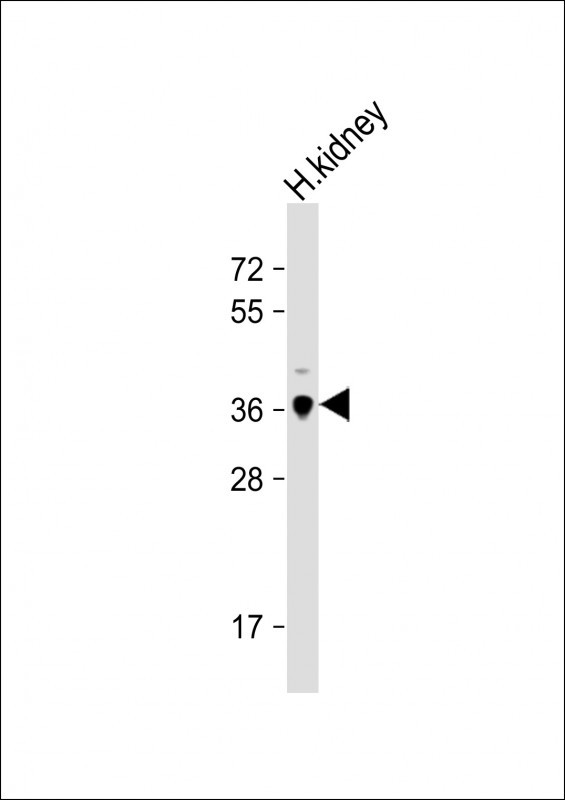
Western Blot at 1:1000 dilution + human kidney lysate Lysates/proteins at 20 ug per lane.Application
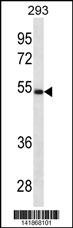
Western blot analysis in 293 cell line lysates (35ug/lane).| Product Name | LGMN Antibody |
|---|---|
| Antibody Type | Primary Antibodies |
| Antigen Alias | Legumain, Asparaginyl endopeptidase, Protease, cysteine 1, LGMN, PRSC1 |
| Product description | This gene encodes a cysteine protease that has a strict specificity for hydrolysis of asparaginyl bonds. This enzyme may be involved in the processing of bacterial peptides and endogenous proteins for MHC class II presentation in the lysosomal/endosomal systems. Enzyme activation is triggered by acidic pH and appears to be autocatalytic. Protein expression occurs after monocytes differentiate into dendritic cells. A fully mature, active enzyme is produced following lipopolysaccharide expression in mature dendritic cells. Overexpression of this gene may be associated with the majority of solid tumor types. This gene has a pseudogene on chromosome 13. Several alternatively spliced transcript variants have been described, but the biological validity of only two has been determined. These two variants encode the same isoform.1) Clerin, V., et al. Atherosclerosis 201(1):53-66(2008) |
| Immunogen | This LGMN antibody is generated from rabbits immunized with a KLH conjugated synthetic peptide between 83-112 amino acids from the N-terminal region of human LGMN. |
| Clonality | Polyclonal |
|---|---|
| Isotype | Ig |
| Host Species | Rabbit |
| Tested Applications | WB |
| For WB starting dilution is: 1:1000: |
|
| Species Reactivity | Human |
| Concentration | 1mg/ml |
| Purification | Affinity purified |
| Gene Symbol | LGMN |
|---|---|
| Alternative Names | Legumain Asparaginyl endopeptidase Protease cysteine 1 LGMN PRSC1 |
| Molecular Weight(MW) | 49 kDa |
| Sequence Similarities | Predicted species reactivity based on immunogen sequence: Monkey |
Application
Western Blot at 1:1000 dilution + human kidney lysate Lysates/proteins at 20 ug per lane.
Application
Western blot analysis in 293 cell line lysates (35ug/lane).| Application Notes | For WB starting dilution is: 1:1000: |
|---|
| Form | Liquid |
|---|---|
| Storage Instructions | Store at 4˚C for three months and -20˚C, stable for up to one year. As with all antibodies care should be taken to avoid repeated freeze thaw cycles. Antibodies should not be exposed to prolonged high temperatures. |
| Storage Buffer | Supplied in PBS with 0.09% (W/V) sodium azide. |


