Application
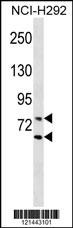
Western blot analysis in NCI-H292 cell line lysates (35ug/lane).| Product Name | LMNA Antibody |
|---|---|
| Antibody Type | Primary Antibodies |
| Antigen Alias | Prelamin-A/C, Lamin-A/C, 70 kDa lamin, Renal carcinoma antigen NY-REN-32, LMNA, LMN1 |
| Product description | The nuclear lamina consists of a two-dimensional matrix of proteins located next to the inner nuclear membrane. The lamin family of proteins make up the matrix and are highly conserved in evolution. During mitosis, the lamina matrix is reversibly disassembled as the lamin proteins are phosphorylated. Lamin proteins are thought to be involved in nuclear stability, chromatin structure and gene expression. Vertebrate lamins consist of two types, A and B. Through alternate splicing, this gene encodes three type A lamin isoforms. Mutations in this gene lead to several diseases: Emery-Dreifuss muscular dystrophy, familial partial lipodystrophy, limb girdle muscular dystrophy, dilated cardiomyopathy, Charcot-Marie-Tooth disease, and Hutchinson-Gilford progeria syndrome.1) Bailey, S.D., et al. Diabetes Care 33(10):2250-2253(2010) |
| Immunogen | This LMNA antibody is generated from rabbits immunized with a KLH conjugated synthetic peptide between 401-427 amino acids from the Central region of human LMNA. |
| Clonality | Polyclonal |
|---|---|
| Isotype | Ig |
| Host Species | Rabbit |
| Tested Applications | WB |
| For WB starting dilution is: 1:1000: |
|
| Species Reactivity | Human |
| Concentration | 1mg/ml |
| Purification | Affinity purified |
| Gene Symbol | LMNA |
|---|---|
| Alternative Names | Prelamin-A/C Lamin-A/C 70 kDa lamin Renal carcinoma antigen NY-REN-32 LMNA LMN1 |
| Molecular Weight(MW) | 74 kDa |
Application
Western blot analysis in NCI-H292 cell line lysates (35ug/lane).| Application Notes | For WB starting dilution is: 1:1000: |
|---|
| Form | Liquid |
|---|---|
| Storage Instructions | Store at 4˚C for three months and -20˚C, stable for up to one year. As with all antibodies care should be taken to avoid repeated freeze thaw cycles. Antibodies should not be exposed to prolonged high temperatures. |
| Storage Buffer | Supplied in PBS with 0.09% (W/V) sodium azide. |


