Application
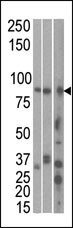
Antibody is used in Western blot to detect MARK1 in, from left to right, Hela, T47D, and mouse brain cell line/ tissue lysate.| Product Name | MARK1 Antibody |
|---|---|
| Antibody Type | Primary Antibodies |
| Product description | MARK is a family of kinases that is known for its involvement in establishing cell polarity and in phosphorylating tau protein during Alzheimer neurodegeneration. Expression of MARK causes the phosphorylation of MAPs at their KXGS motifs, thereby detaching MAPs from the microtubules and thus facilitating the transport of particles. This occurs without impairing the intrinsic activity of motors because the velocity during active movement remains unchanged. In primary retinal ganglion cells, transfection with tau leads to the inhibition of axonal transport of mitochondria, APP vesicles, and other cell components which leads to starvation of axons and vulnerability against stress. This transport inhibition can be rescued by phosphorylating tau with MARK1) Drewes, G., et al., Cell 89(2):297-308 (1997). |
| Immunogen | This MARK1 antibody is generated from rabbits immunized with a KLH conjugated synthetic peptide between 671-700 amino acids from the C-terminal region of human MARK1. |
| Clonality | Polyclonal |
|---|---|
| Isotype | Ig |
| Host Species | Rabbit |
| Tested Applications | WB |
| For WB starting dilution is: 1:1000 | |
| Species Reactivity | HumanMouse |
| Concentration | 1mg/ml |
| Purification | Unpurified |
| Gene Symbol | MARK1 |
|---|---|
| Alternative Names | Serine/threonine-protein kinase MARK1 MAP/microtubule affinity-regulating kinase 1 PAR1 homolog c Par-1c Par1c MARK1 ( HGNC:6896 ) |
| Molecular Weight(MW) | 89 kDa |
Application
Antibody is used in Western blot to detect MARK1 in, from left to right, Hela, T47D, and mouse brain cell line/ tissue lysate.| Application Notes | For WB starting dilution is: 1:1000 |
|---|
| Form | Liquid |
|---|---|
| Storage Instructions | Store at 4˚C for three months and -20˚C, stable for up to one year. As with all antibodies care should be taken to avoid repeated freeze thaw cycles. Antibodies should not be exposed to prolonged high temperatures. |
| Storage Buffer | Supplied in PBS with 0.09% (W/V) sodium azide. |


