Application
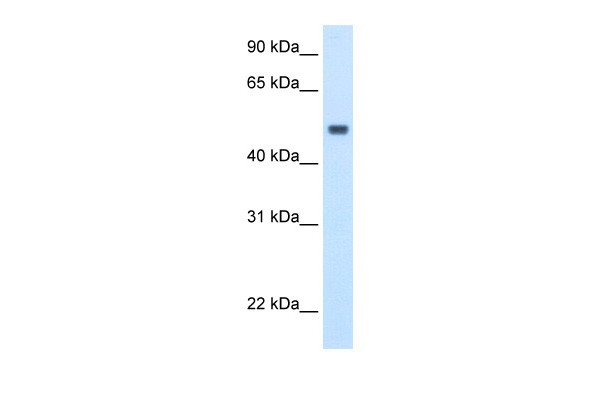
Antibody used in WB on Human Liver at 2.5 ug/ml.| Product Name | MAT1A Antibody |
|---|---|
| Antibody Type | Primary Antibodies |
| Product description | MAT1A catalyzes a two-step reaction that involves the transfer of the adenosyl moiety of ATP to methionine to form S-adenosylmethionine and tripolyphosphate, which is subsequently cleaved to PPi and Pi. S-adenosylmethionine is the source of methyl groups for most biological methylations. MAT1A is found as a homotetramer (MAT I) or a homodimer (MAT III) whereas a third form, MAT II (gamma), is encoded by the MAT2A gene. Mutations in its gene are associated with methionine adenosyltransferase deficiency.This gne encodes methionine adenosyltransferase I (alpha isoform), which catalyzes the formation of S-adenosylmethionine from methionine and ATP. Methionine adenosyltransferase deficiency is caused by recessive and dominant mutations, the latter identified in autosomal dominant persistant hypermethioninemia.1) Oh, J.H., (2005) Mamm. Genome 16 (12), 942-954. |
| Immunogen | Antibody produced in rabbits immunized with a synthetic peptide corresponding a region of human MAT1A. |
| Clonality | Polyclonal |
|---|---|
| Host Species | Rabbit |
| Tested Applications | ELISAWB |
| MAT1A antibody can be used for detection of MAT1A by ELISA at 1:1562500. MAT1A antibody can be used for detection of MAT1A by western blot at 2.5 μg/mL, and HRP conjugated secondary antibody should be diluted 1:50,000 - 100,000. | |
| Species Reactivity | DogHuman |
| Concentration | 1mg/ml |
| Purification | Protein A |
| Gene Symbol | MAT1A |
|---|---|
| Alternative Names | MAT1A MAT MATA1 SAMS SAMS1 |
| Molecular Weight(MW) | 44 kDa |
Application
Antibody used in WB on Human Liver at 2.5 ug/ml.| Positive Control | 1) Cat. No. XBL-10409 - Fetal Liver Tissue Lysate |
|---|---|
| Application Notes | MAT1A antibody can be used for detection of MAT1A by ELISA at 1:1562500. MAT1A antibody can be used for detection of MAT1A by western blot at 2.5 μg/mL, and HRP conjugated secondary antibody should be diluted 1:50,000 - 100,000. |
| Form | Liquid |
|---|---|
| Storage Instructions | For short periods of storage (days) store at 4˚C. For longer periods of storage, store MAT1A antibody at -20˚C. As with any antibody avoid repeat freeze-thaw cycles. |
| Storage Buffer | IgG in phosphate buffered saline , pH 7.4, 150mM NaCl, 0.02% sodium azide and 50% glycerol.Store at -20 °C.Stable for 12 months from date of receipt |


