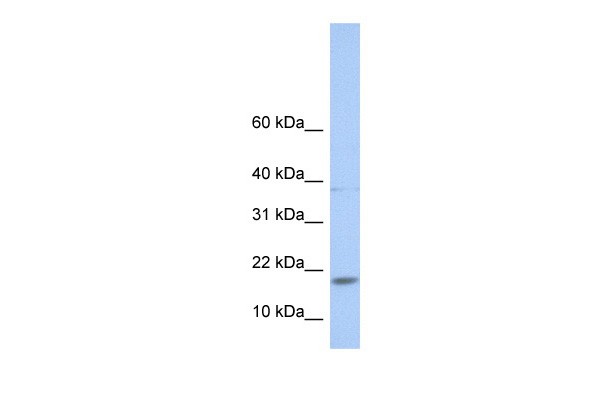
Application
Antibody used in WB on Human Lung at 0.2-1 ug/ml.| Product Name | MAX Antibody |
|---|---|
| Antibody Type | Primary Antibodies |
| Product description | MAX is a member of the basic helix-loop-helix leucine zipper (bHLHZ) family of transcription factors. It is able to form homodimers and heterodimers with other family members, which include Mad, Mxi1 and Myc. Myc is an oncoprotein implicated in cell proliferation, differentiation and apoptosis. The homodimers and heterodimers compete for a common DNA target site (the E box) and rearrangement among these dimer forms provides a complex system of transcriptional regulation.The protein encoded by this gene is a member of the basic helix-loop-helix leucine zipper (bHLHZ) family of transcription factors. It is able to form homodimers and heterodimers with other family members, which include Mad, Mxi1 and Myc. Myc is an oncoprotein implicated in cell proliferation, differentiation and apoptosis. The homodimers and heterodimers compete for a common DNA target site (the E box) and rearrangement among these dimer forms provides a complex system of transcriptional regulation. Multiple alternatively spliced transcript variants have been described for this gene but the full length nature for some of them is unknown.The protein encoded by this gene is a member of the basic helix-loop-helix leucine zipper (bHLHZ) family of transcription factors. It is able to form homodimers and heterodimers with other family members, which include Mad, Mxi1 and Myc. Myc is an oncoprotein implicated in cell proliferation, differentiation and apoptosis. The homodimers and heterodimers compete for a common DNA target site (the E box) and rearrangement among these dimer forms provides a complex system of transcriptional regulation. Multiple alternatively spliced transcript variants have been described for this gene but the full-length nature for some of them is unknown.1) Faiola, F., (2007) Biochem. J. 403 (3), 397-407. |
| Immunogen | Antibody produced in rabbits immunized with a synthetic peptide corresponding a region of human MAX. |
| Clonality | Polyclonal |
|---|---|
| Host Species | Rabbit |
| Tested Applications | ELISAWB |
| MAX antibody can be used for detection of MAX by ELISA at 1:12500. MAX antibody can be used for detection of MAX by western blot at 1 μg/mL, and HRP conjugated secondary antibody should be diluted 1:50,000 - 100,000. | |
| Species Reactivity | Human |
| Concentration | 1mg/ml |
| Purification | Affinity purified |
| Gene Symbol | MAX |
|---|---|
| Alternative Names | MAX MGC10775 MGC11225 MGC18164 MGC34679 MGC36767 orf1 bHLHd4 |
| Molecular Weight(MW) | 18 kDa |
Application
Antibody used in WB on Human Lung at 0.2-1 ug/ml.| Positive Control | 1) Cat. No. XBL-10410 - Fetal Lung Tissue Lysate |
|---|---|
| Application Notes | MAX antibody can be used for detection of MAX by ELISA at 1:12500. MAX antibody can be used for detection of MAX by western blot at 1 μg/mL, and HRP conjugated secondary antibody should be diluted 1:50,000 - 100,000. |
| Form | Liquid |
|---|---|
| Storage Instructions | For short periods of storage (days) store at 4˚C. For longer periods of storage, store MAX antibody at -20˚C. As with any antibody avoid repeat freeze-thaw cycles. |
| Storage Buffer | Antibody is lyophilized in PBS buffer with 2% sucrose. Add 50 μL of distilled water. Final antibody concentration is 1 mg/mL. |


