Application
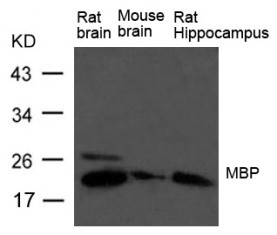
Western blot analysis of extract from Rat brain, Mouse brain and Rat hippocampus Tissue using MBP Antibody.| Product Name | MBP (myelin basic protein) Antibody |
|---|---|
| Antibody Type | Primary Antibodies |
| Product description | The classic group of MBP isoforms (isoform 4-isoform 14) are with PLP the most abundant protein components of the myelin membrane in the CNS. They have a role in both its formation and stabilization. The smaller isoforms might have an important role in remyelination of denuded axons in multiple sclerosis. The non-classic group of MBP isoforms (isoform 1-isoform 3/Golli-MBPs) may preferentially have a role in the early developing brain long before myelination, maybe as components of transcriptional complexes, and may also be involved in signaling pathways in T-cells and neural cells. Differential splicing events combined with optional post-translational modifications give a wide spectrum of isomers, with each of them potentially having a specialized function. Induces T-cell proliferation.1) Pribyl T. M., Campagnoni C. W., Kampf K., Kashima T., Handley V. W., McMahon J., Campagnoni A. T. Proc. Natl. Acad. Sci. U. S. A. 90:10695-10699 (1993) Nye S. H., Pelfrey C. M., Burkwit J. J., Voskuhl R. R., Lenardo M. J., Mueller J. P. Mol. Immunol. 32:1131-1141 (1995) |
| Immunogen | MBP (myelin basic protein) antibody was raised against a peptide sequence around aa.291~295 (G-G-R-D-S) derived from Human MBP. |
| Clonality | Polyclonal |
|---|---|
| Host Species | Rabbit |
| Tested Applications | WB |
| Western Blot: 1:500~1:1000 | |
| Species Reactivity | HumanMouseRat |
| Concentration | 1mg/ml |
| Purification | Affinity purified |
| Gene Symbol | MBP |
|---|---|
| Alternative Names | MGC99675 |
| Molecular Weight(MW) | 14~33 kDa |
| Tissue Specificity | This antibody detects endogenous level of total MBP(myelin basic protein) protein. |
| Entrez Gene | 4155 |
|---|---|
| Protein Accession | NP_001020252.1 |
Application
Western blot analysis of extract from Rat brain, Mouse brain and Rat hippocampus Tissue using MBP Antibody.| Application Notes | Western Blot: 1:500~1:1000 |
|---|
| Form | Liquid |
|---|---|
| Storage Instructions | Store antibody at -20˚C for up to one year. |
| Storage Buffer | Antibody supplied in phosphate buffered saline (without Mg2+ and Ca2+), pH 7.4, 150mM NaCl, 0.02% sodium azide and 50% glycerol. |


