Application
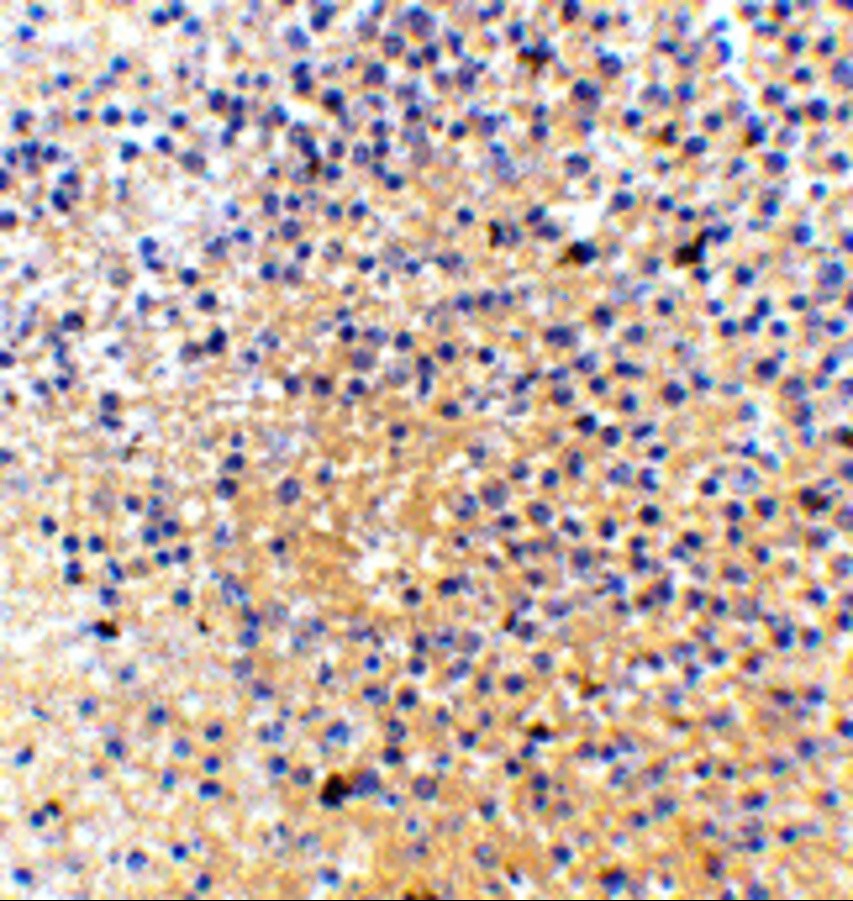
Immunohistochemistry of MD-1 in human spleen tissue with MD-1 antibody at 2.5 μg/mL.Application
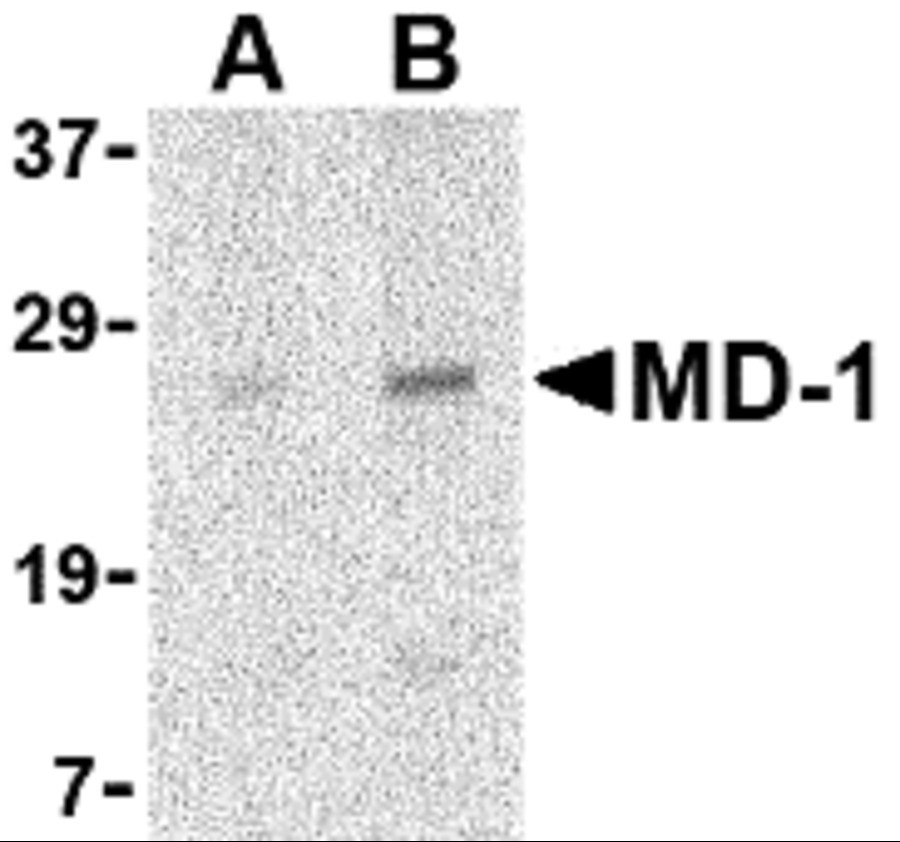
Western blot analysis of MD-1 in Daudi cell lysate with MD-1 antibody at (A) 1 and (B) 2 μg/mL.| Product Name | MD-1 Antibody |
|---|---|
| Antibody Type | Primary Antibodies |
| Product description | MD-1 Antibody: Toll-like receptors (TLRs) are evolutionarily conserved pattern-recognition molecules that recognize different microbial products during infection and serve as an important link between the innate and adaptive immune responses. The signaling of these TLRs is kept under tight control by the expression of endogenous inhibiting proteins such as RP105, a recently identified homolog of TLR4. This protein, in association with MD-1, interacts with and inhibits the TLR4/MD-2 signaling pathway. While MD-2 can directly bind to LPS, one of the activating molecules of TLR4, the function of MD-1 is less well-known. It has been suggested however, that the RP105/MD-1 complex influences antibody production mediated by both TLR4/MD-2 and TLR2 receptor complexes.1) Takeda K, Kaisho T, and Akira S. Toll-like receptors. Annu. Rev. Immunol. 2003; 21:335-76. |
| Immunogen | MD-1 antibody was raised against a 15 amino acid synthetic peptide from near the center of human MD-1. The immunogen is located within the last 50 amino acids of MD-1. |
| Clonality | Polyclonal |
|---|---|
| Isotype | IgG |
| Host Species | Rabbit |
| Tested Applications | ELISAIHC-PWB |
| MD-1 antibody can be used for the detection of MD-1 by Western blot at 1 - 2 μg/mL. Antibody can also be used for immunohistochemistry starting at 2.5 μg/mL. | |
| Species Reactivity | HumanMouseRat |
| Concentration | 1mg/ml |
| Purification | Affinity purified |
| Gene Symbol | LY86 |
|---|---|
| Alternative Names | MD-1 Antibody: MD-1 MMD-1 dJ80N2.1 MD1 Lymphocyte antigen 86 Protein MD-1 Ly-86 |
| Sequence Similarities | 3) Cat. No. 10-901 - Human Spleen Tissue Slide |
Application
Immunohistochemistry of MD-1 in human spleen tissue with MD-1 antibody at 2.5 μg/mL.
Application
Western blot analysis of MD-1 in Daudi cell lysate with MD-1 antibody at (A) 1 and (B) 2 μg/mL.| Positive Control | 1) Cat. No. 1224 - Daudi Cell Lysate |
|---|---|
| Application Notes | MD-1 antibody can be used for the detection of MD-1 by Western blot at 1 - 2 μg/mL. Antibody can also be used for immunohistochemistry starting at 2.5 μg/mL. |
| Form | Liquid |
|---|---|
| Storage Instructions | MD-1 antibody can be stored at 4˚C for three months and -20˚C, stable for up to one year. As with all antibodies care should be taken to avoid repeated freeze thaw cycles. Antibodies should not be exposed to prolonged high temperatures. |
| Storage Buffer | MD-1 Antibody is supplied in PBS containing 0.02% sodium azide. |


