Application
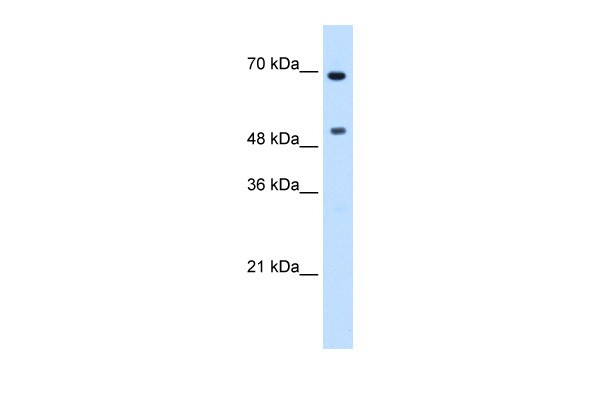
Antibody used in WB on Transfected 293T at 0.0625 ug/ml.Application
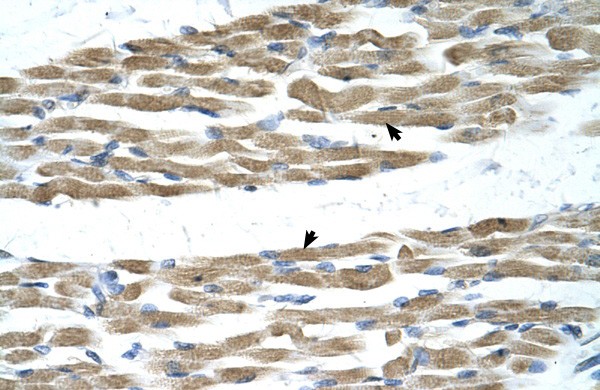
Antibody used in IHC on Human Muscle.| Product Name | MYC Antibody |
|---|---|
| Antibody Type | Tags Antibodies |
| Product description | MYC is a multifunctional, nuclear phosphoprotein that plays a role in cell cycle progression, apoptosis and cellular transformation. It functions as a transcription factor that regulates transcription of specific target genes. Mutations, overexpression, rearrangement and translocation of this MYC gene have been associated with a variety of hematopoietic tumors, leukemias and lymphomas, including Burkitt lymphoma.The protein encoded by this gene is a multifunctional, nuclear phosphoprotein that plays a role in cell cycle progression, apoptosis and cellular transformation. It functions as a transcription factor that regulates transcription of specific target genes. Mutations, overexpression, rearrangement and translocation of this gene have been associated with a variety of hematopoietic tumors, leukemias and lymphomas, including Burkitt lymphoma. There is evidence to show that alternative translation initiations from an upstream, in-frame non-AUG (CUG) and a downstream AUG start site result in the production of two isoforms with distinct N-termini. The synthesis of non-AUG initiated protein is suppressed in Burkitt's lymphomas, suggesting its importance in the normal function of this gene.The protein encoded by this gene is a multifunctional, nuclear phosphoprotein that plays a role in cell cycle progression, apoptosis and cellular transformation. It functions as a transcription factor that regulates transcription of specific target genes. Mutations, overexpression, rearrangement and translocation of this gene have been associated with a variety of hematopoietic tumors, leukemias and lymphomas, including Burkitt lymphoma. There is evidence to show that alternative translation initiations from an upstream, in-frame non-AUG (CUG) and a downstream AUG start site result in the production of two isoforms with distinct N-termini. The synthesis of non-AUG initiated protein is suppressed in Burkitt's lymphomas, suggesting its importance in the normal function of this gene.1) Frater, J.L., (2006) Cancer Genet. Cytogenet. 166 (2), 139-145. |
| Immunogen | Antibody produced in rabbits immunized with a synthetic peptide corresponding a region of human MYC. |
| Clonality | Polyclonal |
|---|---|
| Host Species | Rabbit |
| Tested Applications | ELISAIHCWB |
| MYC antibody can be used for detection of MYC by ELISA at 1:312500. MYC antibody can be used for detection of MYC by western blot at 0.0625 μg/mL, and HRP conjugated secondary antibody should be diluted 1:50,000 - 100,000. | |
| Species Reactivity | Human |
| Concentration | 1mg/ml |
| Purification | Affinity purified |
| Gene Symbol | MYC |
|---|---|
| Alternative Names | MYC c-Myc MRTL MYCC bHLHe39 |
| Molecular Weight(MW) | 50 kDa |
Application
Antibody used in WB on Transfected 293T at 0.0625 ug/ml.
Application
Antibody used in IHC on Human Muscle.| Positive Control | 1) Tranfected 293T Cell Lysate |
|---|---|
| Application Notes | MYC antibody can be used for detection of MYC by ELISA at 1:312500. MYC antibody can be used for detection of MYC by western blot at 0.0625 μg/mL, and HRP conjugated secondary antibody should be diluted 1:50,000 - 100,000. |
| Form | Liquid |
|---|---|
| Storage Instructions | For short periods of storage (days) store at 4˚C. For longer periods of storage, store MYC antibody at -20˚C. As with any antibody avoid repeat freeze-thaw cycles. |
| Storage Buffer | Antibody is lyophilized in PBS buffer with 2% sucrose. Add 50 μL of distilled water. Final antibody concentration is 1 mg/mL. |


