Application
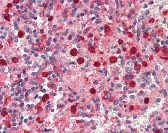
Immunohistochemistry staining of Myeloperoxidase in spleen tissue using Myeloperoxidase Antibody.| Product Name | Myeloperoxidase Antibody |
|---|---|
| Antibody Type | Primary Antibodies |
| Product description | Human myeloperoxidase (MPO) is a dimeric protein composed of two heavy subunits (53 kDa) and two light subunits (15 kDa). Each MPO molecule contains two prosthetic porphyrins which play an important role in the catalytic cycle. Molecular weights for MPO isoforms from pools of normal human samples range from 114,000 to 140,000 daltons reflecting a heterogeneous mixture of isoforms when assayed under non-reducing conditions of SDS-PAGE. Often MPO from a single donor will yield a homogenous preparation reflecting a single isoform. The carbohydrate component of MPO, consisting of mannose, glucose and N-acetylglucosamine residues is 2.5%. MPO is inhibited by azide and other compounds. MPO is stored in primary granules of neutrophils and serves as a bactericidal agent in that MPO catalyzes the production of hypochlorous acid (HOCl), a powerful oxidant. HOCl is derived from chloride ion (Cl-) and hydrogen peroxide (H2O2). In a number of inflammatory situations, MPO is released into the extracellular matrix where its measurement can be used as an indication of neutrophil activation. |
| Immunogen | Myeloperoxidase antibody was raised against amino acids 3 - 14 of Myeloperoxidase (Human). |
| Clonality | Polyclonal |
|---|---|
| Host Species | Rabbit |
| Tested Applications | ELISAIFIHCIPWB |
| Myeloperoxidase antibody can be used in immunohistochemistry starting at 10 μg/mL. | |
| Species Reactivity | Human |
| Concentration | 1mg/ml |
| Purification | Affinity purified |
| Gene Symbol | MPO |
|---|---|
| Alternative Names | MPO Myeloperoxidase precursor Myeloperoxidase |
Application
Immunohistochemistry staining of Myeloperoxidase in spleen tissue using Myeloperoxidase Antibody.| Application Notes | Myeloperoxidase antibody can be used in immunohistochemistry starting at 10 μg/mL. |
|---|
| Form | Liquid |
|---|---|
| Storage Instructions | Store Myeloperoxidase antibody at 4 ˚C or -20 ˚C. As with all antibodies avoid freeze/thaw cycles. |
| Storage Buffer | PBS, pH 7.2, 0.01% sodium azide. |


