Application
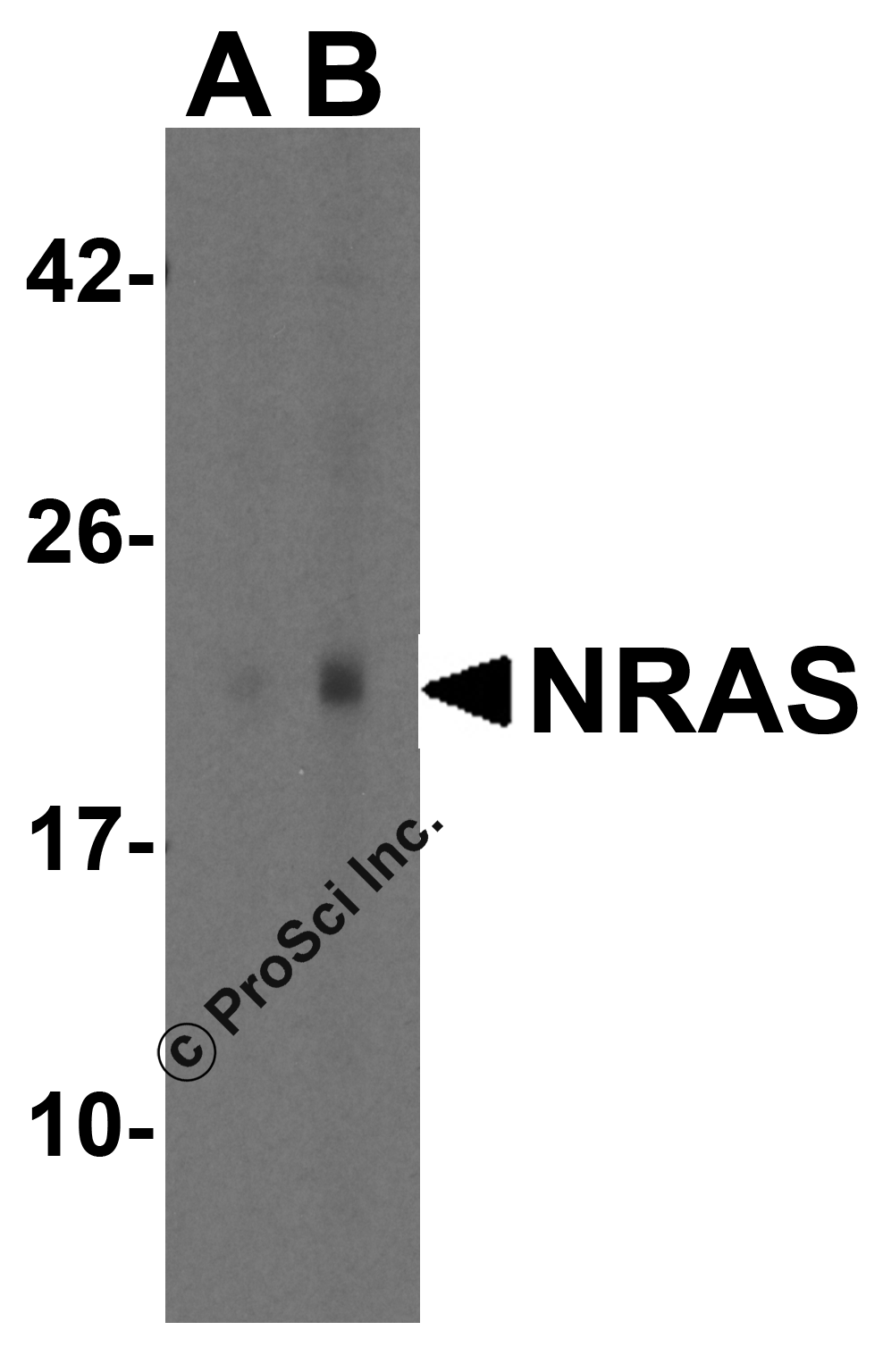
Western blot analysis of NRAS in A431 cell lysate with NRAS antibody at (A) 1 and (B) 2 μg/mL.| Product Name | N-RAS Antibody |
|---|---|
| Antibody Type | Primary Antibodies |
| Product description | N-RAS Antibody: Activating mutations and overexpression of classical Ras subfamily members (N-RAS, H-RAS, and K-RAS) have been widely investigated as key events in the development of human cancers. The N-RAS protein shuttles between the Golgi apparatus and the plasma membrane. This shuttling is regulated through palmitoylation and depalmitoylation by the ZDHHC9-GOLGA7 complex. N-RAS, which has intrinsic GTPase activity, is activated by a guanine nucleotide-exchange factor and inactivated by a GTPase activating protein. Mutations in this gene have been associated with somatic rectal cancer, follicular thyroid cancer, autoimmune lymphoproliferative syndrome, Noonan syndrome, and juvenile myelomonocytic leukemia.1) Ehrhardt A, Ehrhardt GR, Guo X, et al. Ras and relatives--job sharing and networking keep an old family together. Exp. Hematol. 2002; 30:1089-106. |
| Immunogen | N-RAS antibody was raised against a 15 amino acid peptide near the carboxy terminus of human N-RAS. The immunogen is located within the last 50 amino acids of N-RAS. |
| Clonality | Polyclonal |
|---|---|
| Isotype | IgG |
| Host Species | Rabbit |
| Tested Applications | ELISAWB |
| N-RAS antibody can be used for detection of N-RAS by Western blot at 1 and 2 μg/mL. | |
| Species Reactivity | HumanMouseRat |
| Concentration | 1mg/ml |
| Purification | Affinity purified |
| Gene Symbol | NRAS |
|---|---|
| Alternative Names | N-RAS Antibody: NS6 ALPS4 N-ras NRAS1 HRAS1 GTPase NRas Transforming protein N-Ras |
| Molecular Weight(MW) | Predicted: 22 kDa Observed: 22 kDa |
| Sequence Similarities | Predicted species reactivity based on immunogen sequence: Pig: (100%) |
| Tissue Specificity | N-RAS antibody is predicted to not cross-react with H-RAS |
Application
Western blot analysis of NRAS in A431 cell lysate with NRAS antibody at (A) 1 and (B) 2 μg/mL.| Positive Control | 1) Cat. No. 1202 – A431 Cell Lysate |
|---|---|
| Application Notes | N-RAS antibody can be used for detection of N-RAS by Western blot at 1 and 2 μg/mL. |
| Form | Liquid |
|---|---|
| Storage Instructions | N-RAS antibody can be stored at 4˚C for three months and -20˚C, stable for up to one year. |
| Storage Buffer | N-RAS Antibody is supplied in PBS containing 0.02% sodium azide. |


