Application
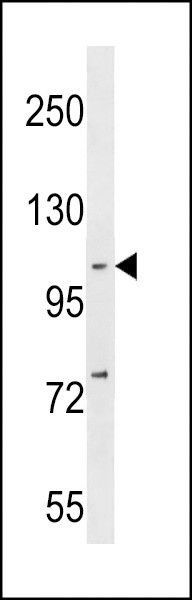
Western blot analysis in MDA-MB231 cell line lysates (35ug/lane).This demonstrates the NFKB antibody detected the NFKB protein (arrow).| Product Name | NFKB Antibody |
|---|---|
| Antibody Type | Primary Antibodies |
| Antigen Alias | Nuclear factor NF-kappa-B p105 subunit, DNA-binding factor KBF1, EBP-1, Nuclear factor of kappa light polypeptide gene enhancer in B-cells 1, Nuclear factor NF-kappa-B p50 subunit, NFKB1 |
| Product description | This gene encodes a 105 kD protein which can undergo cotranslational processing by the 26S proteasome to produce a 50 kD protein. The 105 kD protein is a Rel protein-specific transcription inhibitor and the 50 kD protein is a DNA binding subunit of the NF-kappa-B (NFKB) protein complex. NFKB is a transcription regulator that is activated by various intra- and extra-cellular stimuli such as cytokines, oxidant-free radicals, ultraviolet irradiation, and bacterial or viral products. Activated NFKB translocates into the nucleus and stimulates the expression of genes involved in a wide variety of biological functions. Inappropriate activation of NFKB has been associated with a number of inflammatory diseases while persistent inhibition of NFKB leads to inappropriate immune cell development or delayed cell growth. Two transcript variants encoding different isoforms have been found for this gene.1) Beshir, A.B., et al. Cancer Lett. 299(2):137-149(2010) |
| Immunogen | This NFKB(p105) antibody is generated from rabbits immunized with a KLH conjugated synthetic peptide between 911-937 amino acids from the C-terminal region of human NFKB(p105). |
| Clonality | Polyclonal |
|---|---|
| Isotype | Ig |
| Host Species | Rabbit |
| Tested Applications | WB |
| For WB starting dilution is: 1:1000: |
|
| Species Reactivity | Human |
| Concentration | 1mg/ml |
| Purification | Affinity purified |
| Gene Symbol | NFKB1 |
|---|---|
| Alternative Names | Nuclear factor NF-kappa-B p105 subunit DNA-binding factor KBF1 EBP-1 Nuclear factor of kappa light polypeptide gene enhancer in B-cells 1 Nuclear factor NF-kappa-B p50 subunit NFKB1 |
| Molecular Weight(MW) | 105 kDa |
| Sequence Similarities | Predicted species reactivity based on immunogen sequence: Chicken |
Application
Western blot analysis in MDA-MB231 cell line lysates (35ug/lane).This demonstrates the NFKB antibody detected the NFKB protein (arrow).| Application Notes | For WB starting dilution is: 1:1000: |
|---|
| Form | Liquid |
|---|---|
| Storage Instructions | Store at 4˚C for three months and -20˚C, stable for up to one year. As with all antibodies care should be taken to avoid repeated freeze thaw cycles. Antibodies should not be exposed to prolonged high temperatures. |
| Storage Buffer | Supplied in PBS with 0.09% (W/V) sodium azide. |


