Application
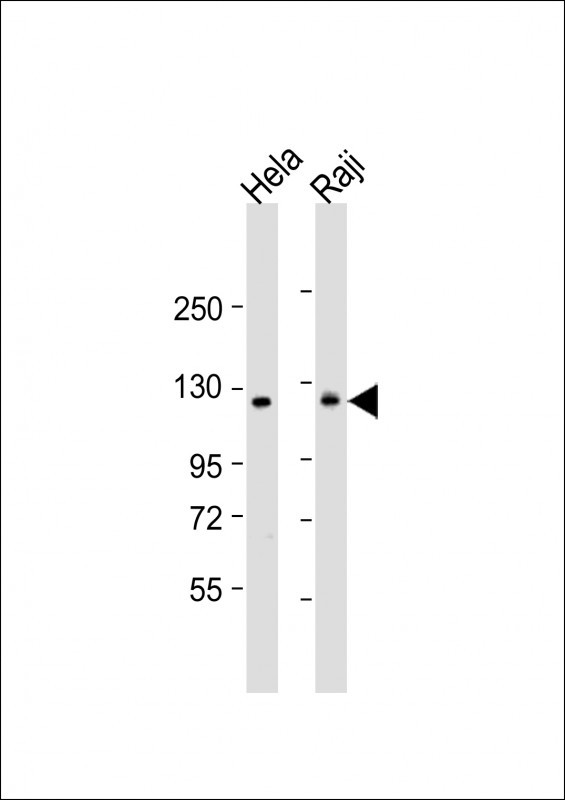
Western Blot at 1:1000 dilution Lane 1: Hela whole cell lysate Lane 2: Raji whole cell lysate Lysates/proteins at 20 ug per lane.| Product Name | NFKB Antibody |
|---|---|
| Antibody Type | Primary Antibodies |
| Antigen Alias | Nuclear factor NF-kappa-B p100 subunit, DNA-binding factor KBF2, H2TF1, Lymphocyte translocation chromosome 10 protein, Nuclear factor of kappa light polypeptide gene enhancer in B-cells 2, Oncogene Lyt-10, Lyt10, Nuclear factor NF-kappa-B p52 subunit, NFK |
| Product description | NF-kappa-B has been detected in numerous cell types that express cytokines, chemokines, growth factors, cell adhesion molecules, and some acute phase proteins in health and in various disease states. NF-kappa-B is activated by a wide variety of stimuli, such as cytokines, oxidant-free radicals, inhaled particles, ultraviolet irradiation, and bacterial or viral products. Inappropriate activation of NF-kappa-B has been linked to inflammatory events associated with autoimmune arthritis, asthma, septic shock, lung fibrosis, glomerulonephritis, atherosclerosis, and AIDS. In contrast, complete and persistent inhibition of NF-kappa-B has been linked directly to apoptosis, inappropriate immune cell development, and delayed cell growth. NFKB1 (MIM 164011) and NFKB2 encode p105 and p100 proteins that are processed to produce the active p50 and p52 NF-kappa-B subunits, respectively. However, the p100 and p105 proteins serve regulatory functions and should not be considered exclusively as precursor forms. The most abundant activated form of NF-kappa-B is a heterodimer of the p50 or p52 subunit bound to the RELA subunit (MIM 164014). Other NF-kappa-B complexes, consisting of hetero- and homodimers of p50, p52, RELA, REL (MIM 164910), and RELB (MIM 604758), have also been detected. NF-kappa-B complexes are inhibited by I-kappa-B proteins, NFKBIA (MIM 164008) or NFKBIB (MIM 604495), which inactivate NF-kappa-B by trapping it in the cytoplasm. Phosphorylation of serine residues on the I-kappa-B proteins by the kinases IKBKA (CHUK; MIM 600664) or IKBKB (MIM 603258) marks them for destruction via the ubiquitination pathway, thereby allowing activation of the NF-kappa-B complex. The activated NF-kappa-B complex translocates into the nucleus and binds DNA at kappa-B-binding motifs, such as 5-prime GGGRNNYYCC 3-prime or 5-prime HGGARNYYCC 3-prime (where H is A, C, or T; R is an A or G purine; and Y is a C or T pyrimidine). For reviews, see Chen et al. (1999) [PubMed 9895331] and Baldwin (1996) [PubMed 8717528].1) Bailey, S.D., et al. Diabetes Care 33(10):2250-2253(2010) |
| Immunogen | This NFKB(p100) antibody is generated from rabbits immunized with a KLH conjugated synthetic peptide between 848-874 amino acids from the C-terminal region of human NFKB(p100). |
| Clonality | Polyclonal |
|---|---|
| Isotype | Ig |
| Host Species | Rabbit |
| Tested Applications | WB |
| For WB starting dilution is: 1:1000: |
|
| Species Reactivity | Human |
| Concentration | 1mg/ml |
| Purification | Affinity purified |
| Gene Symbol | NFKB2 |
|---|---|
| Alternative Names | Nuclear factor NF-kappa-B p100 subunit DNA-binding factor KBF2 H2TF1 Lymphocyte translocation chromosome 10 protein Nuclear factor of kappa light polypeptide gene enhancer in B-cells 2 Oncogene Lyt-10 Lyt10 Nuclear factor NF-kappa-B p52 subunit NFK |
| Molecular Weight(MW) | 97 kDa |
| Sequence Similarities | Predicted species reactivity based on immunogen sequence: Mouse |
Application
Western Blot at 1:1000 dilution Lane 1: Hela whole cell lysate Lane 2: Raji whole cell lysate Lysates/proteins at 20 ug per lane.| Application Notes | For WB starting dilution is: 1:1000: |
|---|
| Form | Liquid |
|---|---|
| Storage Instructions | Store at 4˚C for three months and -20˚C, stable for up to one year. As with all antibodies care should be taken to avoid repeated freeze thaw cycles. Antibodies should not be exposed to prolonged high temperatures. |
| Storage Buffer | Supplied in PBS with 0.09% (W/V) sodium azide. |


