Application
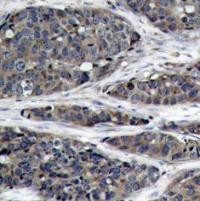
Immunohistochemical analysis of paraffin-embedded human breast carcinoma tissue using NFκB-p105/p50 (Ab-932).Application
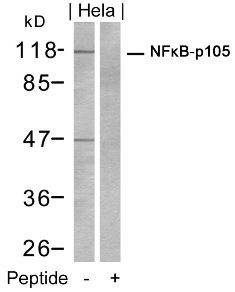
Western blot analysis of lysed extracts from HeLa cells using NFκB-p105/p50 (Ab-932).| Product Name | NFkB p105 / p50 Antibody |
|---|---|
| Antibody Type | Primary Antibodies |
| Antigen Alias | p50, KBF1, p105, EBP-1, NF-kB1, NFKB-p50, NFkappaB, NF-kappaB, NFKB-p105, NF-kappa-B, PRMT4, DNA-binding factor KBF1, NF-kappa-B1 p84/NF-kappa-B1 p98, NFKB1, NFkB-p50 |
| Product description | NF-κ-B is a pleiotropic transcription factor which is present in almost all cell types and is involved in many biological processed such as inflammation, immunity, differentiation, cell growth, tumorigenesis and apoptosis. NF-κ-B is a homo- or heterodimeric complex formed by the Rel-like domain-containing proteins RELA/p65, RELB, NFKB1/p105, NFKB1/p50, REL and NFKB2/p52. The dimers bind at kappa-B sites in the DNA of their target genes and the individual dimers have distinct preferences for different kappa-B sites that they can bind with distinguishable affinity and specificity. Different dimer combinations act as transcriptional activators or repressors, respectively.1) Soren Beinke et al. (2004) Biochem J. 382 (Pt 2): 393–409. Vigo Heissmeyer1, et al. (1999) The EMBO Journal 18: 4766–4778, F Chen, et al. (2006) Cell Death and Differentiation 13: 1835–1838. Kris A. Steinbrecher, et al. (2005) Mol Cell Biol. 25 (19): 8444–8455. |
| Immunogen | NFkB-p105/p50 (Ab-932) antibody was raised against a peptide sequence around aa.930~934 (E-T-S-F-R) derived from Human NFκB-p105. |
| Clonality | Polyclonal |
|---|---|
| Host Species | Rabbit |
| Tested Applications | IHCWB |
| Western Blot: 1:500~1:1000, Immunohistochemistry: 1:50~1:100: |
|
| Species Reactivity | HumanMouseRat |
| Concentration | 1mg/ml |
| Purification | Affinity purified |
| Gene Symbol | NFKB1 |
|---|---|
| Alternative Names | p50 KBF1 p105 EBP-1 NF-kB1 NFKB-p50 NFkappaB NF-kappaB NFKB-p105 NF-kappa-B PRMT4 DNA-binding factor KBF1 NF-kappa-B1 p84/NF-kappa-B1 p98 NFKB1 NFkB-p50 |
| Molecular Weight(MW) | 50, 120 kDa |
| Tissue Specificity | This antibody detects endogenous level of total NFκB-p105/p50 protein. |
| Entrez Gene | 4790 |
|---|---|
| Protein Accession | NP_001158884.1 |
Application
Immunohistochemical analysis of paraffin-embedded human breast carcinoma tissue using NFκB-p105/p50 (Ab-932).
Application
Western blot analysis of lysed extracts from HeLa cells using NFκB-p105/p50 (Ab-932).| Application Notes | Western Blot: 1:500~1:1000, Immunohistochemistry: 1:50~1:100: |
|---|
| Form | Liquid |
|---|---|
| Storage Instructions | Store antibody at -20˚C for up to one year. |
| Storage Buffer | Antibody supplied in phosphate buffered saline (without Mg2+ and Ca2+), pH 7.4, 150mM NaCl, 0.02% sodium azide and 50% glycerol. |


