Application
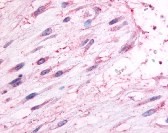
Immunohistochemistry staining of Oxytocin receptor in uterus, pregnant tissue using Oxytocin receptor Antibody.| Product Name | Oxytocin Receptor Antibody |
|---|---|
| Antibody Type | Primary Antibodies |
| Antigen Alias | OXTR, Oxytocin receptor, Oxt-r, OT-R |
| Product description | The oxytocin receptor belongs to the vasopressin/oxytocin family of GPCRs because it binds similar cyclic nonapeptide hormones. The oxytocin receptor functions primarily during labor and lactation. There is a dramatic increase in the number of oxytocin receptors just before the onset of labor causing the uterine muscles to become exceedingly sensitive to oxytocin. The activated oxytocin receptor causes an inward membrane current that results in smooth muscle contraction during labor and milk ejection during lactation. This receptor also plays a role in natriuresis, kaliuresis and may have an antistress effect. |
| Immunogen | Oxytocin Receptor antibody was raised against a peptide located in the C-Terminal cytoplasmic domain of Oxytocin Receptor (Human). |
| Clonality | Polyclonal |
|---|---|
| Host Species | Rabbit |
| Tested Applications | ELISAIHC |
| Oxytocin Receptor antibody can be used in immunohistochemistry starting at 8 μg/mL.: |
|
| Species Reactivity | Human |
| Concentration | 1mg/ml |
| Purification | Affinity purified |
| Gene Symbol | OXTR |
|---|---|
| Alternative Names | OXTR Oxytocin receptor Oxt-r OT-R |
| Tissue Specificity | BLAST analysis of the peptide immunogen showed no homology with other human proteins. |
Application
Immunohistochemistry staining of Oxytocin receptor in uterus, pregnant tissue using Oxytocin receptor Antibody.| Application Notes | Oxytocin Receptor antibody can be used in immunohistochemistry starting at 8 μg/mL.: |
|---|
| Form | Liquid |
|---|---|
| Storage Instructions | Oxytocin Receptor antibody should be stored long term (months) at -80 ˚C and short term (days) at 4 ˚C. As with all antibodies avoid freeze/thaw cycles. |
| Storage Buffer | PBS, 0.1% sodium azide. |


