Application
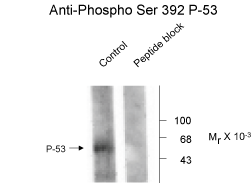
Western blot of rat brain fraction lysate showing phosphospecific immunolabeling of the ~53k p53 protein phosphorylated at Ser392.| Product Name | p53 (phospho Ser392) Antibody |
|---|---|
| Antibody Type | Primary Antibodies |
| Antigen Alias | P53, BCC7, LFS1, TRP53, P53, Antigen NY-CO-13, |
| Product description | p53 has a well established role in the blocking the proliferative action of damaged cells and acting in essence as an anticancer agent. It has been called the guardian of the genome. Phosphorylation of Ser392 in p53 is associated with formation of human tumors. In addition p53 has also been linked to affects of aging and oxidative stress. An increase in p53 has also been linked to deficits in LTP and learning and memory. We raised this polyclonal antibody against a peptide representing the sequence around Ser392 of p53.1) Saito, S., Yamaguchi, H., Higashimoto, Y., Chao, C., Xu, Y., Fornace, A.J., Jr., Appella, E., and Anderson, C.W., "Phosphorylation site interdependence of human p53 post-translational modifications in response to stress," J. Biol. Chem., 278 (2003) 37,536-37,544. |
| Immunogen | p53 (Ser392) polyclonal antibody was raised against a synthetic phosphopeptide corresponding to amino acids residues surrounding the phospho-Ser392 of p53. |
| Modification | p-Ser392 |
| Clonality | Polyclonal |
|---|---|
| Host Species | Rabbit |
| Tested Applications | WB |
| Immunolabeling of the 53 kDa p53 protein in Western blots of PMA treated NIH3T3 cells is blocked by the Ser392 phosphopeptide used as antigen but by the corresponding non-phosphopeptide. Applications include Dot Blots (DB) and Western Blots (WB). Immunohistochemistry: not determined. Human and some non-human primates have 100% amino acid sequence identity with the antigen used to raise the antibody. When internally tested under ideal conditions the working dilutions were 1:1000 for DB and WB.: |
|
| Species Reactivity | HumanMonkey |
| Concentration | 1mg/ml |
| Purification | Affinity purified |
| Gene Symbol | TP53 |
|---|---|
| Alternative Names | P53 BCC7 LFS1 TRP53 P53 Antigen NY-CO-13 |
| Molecular Weight(MW) | 53 |
| Tissue Specificity | p53 antibody is specific for the 53 kDa p53 protein phosphorylated at Ser392. |
Application
Western blot of rat brain fraction lysate showing phosphospecific immunolabeling of the ~53k p53 protein phosphorylated at Ser392.| Application Notes | Immunolabeling of the 53 kDa p53 protein in Western blots of PMA treated NIH3T3 cells is blocked by the Ser392 phosphopeptide used as antigen but by the corresponding non-phosphopeptide. Applications include Dot Blots (DB) and Western Blots (WB). Immunohistochemistry: not determined. Human and some non-human primates have 100% amino acid sequence identity with the antigen used to raise the antibody. When internally tested under ideal conditions the working dilutions were 1:1000 for DB and WB.: |
|---|
| Form | Liquid |
|---|---|
| Storage Instructions | For long term storage –80˚C is recommended, but shorter term storage at –20˚C is also acceptable as aliquots may be taken without freeze/thawing due to the presence of 50% glycerol. Stable for one year. |
| Storage Buffer | 100 uL in 10 mM HEPES (pH 7.5), 150 mM NaCl, 100 ug per mL BSA and 50% glycerol. |


