Application
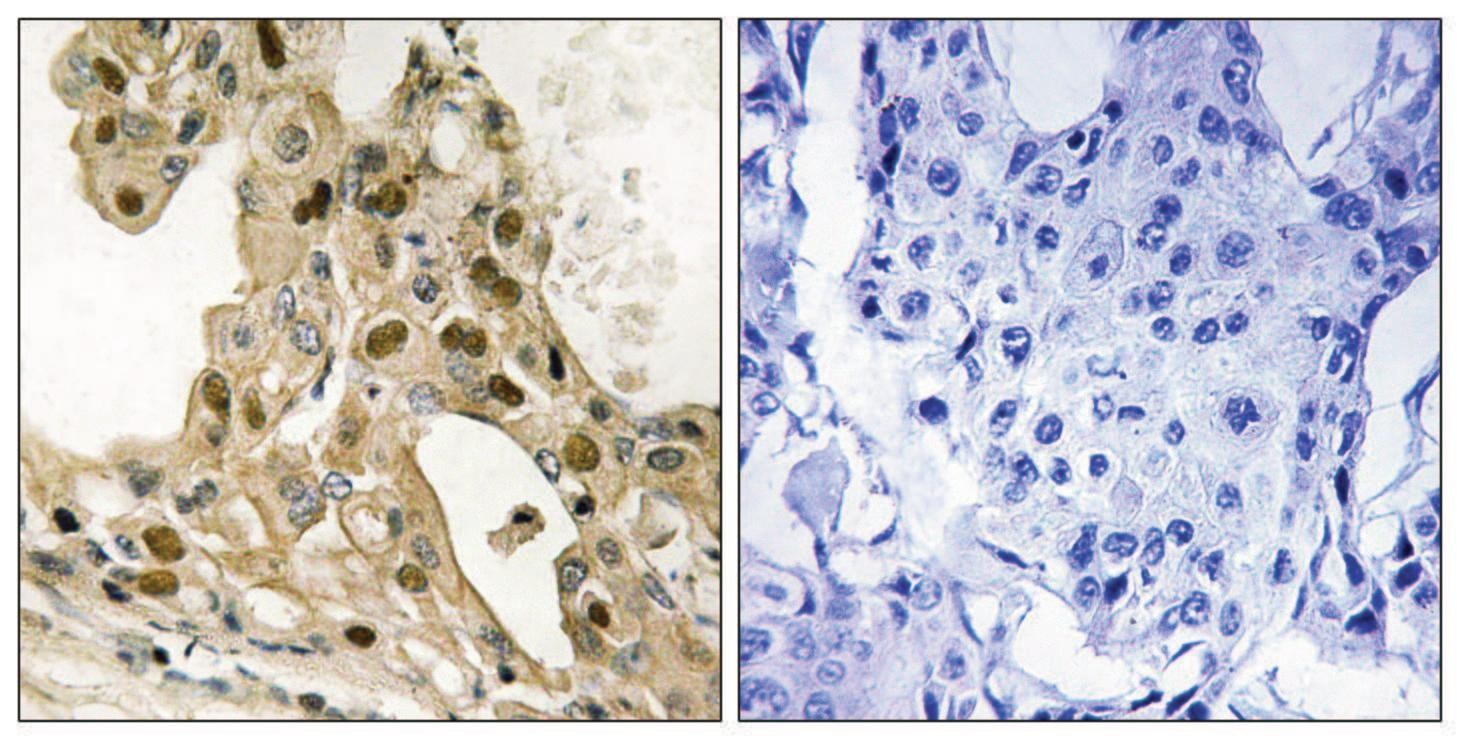
Immunohistochemical analysis of paraffin-embedded human breast carcinoma tissue using p53 (Phospho-Thr387) antibody (left) or the same antibody preincubated with blocking peptide (right).| Product Name | p53 (phospho Thr387) Antibody |
|---|---|
| Antibody Type | Primary Antibodies |
| Antigen Alias | TP53, tumor protein p53, Tumor suppressor p53 |
| Product description | Acts as a tumor suppressor in many tumor types; induces growth arrest or apoptosis depending on the physiological circumstances and cell type. Involved in cell cycle regulation as a trans-activator that acts to negatively regulate cell division by controlling a set of genes required for this process. One of the activated genes is an inhibitor of cyclin-dependent kinases. Apoptosis induction seems to be mediated either by stimulation of BAX and FAS antigen expression, or by repression of Bcl-2 expression. Implicated in Notch signaling cross-over.1) Zakut-Houri R., EMBO J. 4:1251-1255(1985). |
| Immunogen | p53 (phospho Thr387) antibody was raised against a peptide sequence around phosphorylation site of threonine 387 (F-K-T (p)-E-G) derived from Human p53. |
| Modification | p-Thr387 |
| Clonality | Polyclonal |
|---|---|
| Isotype | IgG |
| Host Species | Rabbit |
| Tested Applications | IHC |
| IHC:1:50~1:200 Notes:Optimal dilutions/concentrations should be determined by the researcher. |
|
| Species Reactivity | Human |
| Concentration | 1mg/ml |
| Purification | Affinity purified |
| Gene Symbol | TP53 |
|---|---|
| Alternative Names | TP53 tumor protein p53 Tumor suppressor p53 |
| Molecular Weight(MW) | 43 kDa |
| Tissue Specificity | The antibody detects endogenous levels of p53 only when phosphorylated at threonine 387. |
| Entrez Gene | 7157 |
|---|---|
| Protein Accession | NP_000537.3 |
Application
Immunohistochemical analysis of paraffin-embedded human breast carcinoma tissue using p53 (Phospho-Thr387) antibody (left) or the same antibody preincubated with blocking peptide (right).| Application Notes | IHC:1:50~1:200 Notes:Optimal dilutions/concentrations should be determined by the researcher. |
|---|
| Form | Liquid |
|---|---|
| Storage Instructions | Store antibody at -20˚C for up to one year. |
| Storage Buffer | Antibody supplied in phosphate buffered saline (without Mg2+ and Ca2+), pH 7.4, 150mM NaCl, 0.02% sodium azide and 50% glycerol. |


