Application
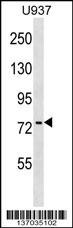
Western blot analysis in U937 cell line lysates (35ug/lane).| Product Name | PABPC4 Antibody |
|---|---|
| Antibody Type | Primary Antibodies |
| Antigen Alias | Polyadenylate-binding protein 4, PABP-4, Poly(A)-binding protein 4, Activated-platelet protein 1, APP-1, Inducible poly(A)-binding protein, iPABP, PABPC4, APP1, PABP4 |
| Product description | Poly(A)-binding proteins (PABPs) bind to the poly(A) tail present at the 3-prime ends of most eukaryotic mRNAs. PABPC4 or IPABP (inducible PABP) was isolated as an activation-induced T-cell mRNA encoding a protein. Activation of T cells increased PABPC4 mRNA levels in T cells approximately 5-fold. PABPC4 contains 4 RNA-binding domains and proline-rich C terminus. PABPC4 is localized primarily to the cytoplasm. It is suggested that PABPC4 might be necessary for regulation of stability of labile mRNA species in activated T cells. PABPC4 was also identified as an antigen, APP1 (activated-platelet protein-1), expressed on thrombin-activated rabbit platelets. PABPC4 may also be involved in the regulation of protein translation in platelets and megakaryocytes or may participate in the binding or stabilization of polyadenylates in platelet dense granules. Alternatively spliced transcript variants encoding different isoforms have been found for this gene.1) Jonson, L., et al. Mol. Cell Proteomics 6(5):798-811(2007) |
| Immunogen | This PABPC4 antibody is generated from rabbits immunized with a KLH conjugated synthetic peptide between 219-247 amino acids from the Central region of human PABPC4. |
| Clonality | Polyclonal |
|---|---|
| Isotype | Ig |
| Host Species | Rabbit |
| Tested Applications | WB |
| For WB starting dilution is: 1:1000: |
|
| Species Reactivity | Human |
| Concentration | 1mg/ml |
| Purification | Affinity purified |
| Gene Symbol | PABPC4 |
|---|---|
| Alternative Names | Polyadenylate-binding protein 4 PABP-4 Poly(A)-binding protein 4 Activated-platelet protein 1 APP-1 Inducible poly(A)-binding protein iPABP PABPC4 APP1 PABP4 |
| Molecular Weight(MW) | 71 kDa |
Application
Western blot analysis in U937 cell line lysates (35ug/lane).| Application Notes | For WB starting dilution is: 1:1000: |
|---|
| Form | Liquid |
|---|---|
| Storage Instructions | Store at 4˚C for three months and -20˚C, stable for up to one year. As with all antibodies care should be taken to avoid repeated freeze thaw cycles. Antibodies should not be exposed to prolonged high temperatures. |
| Storage Buffer | Supplied in PBS with 0.09% (W/V) sodium azide. |


