Application
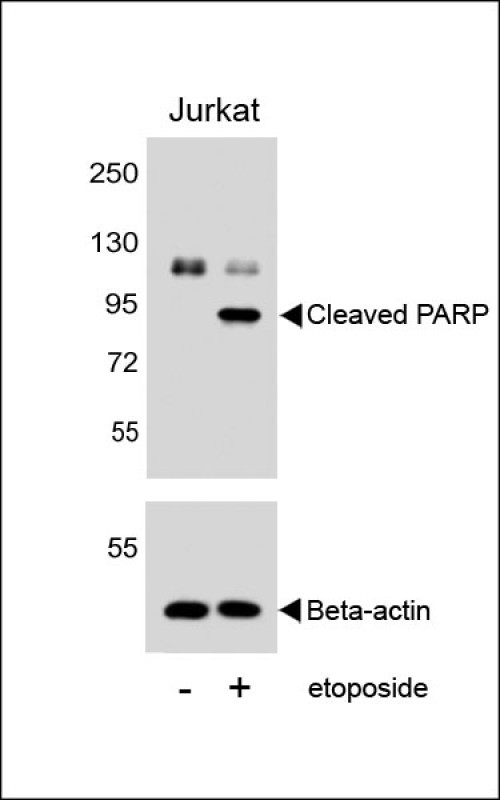
Western blot analysis of lysates from Jurkat cell line, untreated or treated with etoposide, 25uM, using Cleaved PARP Antibody (upper) or Beta-actin (lower).| Product Name | PARP1 Antibody |
|---|---|
| Antibody Type | Primary Antibodies |
| Antigen Alias | Poly [ADP-ribose] polymerase 1, PARP-1, 2.4.2.30, ADP-ribosyltransferase diphtheria toxin-like 1, ARTD1, NAD(+) ADP-ribosyltransferase 1, ADPRT 1, Poly[ADP-ribose] synthase 1, PARP1, ADPRT, PPOL |
| Product description | Involved in the base excision repair (BER) pathway, by catalyzing the poly(ADP-ribosyl)ation of a limited number of acceptor proteins involved in chromatin architecture and in DNA metabolism. This modification follows DNA damages and appears as an obligatory step in a detection/signaling pathway leading to the reparation of DNA strand breaks. Mediates the poly(ADP- ribosyl)ation of APLF and CHFR. Positively regulates the transcription of MTUS1 and negatively regulates the transcription of MTUS2/TIP150. With EEF1A1 and TXK, forms a complex that acts as a T-helper 1 (Th1) cell-specific transcription factor and binds the promoter of IFN-gamma to directly regulate its transcription, and is thus involved importantly in Th1 cytokine production. Required for PARP9 and DTX3L recruitment to DNA damage sites. PARP1-dependent PARP9-DTX3L-mediated ubiquitination promotes the rapid and specific recruitment of 53BP1/TP53BP1, UIMC1/RAP80, and BRCA1 to DNA damage sites.1) Uchida K.,et al.Biochem. Biophys. Res. Commun. 148:617-622(1987). |
| Immunogen | This antibody is generated from a rabbit immunized with a KLH conjugated synthetic peptide between 191-225 amino acids from human. |
| Clonality | Polyclonal |
|---|---|
| Isotype | Ig |
| Host Species | Rabbit |
| Tested Applications | WB |
| For WB starting dilution is: 1:500: |
|
| Species Reactivity | Human |
| Concentration | 1mg/ml |
| Purification | Affinity purified |
| Gene Symbol | PARP1 |
|---|---|
| Alternative Names | Poly [ADP-ribose] polymerase 1 PARP-1 2.4.2.30 ADP-ribosyltransferase diphtheria toxin-like 1 ARTD1 NAD(+) ADP-ribosyltransferase 1 ADPRT 1 Poly[ADP-ribose] synthase 1 PARP1 ADPRT PPOL |
| Molecular Weight(MW) | 113 kDa |
Application
Western blot analysis of lysates from Jurkat cell line, untreated or treated with etoposide, 25uM, using Cleaved PARP Antibody (upper) or Beta-actin (lower).| Application Notes | For WB starting dilution is: 1:500: |
|---|
| Form | Liquid |
|---|---|
| Storage Instructions | Store at 4˚C for three months and -20˚C, stable for up to one year. As with all antibodies care should be taken to avoid repeated freeze thaw cycles. Antibodies should not be exposed to prolonged high temperatures. |
| Storage Buffer | Supplied in PBS with 0.09% (W/V) sodium azide. |


