Application
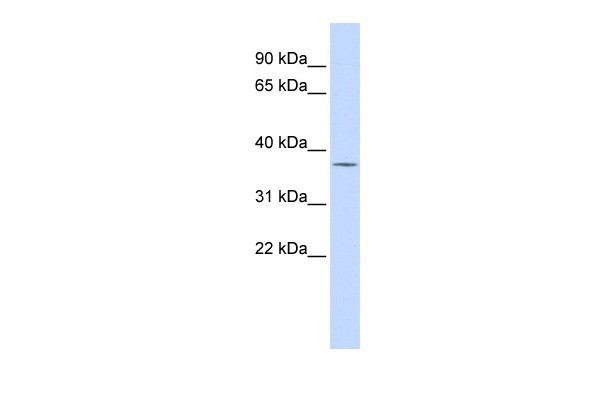
Antibody used in WB on Human 293T at 0.2-1 ug/ml.Application
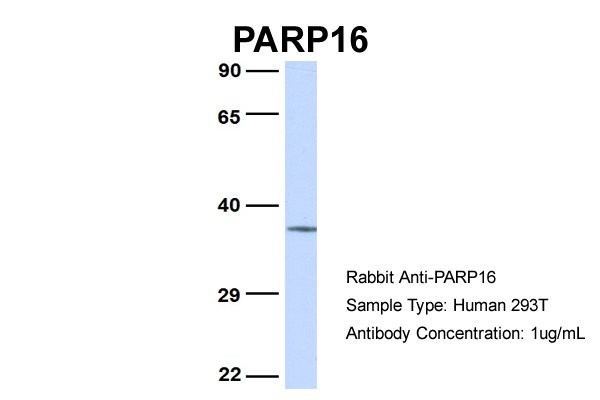
Antibody used in WB on Human 293T at 1 ug/ml.| Product Name | PARP16 Antibody |
|---|---|
| Antibody Type | Primary Antibodies |
| Antigen Alias | PARP16, C15orf30, FLJ20509, FLJ25281, ARTD15, pART15 |
| Product description | Poly (ADP-ribosyl)ation is an immediate DNA-damage-dependent post-translational modification of histones and other nuclear proteins that contributes to the survival of injured proliferating cells. PARP16 is a member of poly (ADP-ribose) polymerases (PARPs) family that is encoded by different genes and displaying a conserved catalytic domain in which PARP-1 (113 kDa), the founding member, and PARP-2 (62 kDa) are so far the sole enzymes whose catalytic activity has been shown to be immediately stimulated by DNA strand breaks. A large repertoire of sequences encoding novel PARPs now extends considerably the field of poly (ADP-ribosyl)ation reactions to various aspects of the cell biology including cell proliferation and cell death. Some of these new members interact with each other, share common partners and common subcellular localizations suggesting possible fine tuning in the regulation of this post-translational modification of proteins.1) Ame, J.C., (2004) Bioessays 26 (8), 882-893. |
| Immunogen | Antibody produced in rabbits immunized with a synthetic peptide corresponding a region of human PARP16. |
| Clonality | Polyclonal |
|---|---|
| Host Species | Rabbit |
| Tested Applications | ELISAWB |
| PARP16 antibody can be used for detection of PARP16 by ELISA at 1:312500. PARP16 antibody can be used for detection of PARP16 by western blot at 1 μg/mL, and HRP conjugated secondary antibody should be diluted 1:50,000 - 100,000.: |
|
| Species Reactivity | Human |
| Concentration | 1mg/ml |
| Purification | Affinity purified |
| Gene Symbol | PARP16 |
|---|---|
| Alternative Names | PARP16 C15orf30 FLJ20509 FLJ25281 ARTD15 pART15 |
| Molecular Weight(MW) | 36 kDa |
Application
Antibody used in WB on Human 293T at 0.2-1 ug/ml.
Application
Antibody used in WB on Human 293T at 1 ug/ml.| Positive Control | 1) 293T Cell Lysate |
|---|---|
| Application Notes | PARP16 antibody can be used for detection of PARP16 by ELISA at 1:312500. PARP16 antibody can be used for detection of PARP16 by western blot at 1 μg/mL, and HRP conjugated secondary antibody should be diluted 1:50,000 - 100,000.: |
| Form | Liquid |
|---|---|
| Storage Instructions | For short periods of storage (days) store at 4˚C. For longer periods of storage, store PARP16 antibody at -20˚C. As with any antibody avoid repeat freeze-thaw cycles. |
| Storage Buffer | Antibody is lyophilized in PBS buffer with 2% sucrose. Add 50 μL of distilled water. Final antibody concentration is 1 mg/mL. |


