Application
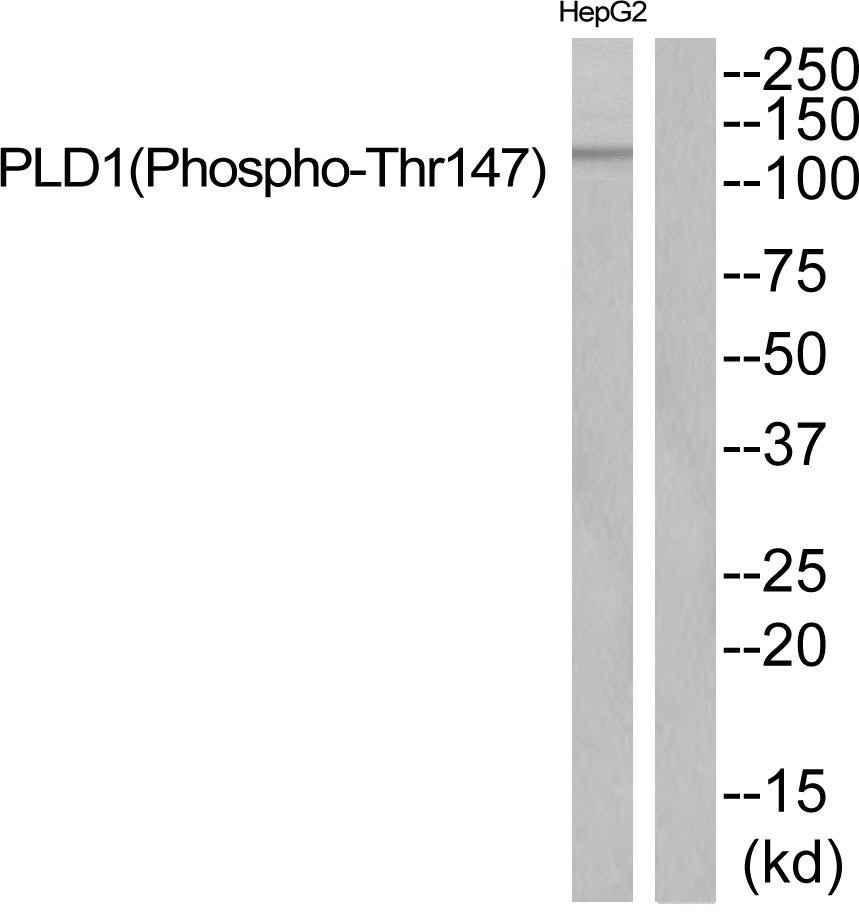
Western blot analysis of extracts from HepG2 cells using PLD1 (Phospho-Thr147) Antibody. The lane on the right is treated with the antigen-specific peptide.| Product Name | PLD1 (phospho Thr147) Antibody |
|---|---|
| Antibody Type | Primary Antibodies |
| Antigen Alias | PLD 1, hPLD1, Choline phosphatase 1 |
| Product description | Phosphatidylcholine (PC)-specific phospholipases D (PLDs; EC 3.1.4.4) catalyze the hydrolysis of PC to produce phosphatidic acid and choline. A range of agonists acting through G protein-coupled receptors and receptor tyrosine kinases stimulate this hydrolysis. PC-specific PLD activity has been implicated in numerous cellular pathways, including signal transduction, membrane trafficking, and the regulation of mitosis.1) Hammond S.M., J. Biol. Chem. 272:3860-3868(1997) [PubMed: 9013646]. |
| Immunogen | PLD1 (phospho Thr147) antibody was raised against a peptide sequence around phosphorylation site of threonine 147 (R-H-T (p)-F-R) derived from Human PLD1. |
| Modification | p-Thr147 |
| Clonality | Polyclonal |
|---|---|
| Isotype | IgG |
| Host Species | Rabbit |
| Tested Applications | WB |
| Western Blot: 1:500~1:1000: |
|
| Species Reactivity | HumanMouseRat |
| Concentration | 1mg/ml |
| Purification | Affinity purified |
| Gene Symbol | PLD1 |
|---|---|
| Alternative Names | PLD 1 hPLD1 Choline phosphatase 1 |
| Molecular Weight(MW) | 120 kDa |
| Tissue Specificity | The antibody detects endogenous levels of PLD1 only when phosphorylated at threonine 147. |
| Entrez Gene | 5337 |
|---|---|
| Protein Accession | NP_002653.1 |
Application
Western blot analysis of extracts from HepG2 cells using PLD1 (Phospho-Thr147) Antibody. The lane on the right is treated with the antigen-specific peptide.| Application Notes | Western Blot: 1:500~1:1000: |
|---|
| Form | Liquid |
|---|---|
| Storage Instructions | Store antibody at -20˚C for up to one year. |
| Storage Buffer | Antibody supplied in phosphate buffered saline (without Mg2+ and Ca2+), pH 7.4, 150mM NaCl, 0.02% sodium azide and 50% glycerol. |


