Application
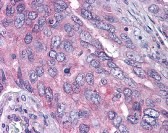
Immunohistochemistry staining of Polo-like kinase in lung carcinoma tissue using Polo-like kinase Antibody.| Product Name | Polo-Like Kinase (phospho Thr210) Antibody |
|---|---|
| Antibody Type | Primary Antibodies |
| Antigen Alias | PLK1, Polo like kinase, Polo-like kinase (Drosophila), Polo-like kinase 1, STPK13, Polo (Drosophia)-like kinase, PLK, PLK-1 |
| Product description | Polo-like kinase 1, also known as Plk-1, serine-threonine protein kinase 13 and STPK13, may be required for cell division and have a role during G1 or S phase and is associated with the phosphorylation of cyclin B1. Phosphorylation of Plk-1 on T210 contributes to proper mitotic progression. Plk-1 has a nuclear localization and accumulates to a maximum during the G2 and M phases, declines to a nearly undetectable level following mitosis and throughout G1 phase, and then begins to accumulate again during S phase. Plk-1 is a member of the Ser/Thr protein kinase family and the CDC5/Polo subfamily and contains 2 POLO box domains. |
| Immunogen | Polo - Like Kinase antibody was raised against synthetic phospho peptide corresponding aa 205 - 214 of Polo - Like Kinase (Human). |
| Modification | p-Thr210 |
| Clonality | Polyclonal |
|---|---|
| Host Species | Rabbit |
| Tested Applications | ELISAIHCWB |
| Polo-Like Kinase antibody can be used in ELISA starting at 1:10000, Western Blot starting at 1:500 - 1:2000, immunohistochemistry starting at 5 μg/mL, and immunohistochemistry in frozen tissues starting at 1:500 - 1:2000.: |
|
| Species Reactivity | Human |
| Concentration | 1mg/ml |
| Purification | Affinity purified |
| Gene Symbol | PLK1 |
|---|---|
| Alternative Names | PLK1 Polo like kinase Polo-like kinase (Drosophila) Polo-like kinase 1 STPK13 Polo (Drosophia)-like kinase PLK PLK-1 |
| Tissue Specificity | pThr210 |
Application
Immunohistochemistry staining of Polo-like kinase in lung carcinoma tissue using Polo-like kinase Antibody.| Application Notes | Polo-Like Kinase antibody can be used in ELISA starting at 1:10000, Western Blot starting at 1:500 - 1:2000, immunohistochemistry starting at 5 μg/mL, and immunohistochemistry in frozen tissues starting at 1:500 - 1:2000.: |
|---|
| Form | Liquid |
|---|---|
| Storage Instructions | Store Polo-Like Kinase antibody at 4 ˚C or -20 ˚C. As with all antibodies avoid freeze/thaw cycles. |
| Storage Buffer | 0.02 M potassium phosphate, 0.15 M sodium chloride, pH 7.2, 0.01% sodium azide. |


