Application
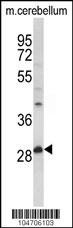
Western blot analysis of hPPT1-C46 in mouse cerebellum tissue lysates (35ug/lane)| Product Name | PPT1 Antibody |
|---|---|
| Antibody Type | Primary Antibodies |
| Product description | Palmitoyl-protein thioesterase-1 (PPT1) is a lysosomal hydrolase that removes long-chain fatty acyl groups from modified cysteine residues in proteins. Mutations in PPT1 have been found to cause the infantile form of neuronal ceroid lipofuscinosis (INCL), and an animal model has been developed.1 The deduced PPT2 protein contains 302 amino acids, including a 27-amino acid leader peptide, a sequence motif characteristic of many thioesterases and lipases, and 5 potential N-linked glycosylation sites.2 PPT2 shares 18% amino acid identity with PPT1. Northern blot analysis detected a predominant 2.0-kb PPT2 transcript in the human tissues examined, with the highest expression in skeletal muscle; variable amounts of 2.8- and 7.0-kb transcripts were also observed. Recombinant PPT2, like PPT1, possesses thioesterase activity and localizes to the lysosome. Since PPT2 could not substitute for PPT1 in correcting the metabolic defect in INCL cells and was unable to remove palmitate groups from palmitoylated proteins that are routinely used as substrates for PPT1it has been postulated that PPT2 possesses a different substrate specificity than PPT1.1) Calero, G., et al., J. Biol. Chem. 278(39):37957-37964 (2003). |
| Immunogen | This PPT1 antibody is generated from rabbits immunized with a KLH conjugated synthetic peptide between 32-63 amino acids from the N-terminal region of human PPT1. |
| Clonality | Polyclonal |
|---|---|
| Isotype | Ig |
| Host Species | Rabbit |
| Tested Applications | WB |
| For WB starting dilution is: 1:1000 | |
| Species Reactivity | HumanMouse |
| Concentration | 1mg/ml |
| Purification | Unpurified |
| Gene Symbol | PPT1 |
|---|---|
| Alternative Names | Palmitoyl-protein thioesterase 1 PPT-1 Palmitoyl-protein hydrolase 1 PPT1 PPT |
| Molecular Weight(MW) | 34 kDa |
| Sequence Similarities | Predicted species reactivity based on immunogen sequence: Bovine |
Application
Western blot analysis of hPPT1-C46 in mouse cerebellum tissue lysates (35ug/lane)| Application Notes | For WB starting dilution is: 1:1000 |
|---|
| Form | Liquid |
|---|---|
| Storage Instructions | Store at 4˚C for three months and -20˚C, stable for up to one year. As with all antibodies care should be taken to avoid repeated freeze thaw cycles. Antibodies should not be exposed to prolonged high temperatures. |
| Storage Buffer | Supplied in PBS with 0.09% (W/V) sodium azide. |


