Application
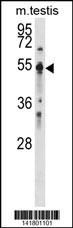
Western blot analysis in mouse testis tissue lysates (35ug/lane).| Product Name | PTPN1 Antibody |
|---|---|
| Antibody Type | Primary Antibodies |
| Antigen Alias | Tyrosine-protein phosphatase non-receptor type 1, Protein-tyrosine phosphatase 1B, PTP-1B, PTPN1, PTP1B |
| Product description | The protein encoded by this gene is the founding member of the protein tyrosine phosphatase (PTP) family, which was isolated and identified based on its enzymatic activity and amino acid sequence. PTPs catalyze the hydrolysis of the phosphate monoesters specifically on tyrosine residues. Members of the PTP family share a highly conserved catalytic motif, which is essential for the catalytic activity. PTPs are known to be signaling molecules that regulate a variety of cellular processes including cell growth, differentiation, mitotic cycle, and oncogenic transformation. This PTP has been shown to act as a negative regulator of insulin signaling by dephosphorylating the phosphotryosine residues of insulin receptor kinase. This PTP was also reported to dephosphorylate epidermal growth factor receptor kinase, as well as JAK2 and TYK2 kinases, which implicated the role of this PTP in cell growth control, and cell response to interferon stimulation.1) Stuible, M., et al. Trends Cell Biol. 20(11):672-679(2010) |
| Immunogen | This PTPN1 antibody is generated from rabbits immunized with a KLH conjugated synthetic peptide between 221-249 amino acids from the Central region of human PTPN1. |
| Clonality | Polyclonal |
|---|---|
| Isotype | Ig |
| Host Species | Rabbit |
| Tested Applications | WB |
| For WB starting dilution is: 1:1000: |
|
| Species Reactivity | Mouse |
| Concentration | 1mg/ml |
| Purification | Affinity purified |
| Gene Symbol | PTPN1 |
|---|---|
| Alternative Names | Tyrosine-protein phosphatase non-receptor type 1 Protein-tyrosine phosphatase 1B PTP-1B PTPN1 PTP1B |
| Molecular Weight(MW) | 50 kDa |
| Sequence Similarities | Predicted species reactivity based on immunogen sequence: Rat |
Application
Western blot analysis in mouse testis tissue lysates (35ug/lane).| Application Notes | For WB starting dilution is: 1:1000: |
|---|
| Form | Liquid |
|---|---|
| Storage Instructions | Store at 4˚C for three months and -20˚C, stable for up to one year. As with all antibodies care should be taken to avoid repeated freeze thaw cycles. Antibodies should not be exposed to prolonged high temperatures. |
| Storage Buffer | Supplied in PBS with 0.09% (W/V) sodium azide. |


