Application
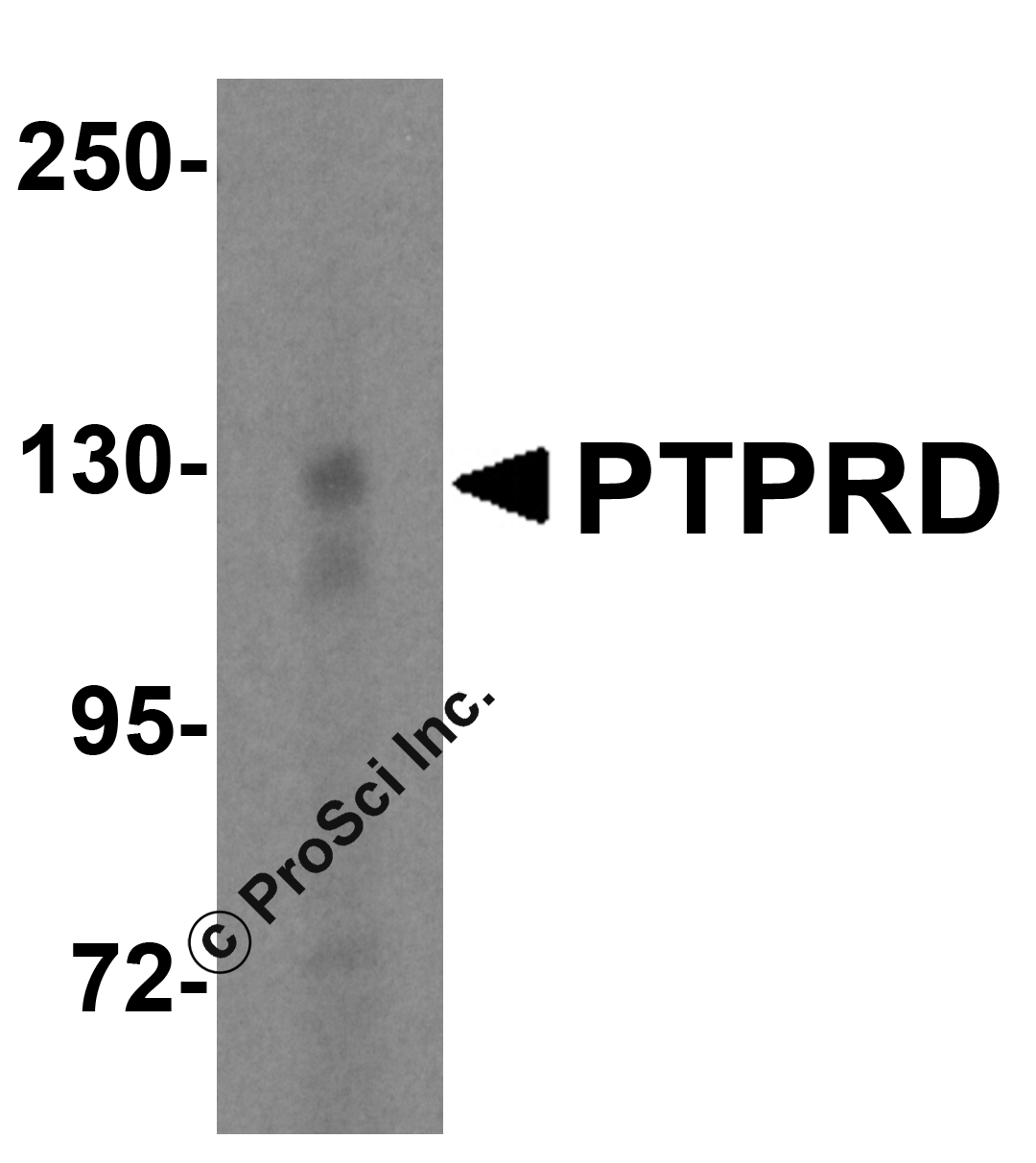
Western blot analysis of PTPRD in HeLa cell lysate with PTPRD antibody at 1 μg/mL.| Product Name | PTPRD Antibody |
|---|---|
| Antibody Type | Primary Antibodies |
| Antigen Alias | PTPRD Antibody: HPTP, PTPD, HPTPD, HPTPDELTA, RPTPDELTA, Receptor-type tyrosine-protein phosphatase delta, Protein-tyrosine phosphatase delta |
| Product description | PTPRD Antibody: PTPRD (Protein tyrosine phosphatase receptor type D) is a member of the protein tyrosine phosphatase (PTP) family that plays diverse roles during development including cell growth, differentiation, mitotic cycle and oncogenic transformation. PTPRD contains an extracellular region, a single transmembrane segment and two tandem intracytoplasmic catalytic domains. The extracellular region of PTPRD is composed of three Ig-like and eight fibronectin type III-like domains (1,3). PTPRD interacts with PPFIA1-3 and is a tumor suppressor on chromosome 9p that is involved in the development of glioblastoma multiforme (GBMs) and multiple human cancers.1) Krueger NX, Streuli M, and Saito H. Structural diversity and evolution of human receptor-like protein tyrosine phosphatases. EMBO J. 1990; 9:3241-52. |
| Immunogen | PTPRD antibody was raised against an 18 amino acid synthetic peptide near the amino terminus of human PTPRD. The immunogen is located within the first 50 amino acids of PTPRD. |
| Clonality | Polyclonal |
|---|---|
| Isotype | IgG |
| Host Species | Rabbit |
| Tested Applications | ELISAWB |
| PTPRD antibody can be used for detection of PTPRD by Western blot at 1 - 2 μg/mL.: |
|
| Species Reactivity | Human |
| Concentration | 1mg/ml |
| Purification | Affinity purified |
| Gene Symbol | PTPRD |
|---|---|
| Alternative Names | PTPRD Antibody: HPTP PTPD HPTPD HPTPDELTA RPTPDELTA Receptor-type tyrosine-protein phosphatase delta Protein-tyrosine phosphatase delta |
| Molecular Weight(MW) | Predicted: 165, 210 kDa (130 kDa for cleavage product) Observed: 130 kDa |
| Sequence Similarities | Predicted species reactivity based on immunogen sequence: Mouse: (100%) |
| Tissue Specificity | PTPRD antibody is human specific. At least three alternatively spliced transcript variants encoding distinct isoforms have been observed. PTPRD cleavage products are often observed in vivo |
Application
Western blot analysis of PTPRD in HeLa cell lysate with PTPRD antibody at 1 μg/mL.| Positive Control | 1) Cat. No. 1201 - HeLa Cell Lysate |
|---|---|
| Application Notes | PTPRD antibody can be used for detection of PTPRD by Western blot at 1 - 2 μg/mL.: |
| Form | Liquid |
|---|---|
| Storage Instructions | PTPRD antibody can be stored at 4˚C for three months and -20˚C, stable for up to one year. As with all antibodies care should be taken to avoid repeated freeze thaw cycles. Antibodies should not be exposed to prolonged high temperatures. |
| Storage Buffer | PTPRD Antibody is supplied in PBS containing 0.02% sodium azide. |


