Application
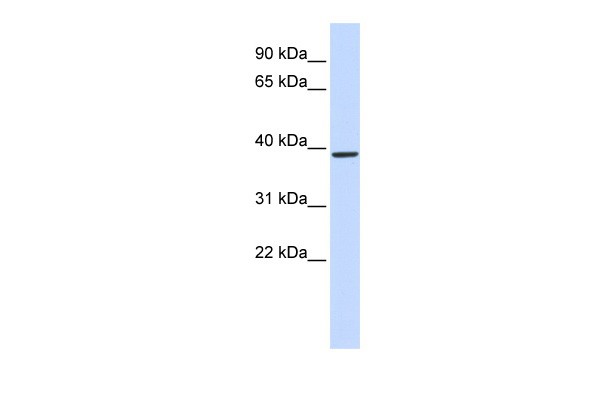
Antibody used in WB on Human Muscle at 0.2-1 ug/ml.| Product Name | QPCT Antibody |
|---|---|
| Antibody Type | Primary Antibodies |
| Antigen Alias | QPCT, GCT, QC, sQC |
| Product description | QPCT is responsible for the biosynthesis of pyroglutamyl peptides. QPCT has a bias against acidic and tryptophan residues adjacent to the N-terminal glutaminyl residue and a lack of importance of chain length after the second residue. It also catalyzes N-terminal pyroglutamate formation. In vitro, catalyzes pyroglutamate formation of N-terminally truncated form of APP amyloid-beta peptides [Glu-3]-beta-amyloid. QPCT may be involved in the N-terminal pyroglutamate formation of several amyloid-related plaque-forming peptides.This gene encodes human pituitary glutaminyl cyclase, which is responsible for the presence of pyroglutamyl residues in many neuroendocrine peptides. The amino acid sequence of this enzyme is 86% identical to that of bovine glutaminyl cyclase. Publication Note: This RefSeq record includes a subset of the publications that are available for this gene. Please see the Entrez Gene record to access additional publications.1) Cynis, H., (2008) J. Mol. Biol. 379 (5), 966-980. |
| Immunogen | Antibody produced in rabbits immunized with a synthetic peptide corresponding a region of human QPCT. |
| Clonality | Polyclonal |
|---|---|
| Host Species | Rabbit |
| Tested Applications | ELISAWB |
| QPCT antibody can be used for detection of QPCT by ELISA at 1:62500. QPCT antibody can be used for detection of QPCT by western blot at 1 μg/mL, and HRP conjugated secondary antibody should be diluted 1:50,000 - 100,000.: |
|
| Species Reactivity | Human |
| Concentration | 1mg/ml |
| Purification | Affinity purified |
| Gene Symbol | QPCT |
|---|---|
| Alternative Names | QPCT GCT QC sQC |
| Molecular Weight(MW) | 38 kDa |
Application
Antibody used in WB on Human Muscle at 0.2-1 ug/ml.| Positive Control | 1) Cat. No. XBL-10413 - Fetal Skeletal Muscle Tissue Lysate |
|---|---|
| Application Notes | QPCT antibody can be used for detection of QPCT by ELISA at 1:62500. QPCT antibody can be used for detection of QPCT by western blot at 1 μg/mL, and HRP conjugated secondary antibody should be diluted 1:50,000 - 100,000.: |
| Form | Liquid |
|---|---|
| Storage Instructions | For short periods of storage (days) store at 4˚C. For longer periods of storage, store QPCT antibody at -20˚C. As with any antibody avoid repeat freeze-thaw cycles. |
| Storage Buffer | Antibody is lyophilized in PBS buffer with 2% sucrose. Add 50 μL of distilled water. Final antibody concentration is 1 mg/mL. |


