Application
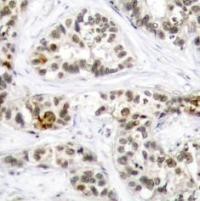
Immunohistochemical analysis of paraffin-embedded human breast carcinoma tissue using RelB (Phospho-Ser573).Application
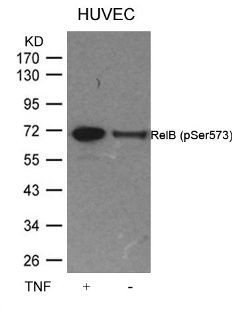
Western blot analysis of lysed extracts from HUVEC cells untreated or treated with TNF using RelB (Phospho-Ser573).| Product Name | RelB (phospho Ser573) Antibody |
|---|---|
| Antibody Type | Primary Antibodies |
| Antigen Alias | IREL, I-REL, REL-B, PDK1, I-Rel, |
| Product description | NF-κ-B is a pleiotropic transcription factor which is present in almost all cell types and is involved in many biological processed such as inflammation, immunity, differentiation, cell growth, tumorigenesis and apoptosis. NF-κ-B is a homo- or heterodimeric complex formed by the Rel-like domain-containing proteins RELA/p65, RELB, NFKB1/p105, NFKB1/p50, REL and NFKB2/p52. The dimers bind at kappa-B sites in the DNA of their target genes and the individual dimers have distinct preferences for different kappa-B sites that they can bind with distinguishable affinity and specificity. Different dimer combinations act as transcriptional activators or repressors, respectively. NF-κ-B is controlled by various mechanisms of post-translational modification and subcellular compartmentalization as well as by interactions with other cofactors or corepressors. NF-κ-B complexes are held in the cytoplasm in an inactive state complexed with members of the NF-κ-B inhibitor (I-kappa-B) family. In a conventional activation pathway, I-kappa-B is phosphorylated by I-kappa-B kinases (IKKs) in response to different activators, subsequently degraded thus liberating the active NF-κ-B complex which translocates to the nucleus. NF-κ-B heterodimeric RelB-p50 and RelB-p52 complexes are transcriptional activators. RELB neither associates with DNA nor with RELA/p65 or REL. Stimulates promoter activity in the presence of NFKB2/p49.1) Marienfeld R, et al. (2001) Oncogene. 20 (56): 8142-7. Charlotte S. Kaetzel1, et al. (2005) Immunological Reviews Volume 206: 83 Elwira Pyz, et al. (2006) J Immunol. 176:7447-55 |
| Immunogen | RelB (Phospho-Ser573) antibody was raised against a peptide sequence around phosphorylation site of serine 573 (L-L-S (p) -P-G) derived from Human RelB. |
| Modification | p-Ser573 |
| Clonality | Polyclonal |
|---|---|
| Host Species | Rabbit |
| Tested Applications | IHCWB |
| Western Blot: 1:500~1:1000, Immunohistochemistry: 1:50~1:100: |
|
| Species Reactivity | HumanMouse |
| Concentration | 1mg/ml |
| Purification | Affinity purified |
| Gene Symbol | RELB |
|---|---|
| Alternative Names | IREL I-REL REL-B PDK1 I-Rel |
| Molecular Weight(MW) | 70 kDa |
| Tissue Specificity | This antibody detects endogenous level of RelB only when phosphorylated at serine 573. |
| Entrez Gene | 5971 |
|---|---|
| Protein Accession | NP_006500.2 |
Application
Immunohistochemical analysis of paraffin-embedded human breast carcinoma tissue using RelB (Phospho-Ser573).
Application
Western blot analysis of lysed extracts from HUVEC cells untreated or treated with TNF using RelB (Phospho-Ser573).| Application Notes | Western Blot: 1:500~1:1000, Immunohistochemistry: 1:50~1:100: |
|---|
| Form | Liquid |
|---|---|
| Storage Instructions | Store antibody at -20˚C for up to one year. |
| Storage Buffer | Antibody supplied in phosphate buffered saline (without Mg2+ and Ca2+), pH 7.4, 150mM NaCl, 0.02% sodium azide and 50% glycerol. |


