Application
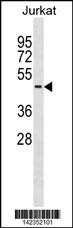
Western blot analysis in Jurkat cell line lysates (35ug/lane).| Product Name | SERPINB8 Antibody |
|---|---|
| Antibody Type | Primary Antibodies |
| Product description | The superfamily of high molecular weight serine proteinase inhibitors (serpins) regulate a diverse set of intracellular and extracellular processes such as complement activation, fibrinolysis, coagulation, cellular differentiation, tumor suppression, apoptosis, and cell migration. Serpins are characterized by well-conserved a tertiary structure that consists of 3 beta sheets and 8 or 9 alpha helices (Huber and Carrell, 1989 [PubMed 2690952]). A critical portion of the molecule, the reactive center loop connects beta sheets A and C. Protease inhibitor-8 (PI8; SERPINB8) is a member of the ov-serpin subfamily, which, relative to the archetypal serpin PI1 (MIM 107400), is characterized by a high degree of homology to chicken ovalbumin, lack of N- and C-terminal extensions, absence of a signal peptide, and a serine rather than an asparagine residue at the penultimate position (summary by Bartuski et al., 1997 [PubMed 9268635]).1) Rose, J.E., et al. Mol. Med. 16 (7-8), 247-253 (2010) : |
| Immunogen | This SERPINB8 antibody is generated from rabbits immunized with a KLH conjugated synthetic peptide between 274-301 amino acids from the C-terminal region of human SERPINB8. |
| Clonality | Polyclonal |
|---|---|
| Isotype | Ig |
| Host Species | Rabbit |
| Tested Applications | WB |
| For WB starting dilution is: 1:1000 | |
| Species Reactivity | Human |
| Concentration | 1mg/ml |
| Purification | Affinity purified |
| Gene Symbol | SERPINB8 |
|---|---|
| Alternative Names | Serpin B8 Cytoplasmic antiproteinase 2 CAP-2 CAP2 Peptidase inhibitor 8 PI-8 SERPINB8 PI8 |
| Molecular Weight(MW) | 43 kDa |
Application
Western blot analysis in Jurkat cell line lysates (35ug/lane).| Application Notes | For WB starting dilution is: 1:1000 |
|---|
| Form | Liquid |
|---|---|
| Storage Instructions | Store at 4˚C for three months and -20˚C, stable for up to one year. As with all antibodies care should be taken to avoid repeated freeze thaw cycles. Antibodies should not be exposed to prolonged high temperatures. |
| Storage Buffer | Supplied in PBS with 0.09% (W/V) sodium azide. |


