Application
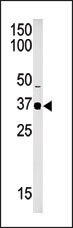
Western blot analysis of anti-SET7 Pabin mouse brain tissue lysate (35ug/lane)| Product Name | SET7 Antibody |
|---|---|
| Antibody Type | Primary Antibodies |
| Product description | Histone methyltransferases (HMTases) selectively methylate evolutionarily conserved arginine or lysine residues, primarily in the N-terminal tails of histones H3 and H4. Signal transduction pathways affecting the N-terminal tails of histones lead to a number of post-translational modifications including acetylation, phosphorylation, poly(ADP-ribosylation), ubiquitination and methylation. These modifications play critical roles in regulating chromatin structure and gene expression. Set7/9 is a histone specific HMTase that methylates histone H3 lysine 4. Set7/9 transfers methyl groups to lysine 4 of histone H3 in complex with S-adenosyl-L-methionine. In yeast, H4-K20 methylation does not have any apparent role in the regulation of gene expression or heterochromatin function; rather it appears to play a role in DNA damage response. Loss of Set9 activity or mutation of H4-K20 markedly impairs yeast cell survival after genotoxic challenge and compromises the ability of cells to maintain checkpoint mediated cell cycle arrest. Genetic experiments link Set9 to Crb2, a homolog of the mammalian checkpoint protein 53BP1, and the enzyme is required for Crb2 localization to sites of DNA damage.1) Chuikov, S., et al., Nature 432(7015):353-360 (2004). |
| Immunogen | This SET7 antibody is generated from rabbits immunized with a KLH conjugated synthetic peptide between 289-317 amino acids from the C-terminal region of human SET7. |
| Clonality | Polyclonal |
|---|---|
| Isotype | Ig |
| Host Species | Rabbit |
| Tested Applications | WB |
| For WB starting dilution is: 1:1000 | |
| Species Reactivity | Human |
| Concentration | 1mg/ml |
| Purification | Unpurified |
| Gene Symbol | SETD7 |
|---|---|
| Alternative Names | Histone-lysine N-methyltransferase SETD7 Histone H3-K4 methyltransferase SETD7 H3-K4-HMTase SETD7 Lysine N-methyltransferase 7 SET domain-containing protein 7 SET7/9 SETD7 KIAA1717 KMT7 SET7 SET9 |
| Molecular Weight(MW) | 41 kDa |
Application
Western blot analysis of anti-SET7 Pabin mouse brain tissue lysate (35ug/lane)| Application Notes | For WB starting dilution is: 1:1000 |
|---|
| Form | Liquid |
|---|---|
| Storage Instructions | Store at 4˚C for three months and -20˚C, stable for up to one year. As with all antibodies care should be taken to avoid repeated freeze thaw cycles. Antibodies should not be exposed to prolonged high temperatures. |
| Storage Buffer | Supplied in PBS with 0.09% (W/V) sodium azide. |


