Application
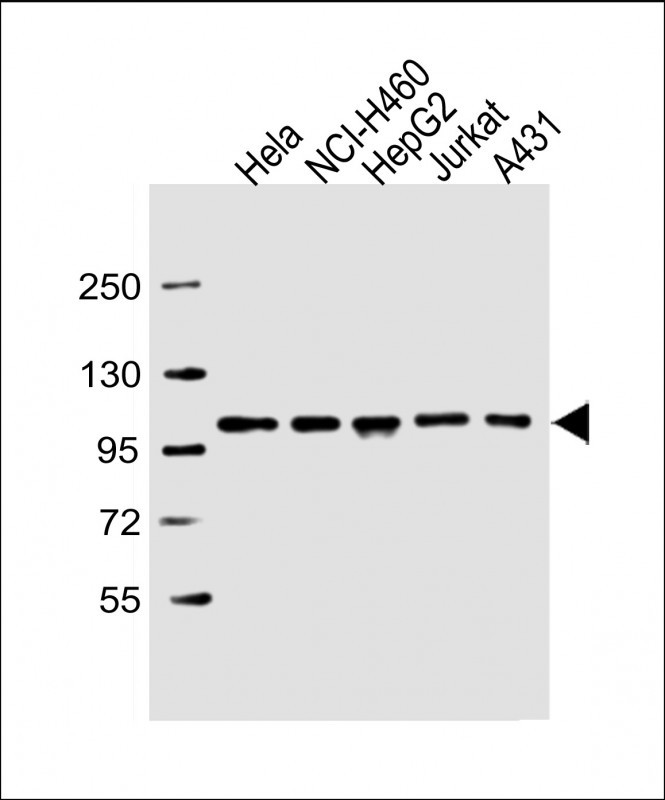
Western Blot at 1:2000 dilution Lane 1: Hela whole cell lysate Lane 2: NCI-H460 whole cell lysate Lane 3: HepG2 whole cell lysate Lane 4: Jurkat whole cell lysate Lane 5: A431 whole cell lysate Lysates/proteins at 20 ug per lane.| Product Name | SFPQ Antibody |
|---|---|
| Antibody Type | Primary Antibodies |
| Product description | DNA-and RNA binding protein, involved in several nuclear processes. Essential pre-mRNA splicing factor required early in spliceosome formation and for splicing catalytic step II, probably as an heteromer with NONO. Binds to pre-mRNA in spliceosome C complex, and specifically binds to intronic polypyrimidine tracts. Interacts with U5 snRNA, probably by binding to a purine-rich sequence located on the 3' side of U5 snRNA stem 1b. May be involved in a pre-mRNA coupled splicing and polyadenylation process as component of a snRNP-free complex with SNRPA/U1A. The SFPQ-NONO heteromer associated with MATR3 may play a role in nuclear retention of defective RNAs. SFPQ may be involved in homologous DNA pairing; in vitro, promotes the invasion of ssDNA between a duplex DNA and produces a D-loop formation. The SFPQ-NONO heteromer may be involved in DNA unwinding by modulating the function of topoisomerase I/TOP1; in vitro, stimulates dissociation of TOP1 from DNA after cleavage and enhances its jumping between separate DNA helices. The SFPQ-NONO heteromer may be involved in DNA nonhomologous end joining (NHEJ) required for double-strand break repair and V(D)J recombination and may stabilize paired DNA ends; in vitro, the complex strongly stimulates DNA end joining, binds directly to the DNA substrates and cooperates with the Ku70/G22P1-Ku80/XRCC5 (Ku) dimer to establish a functional preligation complex. SFPQ is involved in transcriptional regulation. Transcriptional repression is probably mediated by an interaction of SFPQ with SIN3A and subsequent recruitment of histone deacetylases (HDACs). The SFPQ-NONO/SF-1 complex binds to the CYP17 promoter and regulates basal and cAMP-dependent transcriptional avtivity. SFPQ isoform Long binds to the DNA binding domains (DBD) of nuclear hormone receptors, like RXRA and probably THRA, and acts as transcriptional corepressor in absence of hormone ligands. Binds the DNA sequence 5'-CTGAGTC-3' in the insulin-like growth factor response element (IGFRE) and inhibits IGF-I-stimulated transcriptional activity.1) Heyd, F., et al. Mol. Cell 40(1):126-137(2010) |
| Immunogen | This SFPQ antibody is generated from rabbits immunized with a KLH conjugated synthetic peptide between 676-705 amino acids from the C-terminal region of human SFPQ. |
| Clonality | Polyclonal |
|---|---|
| Isotype | Ig |
| Host Species | Rabbit |
| Tested Applications | WB |
| For WB starting dilution is: 1:2000 | |
| Species Reactivity | Human |
| Concentration | 1mg/ml |
| Purification | Affinity purified |
| Gene Symbol | SFPQ |
|---|---|
| Alternative Names | Splicing factor proline- and glutamine-rich 100 kDa DNA-pairing protein hPOMp100 DNA-binding p52/p100 complex 100 kDa subunit Polypyrimidine tract-binding protein-associated-splicing factor PSF PTB-associated-splicing factor SFPQ PSF |
| Molecular Weight(MW) | 76 kDa |
| Sequence Similarities | Predicted species reactivity based on immunogen sequence: Mouse |
Application
Western Blot at 1:2000 dilution Lane 1: Hela whole cell lysate Lane 2: NCI-H460 whole cell lysate Lane 3: HepG2 whole cell lysate Lane 4: Jurkat whole cell lysate Lane 5: A431 whole cell lysate Lysates/proteins at 20 ug per lane.| Application Notes | For WB starting dilution is: 1:2000 |
|---|
| Form | Liquid |
|---|---|
| Storage Instructions | Store at 4˚C for three months and -20˚C, stable for up to one year. As with all antibodies care should be taken to avoid repeated freeze thaw cycles. Antibodies should not be exposed to prolonged high temperatures. |
| Storage Buffer | Supplied in PBS with 0.09% (W/V) sodium azide. |


