Application
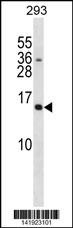
Western blot analysis in 293 cell line lysates (35ug/lane).| Product Name | SH2D1A Antibody |
|---|---|
| Antibody Type | Primary Antibodies |
| Product description | This gene encodes a protein that plays a major role in the bidirectional stimulation of T and B cells. This protein contains an SH2 domain and a short tail. It associates with the signaling lymphocyte-activation molecule, thereby acting as an inhibitor of this transmembrane protein by blocking the recruitment of the SH2-domain-containing signal-transduction molecule SHP-2 to its docking site. This protein can also bind to other related surface molecules that are expressed on activated T, B and NK cells, thereby modifying signal transduction pathways in these cells. Mutations in this gene cause lymphoproliferative syndrome X-linked type 1 or Duncan disease, a rare immunodeficiency characterized by extreme susceptibility to infection with Epstein-Barr virus, with symptoms including severe mononucleosis and malignant lymphoma. Multiple transcript variants encoding different isoforms have been found for this gene.1) Ameratunga, R., et al. N. Z. Med. J. 122(1304):46-53(2009) |
| Immunogen | This SH2D1A antibody is generated from rabbits immunized with a KLH conjugated synthetic peptide between 85-114 amino acids from the C-terminal region of human SH2D1A. |
| Clonality | Polyclonal |
|---|---|
| Isotype | Ig |
| Host Species | Rabbit |
| Tested Applications | WB |
| For WB starting dilution is: 1:1000 | |
| Species Reactivity | Human |
| Concentration | 1mg/ml |
| Purification | Affinity purified |
| Gene Symbol | SH2D1A |
|---|---|
| Alternative Names | SH2 domain-containing protein 1A Duncan disease SH2-protein Signaling lymphocytic activation molecule-associated protein SLAM-associated protein T-cell signal transduction molecule SAP SH2D1A DSHP SAP |
| Molecular Weight(MW) | 14 kDa |
Application
Western blot analysis in 293 cell line lysates (35ug/lane).| Application Notes | For WB starting dilution is: 1:1000 |
|---|
| Form | Liquid |
|---|---|
| Storage Instructions | Store at 4˚C for three months and -20˚C, stable for up to one year. As with all antibodies care should be taken to avoid repeated freeze thaw cycles. Antibodies should not be exposed to prolonged high temperatures. |
| Storage Buffer | Supplied in PBS with 0.09% (W/V) sodium azide. |


