Application
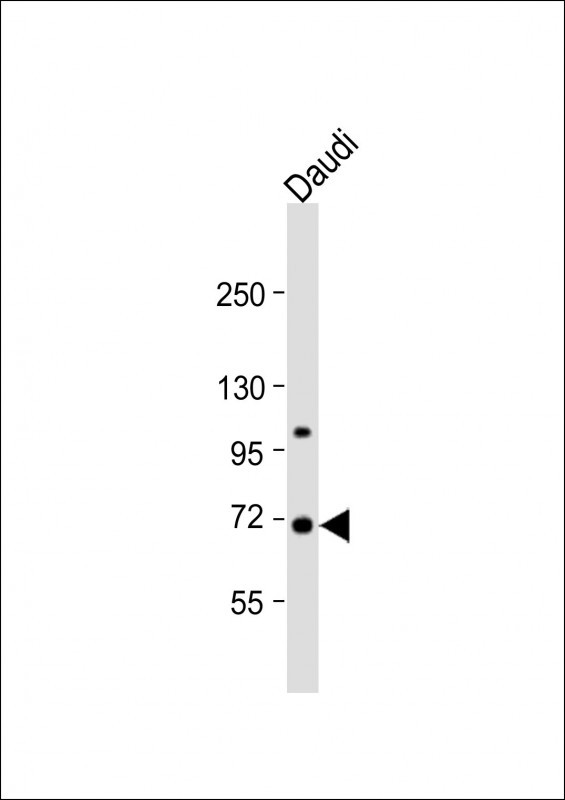
Western Blot at 1:1000 dilution + Daudi whole cell lysate Lysates/proteins at 20 ug per lane.| Product Name | SIGLEC10 Antibody |
|---|---|
| Antibody Type | Primary Antibodies |
| Product description | SIGLEC10 is a putative adhesion molecule that mediates sialic-acid dependent binding to cells. It preferentially binds to alpha2,3- or 2,6-linked sialic acid. The sialic acid recognition site may be masked by cis interactions with sialic acids on the same cell surface. In the immune response, may act as an inhibitory receptor upon ligand induced tyrosine phosphorylation by recruiting cytoplasmic phosphatase(s) via their SH2 domain(s) that block signal transduction through dephosphorylation of signaling molecules. SIGLEC10 interacts with PTPN6/SHP-1 upon phosphorylation. The protein is expressed by peripheral blood leukocytes (eosinophils, monocytes and a natural killer cell subpopulation). Isoform 5 is found to be the most abundant isoform, found in lymph node, lung, ovary and appendix. Isoform 1 is found at high levels and isoform 2 at lower levels in bone marrow, spleen and spinal chord. Isoform 2 is also found in brain. Isoform 4 is specifically found in natural killer cells. SIGLEC10 contains 1 copy of a cytoplasmic motif that is referred to as the immunoreceptor tyrosine-based inhibitor motif (ITIM). This motif is involved in downmodulation of cellular responses. The phosphorylated ITIM motif binds to the SH2 domain of PTPN6/SHP-1. Phosphorylation of Tyr-667 is involved in binding to PTPN6. The SIGLEC10 gene belongs to the immunoglobulin superfamily.1) Strausberg, R.L., et al., Proc. Natl. Acad. Sci. U.S.A. 99(26):16899-16903 (2002). |
| Immunogen | This SIGLEC10 antibody is generated from rabbits immunized with a KLH conjugated synthetic peptide between 656-687 amino acids from the C-terminal region of human SIGLEC10. |
| Clonality | Polyclonal |
|---|---|
| Isotype | Ig |
| Host Species | Rabbit |
| Tested Applications | WB |
| For WB starting dilution is: 1:1000 | |
| Species Reactivity | Human |
| Concentration | 1mg/ml |
| Purification | Affinity purified |
| Gene Symbol | SIGLEC10 |
|---|---|
| Alternative Names | Sialic acid-binding Ig-like lectin 10 Siglec-10 Siglec-like protein 2 SIGLEC10 SLG2 |
| Molecular Weight(MW) | 77 kDa |
Application
Western Blot at 1:1000 dilution + Daudi whole cell lysate Lysates/proteins at 20 ug per lane.| Application Notes | For WB starting dilution is: 1:1000 |
|---|
| Form | Liquid |
|---|---|
| Storage Instructions | Store at 4˚C for three months and -20˚C, stable for up to one year. As with all antibodies care should be taken to avoid repeated freeze thaw cycles. Antibodies should not be exposed to prolonged high temperatures. |
| Storage Buffer | Supplied in PBS with 0.09% (W/V) sodium azide. |


