Application
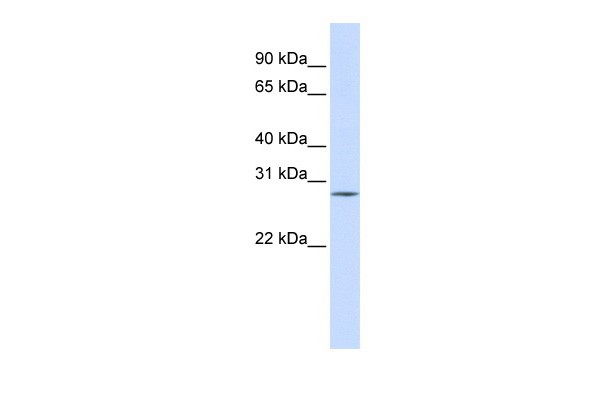
Antibody used in WB on Human Muscle at 0.2-1 ug/ml.| Product Name | SPI1 Antibody |
|---|---|
| Antibody Type | Primary Antibodies |
| Antigen Alias | SPI1, OF, PU.1, SFPI1, SPI-1, SPI-A |
| Product description | SPI1 is known to collaborate with multiple transcription factors and to regulate expression of immunoglobulin genes. Lack of SPI1 expression is associated with defective immunoglobulin transcription in Hodgkin and Reed-Sternberg cells of classical Hodgkin disease. This gene encodes an ETS-domain transcription factor that activates gene expression during myeloid and B-lymphoid cell development. The nuclear protein binds to a purine-rich sequence known as the PU-box found near the promoters of target genes, and regulates their expression in coordination with other transcription factors and cofactors. The protein can also regulate alternative splicing of target genes. Multiple transcript variants encoding different isoforms have been found for this gene.1) Crotti, T.N., (2008) J. Cell. Physiol. 215 (3), 636-644. |
| Immunogen | Antibody produced in rabbits immunized with a synthetic peptide corresponding a region of human SPI1. |
| Clonality | Polyclonal |
|---|---|
| Host Species | Rabbit |
| Tested Applications | ELISAWB |
| SPI1 antibody can be used for detection of SPI1 by ELISA at 1:312500. SPI1 antibody can be used for detection of SPI1 by western blot at 1 μg/mL, and HRP conjugated secondary antibody should be diluted 1:50,000 - 100,000.: |
|
| Species Reactivity | HumanMouseRat |
| Concentration | 1mg/ml |
| Purification | Affinity purified |
| Gene Symbol | SPI1 |
|---|---|
| Alternative Names | SPI1 OF PU.1 SFPI1 SPI-1 SPI-A |
| Molecular Weight(MW) | 31 kDa |
Application
Antibody used in WB on Human Muscle at 0.2-1 ug/ml.| Positive Control | 1) Cat. No. XBL-10413 - Fetal Skeletal Muscle Tissue Lysate |
|---|---|
| Application Notes | SPI1 antibody can be used for detection of SPI1 by ELISA at 1:312500. SPI1 antibody can be used for detection of SPI1 by western blot at 1 μg/mL, and HRP conjugated secondary antibody should be diluted 1:50,000 - 100,000.: |
| Form | Liquid |
|---|---|
| Storage Instructions | For short periods of storage (days) store at 4˚C. For longer periods of storage, store SPI1 antibody at -20˚C. As with any antibody avoid repeat freeze-thaw cycles. |
| Storage Buffer | Antibody is lyophilized in PBS buffer with 2% sucrose. Add 50 μL of distilled water. Final antibody concentration is 1 mg/mL. |


