Application
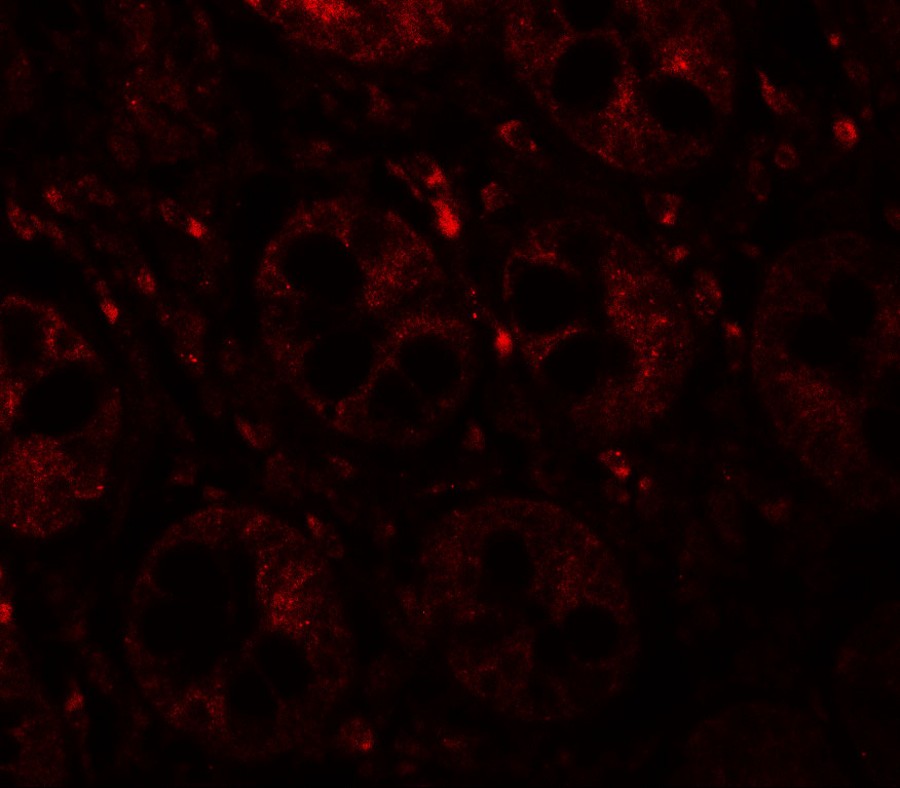
Immunofluorescence of STAT1 in human small intestine tissue with STAT1 antibody at 20 μg/ml.Application
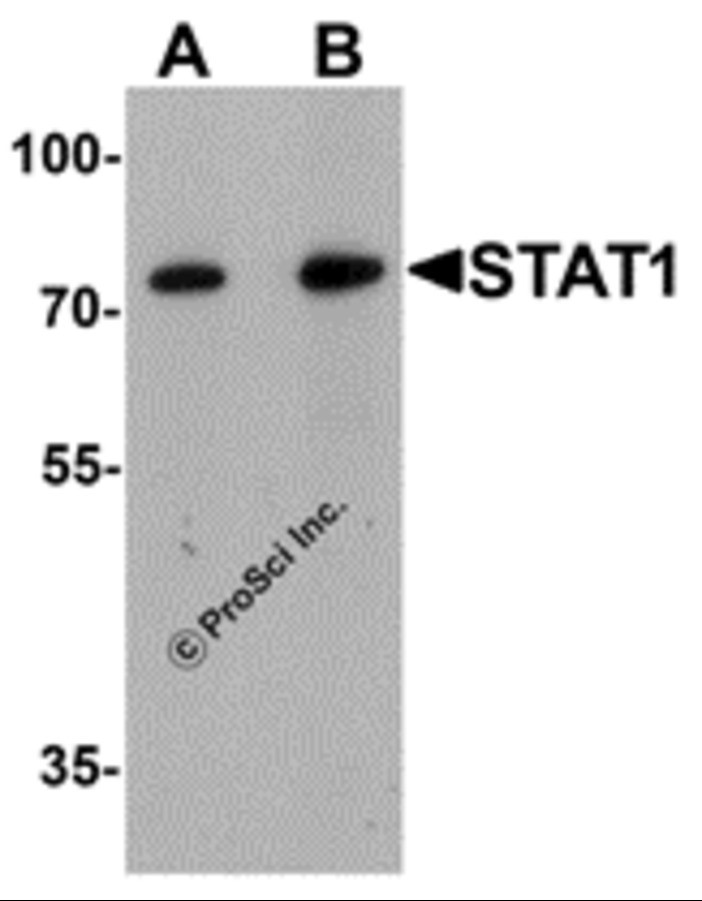
Western blot analysis of STAT1 in human small intestine tissue lysate with STAT1 antibody at (A) 1 and (B) 2 μg/mL.| Product Name | STAT1 Antibody |
|---|---|
| Antibody Type | Primary Antibodies |
| Antigen Alias | STAT1 Antibody: CANDF7, ISGF-3, STAT91 |
| Product description | STAT1 Antibody: STATs (signal transducers and activators of transcription) are a family of cytoplasmic latent transcription factors that are activated to regulate gene expression in response to a large number of extracellular signaling polypeptides including cytokines, interferons, and growth factors. After phosphorylation by JAK tyrosine kinases, STATs enter the nucleus to regulate transcription of many different genes. Among the seven STATs (STAT1, STAT2, STAT3, STAT4, STAT5a, STAT5b, and STAT6), STAT1, STAT3, STAT5a, and STAT5b have a wide activation profile. STAT1 is activated by many different ligands including IFN family (IFN-α, IFN-β, IFN-γ and IL-10), gp130 family (IL-6, IL-11, LIF, CNTF, and G-CSF), and receptor tyrosine kinases (EGF, PDGF, and CSF-1).1) Schindler C, Fu XY, Improta T, et al. Proteins of transcription factor ISGF-3: one gene encodes the 91-and 84-kDa ISGF-3 proteins that are activated by interferon alpha. Proc. Natl. Acad. Sci. USA 1992; 89:7836-9. |
| Immunogen | Rabbit polyclonal STAT1 antibody was raised against a 15 amino acid peptide near the carboxy terminus of human STAT1. The immunogen is located within the last 50 amino acids of STAT1. |
| Clonality | Polyclonal |
|---|---|
| Isotype | IgG |
| Host Species | Rabbit |
| Tested Applications | ELISAIFWB |
| STAT1 antibody can be used for detection of STAT1 by Western blot at 1 - 2 μg/mL.: |
|
| Species Reactivity | Human |
| Concentration | 1mg/ml |
| Purification | Affinity purified |
| Gene Symbol | STAT1 |
|---|---|
| Alternative Names | STAT1 Antibody: CANDF7 ISGF-3 STAT91 |
| Molecular Weight(MW) | Predicted: 83 kDa |
| Sequence Similarities | 2) Cat. No. 11-801 - Human Small Intestine Tissue Slide |
Application
Immunofluorescence of STAT1 in human small intestine tissue with STAT1 antibody at 20 μg/ml.
Application
Western blot analysis of STAT1 in human small intestine tissue lysate with STAT1 antibody at (A) 1 and (B) 2 μg/mL.| Positive Control | 1) Cat. No. 1308 - Human Small Intestine Tissue Lysate |
|---|---|
| Application Notes | STAT1 antibody can be used for detection of STAT1 by Western blot at 1 - 2 μg/mL.: |
| Form | Liquid |
|---|---|
| Storage Instructions | STAT1 antibody can be stored at 4˚C for three months and -20˚C, stable for up to one year. |
| Storage Buffer | STAT1 Antibody is supplied in PBS containing 0.02% sodium azide. |


