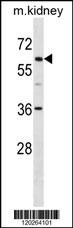
Application
Western blot analysis in mouse kidney tissue lysates (35ug/lane).| Product Name | TFE3 Antibody |
|---|---|
| Antibody Type | Primary Antibodies |
| Antigen Alias | Transcription factor E3, Class E basic helix-loop-helix protein 33, bHLHe33, TFE3, BHLHE33 |
| Product description | The microphthalmia transcription factor/transcription factor E (MITF-TFE) family of basic helix-loop-helix leucine zipper (bHLH-Zip) transcription factors includes four family members: MITF, TFE3, TFEB and TFEC. The TEF3 protein encoded by this gene activates transcription through binding to the muE3 motif of the immunoglobulin heavy-chain enhancer. The TFEC protein forms heterodimers with the TEF3 protein and inhibits TFE3-dependent transcription activation. The TEF3 protein interacts with transcription regulators such as E2F3, SMAD3, and LEF-1, and is involved in TGF-beta-induced transcription, playing important roles in cell growth, proliferation, and osteoclast and macrophage differentiation. The TFE3 protein also activates hepatic IRS-2 gene, and induces hexokinase II (HK2) and insulin-induced gene 1 (INSIG1); it participates in insulin signaling and could be a therapeutic target for diabetes. This gene is also involved in chromosomal translocations, resulting in different fusion gene products in papillary renal cell carcinomas and alveolar soft part sarcomas, such as PRCC-TFE3, RCC17-TFE3, PSF-TFE3, NonO (p54nrb)-TFE3 and ASPL-TFE3.1) Argani, P., et al. Am. J. Surg. Pathol. 34(10):1395-1406(2010) |
| Immunogen | This TFE3 antibody is generated from rabbits immunized with a KLH conjugated synthetic peptide between 489-516 amino acids from the C-terminal region of human TFE3. |
| Clonality | Polyclonal |
|---|---|
| Isotype | Ig |
| Host Species | Rabbit |
| Tested Applications | WB |
| For WB starting dilution is: 1:1000: |
|
| Species Reactivity | HumanMouse |
| Concentration | 1mg/ml |
| Purification | Affinity purified |
| Gene Symbol | TFE3 |
|---|---|
| Alternative Names | Transcription factor E3 Class E basic helix-loop-helix protein 33 bHLHe33 TFE3 BHLHE33 |
| Molecular Weight(MW) | 62 kDa |
| Sequence Similarities | Predicted species reactivity based on immunogen sequence: Bovine |
Application
Western blot analysis in mouse kidney tissue lysates (35ug/lane).| Application Notes | For WB starting dilution is: 1:1000: |
|---|
| Form | Liquid |
|---|---|
| Storage Instructions | Store at 4˚C for three months and -20˚C, stable for up to one year. As with all antibodies care should be taken to avoid repeated freeze thaw cycles. Antibodies should not be exposed to prolonged high temperatures. |
| Storage Buffer | Supplied in PBS with 0.09% (W/V) sodium azide. |


