Application
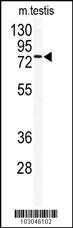
Western blot analysis of anti-TLK2 Antibody in mouse testis tissue lysates (35ug/lane)Application
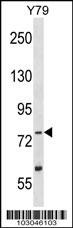
Western blot analysis in Y79 cell line lysates (35ug/lane).| Product Name | TLK2 Antibody |
|---|---|
| Antibody Type | Primary Antibodies |
| Antigen Alias | Serine/threonine-protein kinase tousled-like 2, HsHPK, PKU-alpha, Tousled-like kinase 2, TLK2 |
| Product description | TLK2, a member of the Ser/Thr protein kinase family, is rapidly and transiently inhibited by phosphorylation following the generation of DNA double-stranded breaks during S-phase. This is cell cycle checkpoint and ATM-pathway dependent and appears to regulate processes involved in chromatin assembly. The TLK2 enzyme is cell-cycle regulated, with maximal activity in S-phase. It is inactivated by phosphorylation at Ser-750, potentially by CHK1. TLK2 heterodimerizes with TLK1. This nuclear protein is widely expressed, with presence in fetal placenta, liver, kidney, pancreas, heart and skeletal muscle tissues, and in several adult cell lines.1) Groth, A., et al., EMBO J. 22(7):1676-1687 (2003). Strausberg, R.L., et al., Proc. Natl. Acad. Sci. U.S.A. 99(26):16899-16903 (2002). Sillje, H.H., et al., EMBO J. 18(20):5691-5702 (1999). Yamakawa, A., et al., Gene 202 (1-2), 193-201 (1997). |
| Immunogen | This TLK2 antibody is generated from rabbits immunized with a KLH conjugated synthetic peptide between 141-171 amino acids from the Central region of human TLK2. |
| Clonality | Polyclonal |
|---|---|
| Isotype | Ig |
| Host Species | Rabbit |
| Tested Applications | WB |
| For WB starting dilution is: 1:1000: |
|
| Species Reactivity | HumanMouse |
| Concentration | 1mg/ml |
| Gene Symbol | TLK2 |
|---|---|
| Alternative Names | Serine/threonine-protein kinase tousled-like 2 HsHPK PKU-alpha Tousled-like kinase 2 TLK2 |
| Molecular Weight(MW) | 88 kDa |
Application
Western blot analysis of anti-TLK2 Antibody in mouse testis tissue lysates (35ug/lane)
Application
Western blot analysis in Y79 cell line lysates (35ug/lane).| Application Notes | For WB starting dilution is: 1:1000: |
|---|
| Form | Liquid |
|---|---|
| Storage Instructions | Store at 4˚C for three months and -20˚C, stable for up to one year. As with all antibodies care should be taken to avoid repeated freeze thaw cycles. Antibodies should not be exposed to prolonged high temperatures. |
| Storage Buffer | Supplied in PBS with 0.09% (W/V) sodium azide. |


