Application
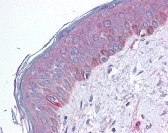
Immunohistochemistry staining of TSC2 in skin tissue using TSC2 Antibody.| Product Name | TSC2 Antibody |
|---|---|
| Antibody Type | Primary Antibodies |
| Antigen Alias | TSC2, LAM, Tuberous sclerosis 2 protein, TSC4, Tuberin, Tuberous sclerosis 2 |
| Product description | Tuberous sclerosis complex (TSC) is an autosomal dominant tumor syndrome caused by mutations in either of the TSC1 or TSC2 tumor suppressor genes. The products of these genes form a protein complex that indirectly decreases the signaling of the mammalian Target of Rapamycin (TOR), an evolutionarily conserved serine/threonine kinase that regulates cell growth and cell cycle through its ability to integrate signals from nutrient levels and growth factors. TOR activity is stimulated by Rheb, a member of the Ras superfamily of G-proteins, when the GTP/GDP ratio bound to Rheb is high. Immunoprecipitated TSC1/TSC2 has been shown to stimulate Rheb GTPase activity in vitro, suggesting that the TSC1/TSC2 complex decreases the ability of Rheb to stimulate TOR activity. This is supported by experiments showing that overexpression of TSC1 and TSC2 results in a significant decrease in the GTP/GDP ratio bound to Rheb and the inhibition of cell growth. At least three isoforms of TSC2 exist. |
| Immunogen | TSC2 antibody was raised against a modified peptide of TSC2 (Human). |
| Clonality | Polyclonal |
|---|---|
| Isotype | IgG |
| Host Species | Rabbit |
| Tested Applications | IFIHC |
| TSC2 antibody can be used in ELISA, Western Blot starting at 1:2000, immunohistochemistry starting at 1:50, and immunoprecipitation: |
|
| Species Reactivity | Human |
| Concentration | 1mg/ml |
| Purification | Affinity purified |
| Gene Symbol | TSC2 |
|---|---|
| Alternative Names | TSC2 LAM Tuberous sclerosis 2 protein TSC4 Tuberin Tuberous sclerosis 2 |
| Tissue Specificity | pSer664 |
Application
Immunohistochemistry staining of TSC2 in skin tissue using TSC2 Antibody.| Application Notes | TSC2 antibody can be used in ELISA, Western Blot starting at 1:2000, immunohistochemistry starting at 1:50, and immunoprecipitation: |
|---|
| Form | Liquid |
|---|---|
| Storage Instructions | Store TSC2 antibody at 4 ˚C or -20 ˚C. As with all antibodies avoid freeze/thaw cycles. |
| Storage Buffer | Phosphate-buffered solution, pH 7.2, 0.09% sodium azide, 50% glycerol. |


