Application
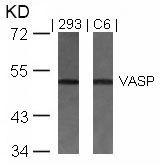
Western blot analysis of lysed extracts from 293 and C6 cells using VASP (Ab-157).Application
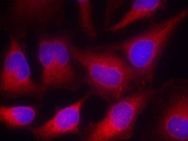
Immunofluorescence staining of methanol-fixed HeLa cells using VASP (Ab-157).| Product Name | VASP Antibody |
|---|---|
| Antibody Type | Primary Antibodies |
| Antigen Alias | VASP |
| Product description | Vasodilator-stimulated phosphoprotein (VASP) is a member of the Ena-VASP protein family. Ena-VASP family members contain an EHV1 N-terminal domain that binds proteins containing E/DFPPPPXD/E motifs and targets Ena-VASP proteins to focal adhesions. In the mid-region of the protein, family members have a proline-rich domain that binds SH3 and WW domain-containing proteins. Their C-terminal EVH2 domain mediates tetramerization and binds both G and F actin. VASP is associated with filamentous actin formation and likely plays a widespread role in cell adhesion and motility. VASP may also be involved in the intracellular signaling pathways that regulate integrin-extracellular matrix interactions. VASP is regulated by the cyclic nucleotide-dependent kinases PKA and PKG.1) Zhao WM, et al. (2001) EMBO J 20 (9): 2315-2325. Millard TH, et al. (2005) EMBO J 24 (2): 240-250. Kühnel K, et al. (2004) Proc Natl Acad Sci U S A 101 (49): 17027-17032. Haffner C, et al. (1995) EMBO J 14 (1): 19-27. Ramesh N, et al. (1997) Proc Natl Acad Sci U S A 94 (26): 14671-14676. |
| Immunogen | VASP (Ab-157) antibody was raised against a peptide sequence around aa.155~159 (R-V-S-N-A) derived from Human VASP. |
| Clonality | Polyclonal |
|---|---|
| Host Species | Rabbit |
| Tested Applications | IFWB |
| Western Blot: 1:500~1:1000, Immunofluorescence: 1:100~1:200: |
|
| Species Reactivity | HumanRat |
| Concentration | 1mg/ml |
| Purification | Affinity purified |
| Gene Symbol | VASP |
|---|---|
| Alternative Names | VASP |
| Molecular Weight(MW) | 50 kDa |
| Tissue Specificity | This antibody detects endogenous level of total VASP protein. |
| Entrez Gene | 7408 |
|---|---|
| Protein Accession | NP_003361.1 |
Application
Western blot analysis of lysed extracts from 293 and C6 cells using VASP (Ab-157).
Application
Immunofluorescence staining of methanol-fixed HeLa cells using VASP (Ab-157).| Application Notes | Western Blot: 1:500~1:1000, Immunofluorescence: 1:100~1:200: |
|---|
| Form | Liquid |
|---|---|
| Storage Instructions | Store antibody at -20˚C for up to one year. |
| Storage Buffer | Antibody supplied in phosphate buffered saline (without Mg2+ and Ca2+), pH 7.4, 150mM NaCl, 0.02% sodium azide and 50% glycerol. |


