Application
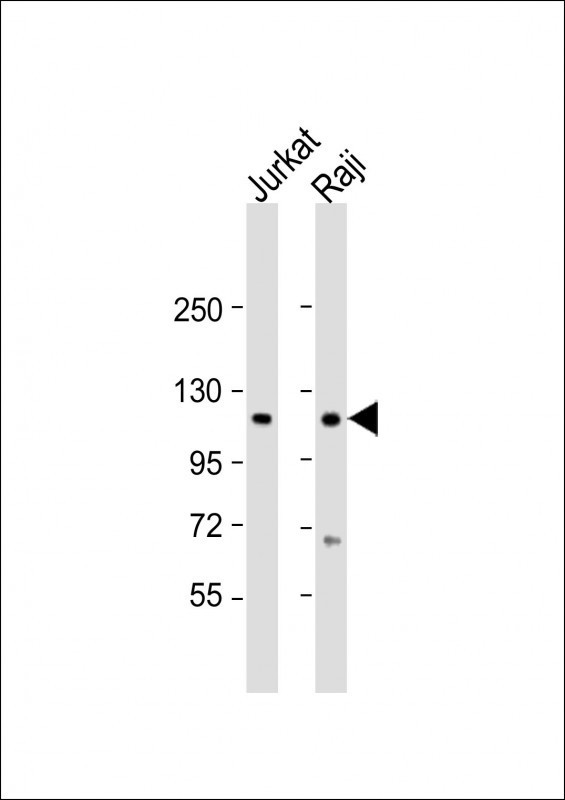
Western Blot at 1:2000 dilution Lane 1: Jurkat whole cell lysate Lane 2: Raji whole cell lysate Lysates/proteins at 20 ug per lane.Application
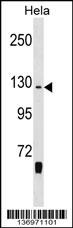
Western blot analysis in Hela cell line lysates (35ug/lane).| Product Name | WHSC1 Antibody |
|---|---|
| Antibody Type | Primary Antibodies |
| Antigen Alias | Histone-lysine N-methyltransferase NSD2, Multiple myeloma SET domain-containing protein, MMSET, Nuclear SET domain-containing protein 2, NSD2, Protein trithorax-5, Wolf-Hirschhorn syndrome candidate 1 protein, WHSC1, WHSC1, KIAA1090, MMSET, NSD2, TRX5 |
| Product description | This gene encodes a protein that contains four domains present in other developmental proteins: a PWWP domain, an HMG box, a SET domain, and a PHD-type zinc finger. It is expressed ubiquitously in early development. Wolf-Hirschhorn syndrome (WHS) is a malformation syndrome associated with a hemizygous deletion of the distal short arm of chromosome 4. This gene maps to the 165 kb WHS critical region and has also been involved in the chromosomal translocation t(4;14)(p16.3;q32.3) in multiple myelomas. Alternative splicing of this gene results in multiple transcript variants encoding different isoforms. Some transcript variants are nonsense-mediated mRNA (NMD) decay candidates, hence not represented as reference sequences.1) Jugessur, A., et al. PLoS ONE(7), E11493 (2010) : |
| Immunogen | This WHSC1 antibody is generated from rabbits immunized with a KLH conjugated synthetic peptide between 1061-1089 amino acids from the C-terminal region of human WHSC1. |
| Clonality | Polyclonal |
|---|---|
| Isotype | Ig |
| Host Species | Rabbit |
| Tested Applications | WB |
| For WB starting dilution is: 1:1000: |
|
| Species Reactivity | Human |
| Concentration | 1mg/ml |
| Purification | Affinity purified |
| Gene Symbol | WHSC1 |
|---|---|
| Alternative Names | Histone-lysine N-methyltransferase NSD2 Multiple myeloma SET domain-containing protein MMSET Nuclear SET domain-containing protein 2 NSD2 Protein trithorax-5 Wolf-Hirschhorn syndrome candidate 1 protein WHSC1 WHSC1 KIAA1090 MMSET NSD2 TRX5 |
| Molecular Weight(MW) | 152 kDa |
| Sequence Similarities | Predicted species reactivity based on immunogen sequence: Mouse |
Application
Western Blot at 1:2000 dilution Lane 1: Jurkat whole cell lysate Lane 2: Raji whole cell lysate Lysates/proteins at 20 ug per lane.
Application
Western blot analysis in Hela cell line lysates (35ug/lane).| Application Notes | For WB starting dilution is: 1:1000: |
|---|
| Form | Liquid |
|---|---|
| Storage Instructions | Store at 4˚C for three months and -20˚C, stable for up to one year. As with all antibodies care should be taken to avoid repeated freeze thaw cycles. Antibodies should not be exposed to prolonged high temperatures. |
| Storage Buffer | Supplied in PBS with 0.09% (W/V) sodium azide. |


