Application
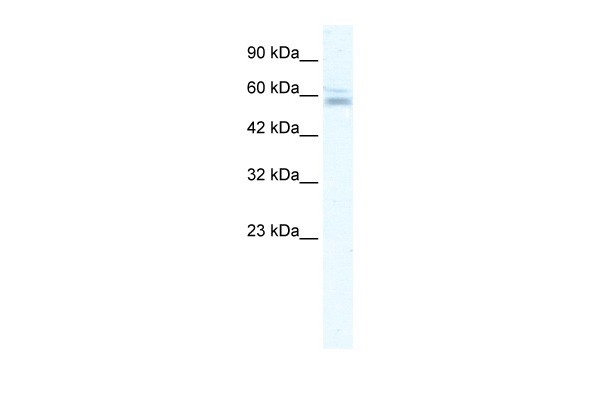
Antibody used in WB on Human Jurkat 2.5 ug/ml.| Product Name | ZNF141 Antibody |
|---|---|
| Antibody Type | Primary Antibodies |
| Antigen Alias | ZNF141, D4S90, PAPA6, pHZ-44 |
| Product description | Zinc finger encoding genes would be good candidates for being involved in the multiple developmental defects associated with chromosomal aneusomy--because of their role as transcriptional regulators, their abundance in the genome and their known association with specific developmental disorders. A zinc finger encoding cDNA (ZNF141) of the C2-H2/KRAB subfamily has been mapped to the 4p- (Wolf-Hirschhorn) syndrome (WHS) chromosome region. ZNF141 was expressed ubiquitously at low levels in the analysed tissue. The identification of a candidate gene for a chromosomal aneusomy syndrome belonging to a class of evolutionary conserved genes will provide options for studying its normal and abnormal expression during mammalian embryogenesis.1) Tommerup, N., et al., (1993) Hum. Mol. Genet. 2 (10), 1571-1575. |
| Immunogen | Antibody produced in rabbits immunized with a synthetic peptide corresponding a region of human ZNF141. |
| Clonality | Polyclonal |
|---|---|
| Host Species | Rabbit |
| Tested Applications | ELISAWB |
| ZNF141 antibody can be used for detection of ZNF141 by ELISA at 1:62500. ZNF141 antibody can be used for detection of ZNF141 by western blot at 2.5 μg/mL, and HRP conjugated secondary antibody should be diluted 1:50,000 - 100,000.: |
|
| Species Reactivity | Human |
| Concentration | 1mg/ml |
| Purification | Affinity purified |
| Gene Symbol | ZNF141 |
|---|---|
| Alternative Names | ZNF141 D4S90 PAPA6 pHZ-44 |
| Molecular Weight(MW) | 55 kDa |
Application
Antibody used in WB on Human Jurkat 2.5 ug/ml.| Positive Control | 1) Cat. No. 1205 - Jurkat Cell Lysate |
|---|---|
| Application Notes | ZNF141 antibody can be used for detection of ZNF141 by ELISA at 1:62500. ZNF141 antibody can be used for detection of ZNF141 by western blot at 2.5 μg/mL, and HRP conjugated secondary antibody should be diluted 1:50,000 - 100,000.: |
| Form | Liquid |
|---|---|
| Storage Instructions | For short periods of storage (days) store at 4˚C. For longer periods of storage, store ZNF141 antibody at -20˚C. As with any antibody avoid repeat freeze-thaw cycles. |
| Storage Buffer | IgG in phosphate buffered saline , pH 7.4, 150mM NaCl, 0.02% sodium azide and 50% glycerol.Store at -20 °C.Stable for 12 months from date of receipt |


