WB
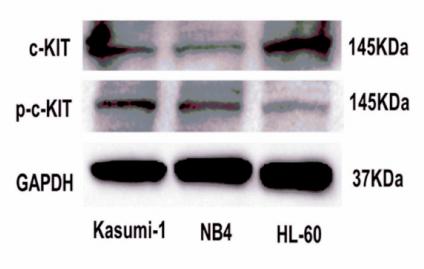
The effects of genetic abnormality-induced cytological and spectral alterations in AML cells. (a) Ratio of clone formation. (b) Relative contents of Raman bands screened by CRT algorithm. (c) Western blot analysis showed the c-KIT and p-c-KIT expression, GAPDH served as loading control, along with (d) ratio of phosphorylated c-KIT to total c-KIT. *P<0.05.IHC
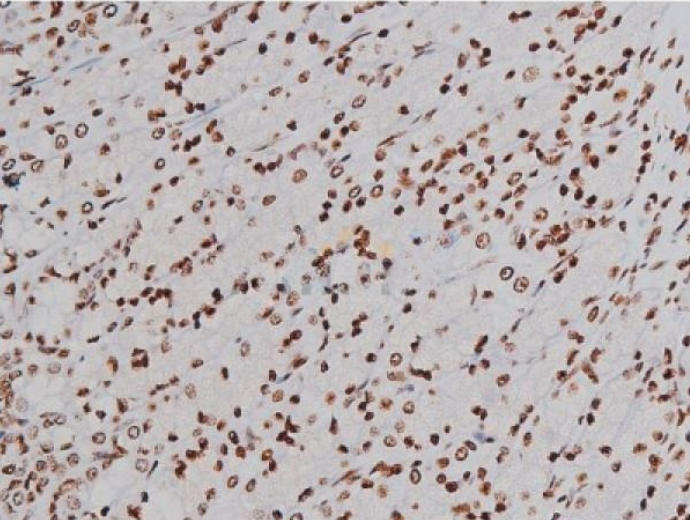
Phospho-c-Kit (Tyr721) Antibody at 1/200 staining Rat ganstric tissue sections by IHC-P. The tissue was formaldehyde fixed and a heat mediated antigen retrieval step in citrate buffer was performed. The tissue was then blocked and incubated with the antibody for 1.5 hours at 22°C. An HRP conjugated goat anti-rabbit antibody was used as the secondary antibody.IHC
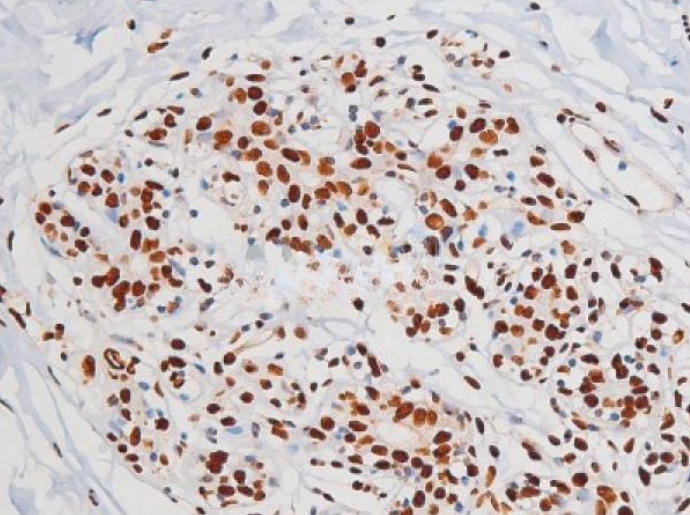
Phospho-c-Kit (Tyr721) Antibody at 1/200 staining Human heart tissue sections by IHC-P. The tissue was formaldehyde fixed and a heat mediated antigen retrieval step in citrate buffer was performed. The tissue was then blocked and incubated with the antibody for 1.5 hours at 22°C. An HRP conjugated goat anti-rabbit antibody was used as the secondary antibody.IHC
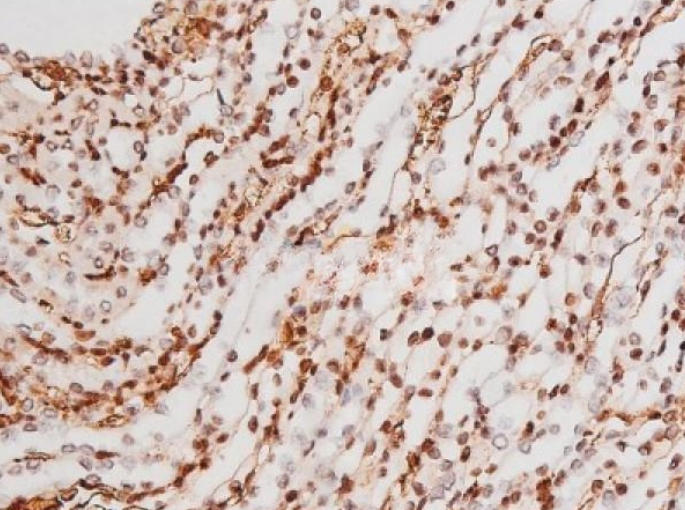
Phospho-c-Kit (Tyr721) Antibody at 1/200 staining Mouse kidney tissue sections by IHC-P. The tissue was formaldehyde fixed and a heat mediated antigen retrieval step in citrate buffer was performed. The tissue was then blocked and incubated with the antibody for 1.5 hours at 22°C. An HRP conjugated goat anti-rabbit antibody was used as the secondary antibody.| Product Name | Rabbit polyclonal antibody to Phospho-c-Kit (Tyr721) |
|---|---|
| Antibody Type | Primary Antibodies |
| Modification | p-Tyr721 |
| Clonality | Polyclonal |
|---|---|
| Isotype | IgG |
| Host Species | Rabbit |
| Tested Applications | IHCWB |
| WB:1:500-1:2000 IHC:1:100-1:500 |
|
| Species Reactivity | HumanMouseRat |
| Concentration | 1mg/ml |
| Purification | Affinity purified |
| Gene Symbol | KIT |
|---|---|
| Gene Synonyms | PBT SCFR C-Kit CD117 MASTC |
| Gene Full Name | KIT proto-oncogene, receptor tyrosine kinase |
| Gene Summary | This gene encodes a receptor tyrosine kinase. This gene was initially identified as a homolog of the feline sarcoma viral oncogene v-kit and is often referred to as proto-oncogene c-Kit. The canonical form of this glycosylated transmembrane protein has an N-terminal extracellular region with five immunoglobulin-like domains, a transmembrane region, and an intracellular tyrosine kinase domain at the C-terminus. Upon activation by its cytokine ligand, stem cell factor (SCF), this protein phosphorylates multiple intracellular proteins that play a role in in the proliferation, differentiation, migration and apoptosis of many cell types and thereby plays an important role in hematopoiesis, stem cell maintenance, gametogenesis, melanogenesis, and in mast cell development, migration and function. This protein can be a membrane-bound or soluble protein. Mutations in this gene are associated with gastrointestinal stromal tumors, mast cell disease, acute myelogenous leukemia, and piebaldism. Multiple transcript variants encoding different isoforms have been found for this gene. [provided by RefSeq, May 2020] |
| Alternative Names | C Kit c-Kit c-Kit Ligand CD117 Kit Kit Ligand KIT oncogene KIT proto oncogene receptor tyrosine kinase KIT_HUMAN Mast cell growth factor receptor Mast/stem cell growth factor receptor Kit MGF p145 c-kit PBT Piebald trait protein Proto oncogene c Kit Proto oncogene tyrosine protein kinase Kit Proto-oncogene c-Kit SCF Receptor SCFR soluble KIT variant 1 Steel Factor Receptor Stem cell factor receptor tyrosine protein kinase Kit Tyrosine-protein kinase Kit v kit Hardy Zuckerman 4 feline sarcoma viral oncogene homolog v kit Hardy Zuckerman 4 feline sarcoma viral oncogene like protein v-kit Hardy-Zuckerman 4 feline sarcoma viral oncogene homolog |
| Molecular Weight(MW) | 145kDa |
| Function | Tyrosine-protein kinase that acts as cell-surface receptor for the cytokine KITLG/SCF and plays an essential role in the regulation of cell survival and proliferation, hematopoiesis, stem cell maintenance, gametogenesis, mast cell development, migration and function, and in melanogenesis. In response to KITLG/SCF binding, KIT can activate several signaling pathways. Phosphorylates PIK3R1, PLCG1, SH2B2/APS and CBL. Activates the AKT1 signaling pathway by phosphorylation of PIK3R1, the regulatory subunit of phosphatidylinositol 3-kinase. Activated KIT also transmits signals via GRB2 and activation of RAS, RAF1 and the MAP kinases MAPK1/ERK2 and/or MAPK3/ERK1. Promotes activation of STAT family members STAT1, STAT3, STAT5A and STAT5B. Activation of PLCG1 leads to the production of the cellular signaling molecules diacylglycerol and inositol 1,4,5-trisphosphate. KIT signaling is modulated by protein phosphatases, and by rapid internalization and degradation of the receptor. Activated KIT promotes phosphorylation of the protein phosphatases PTPN6/SHP-1 and PTPRU, and of the transcription factors STAT1, STAT3, STAT5A and STAT5B. Promotes phosphorylation of PIK3R1, CBL, CRK (isoform Crk-II), LYN, MAPK1/ERK2 and/or MAPK3/ERK1, PLCG1, SRC and SHC1. |
| Cellular Localization | Cell membrane>Single-pass type I membrane protein. |
WB
The effects of genetic abnormality-induced cytological and spectral alterations in AML cells. (a) Ratio of clone formation. (b) Relative contents of Raman bands screened by CRT algorithm. (c) Western blot analysis showed the c-KIT and p-c-KIT expression, GAPDH served as loading control, along with (d) ratio of phosphorylated c-KIT to total c-KIT. *P<0.05.
IHC
Phospho-c-Kit (Tyr721) Antibody at 1/200 staining Rat ganstric tissue sections by IHC-P. The tissue was formaldehyde fixed and a heat mediated antigen retrieval step in citrate buffer was performed. The tissue was then blocked and incubated with the antibody for 1.5 hours at 22°C. An HRP conjugated goat anti-rabbit antibody was used as the secondary antibody.
IHC
Phospho-c-Kit (Tyr721) Antibody at 1/200 staining Human heart tissue sections by IHC-P. The tissue was formaldehyde fixed and a heat mediated antigen retrieval step in citrate buffer was performed. The tissue was then blocked and incubated with the antibody for 1.5 hours at 22°C. An HRP conjugated goat anti-rabbit antibody was used as the secondary antibody.
IHC
Phospho-c-Kit (Tyr721) Antibody at 1/200 staining Mouse kidney tissue sections by IHC-P. The tissue was formaldehyde fixed and a heat mediated antigen retrieval step in citrate buffer was performed. The tissue was then blocked and incubated with the antibody for 1.5 hours at 22°C. An HRP conjugated goat anti-rabbit antibody was used as the secondary antibody.| Application Notes | WB:1:500-1:2000 IHC:1:100-1:500 |
|---|
| Form | Liquid |
|---|---|
| Storage Instructions | Store at -20 °C. Stable for 12 months from date of receipt. |
| Storage Buffer | Rabbit IgG in phosphate buffered saline , pH 7.4, 150mM NaCl, 0.02% sodium azide and 50% glycerol. |


