WB
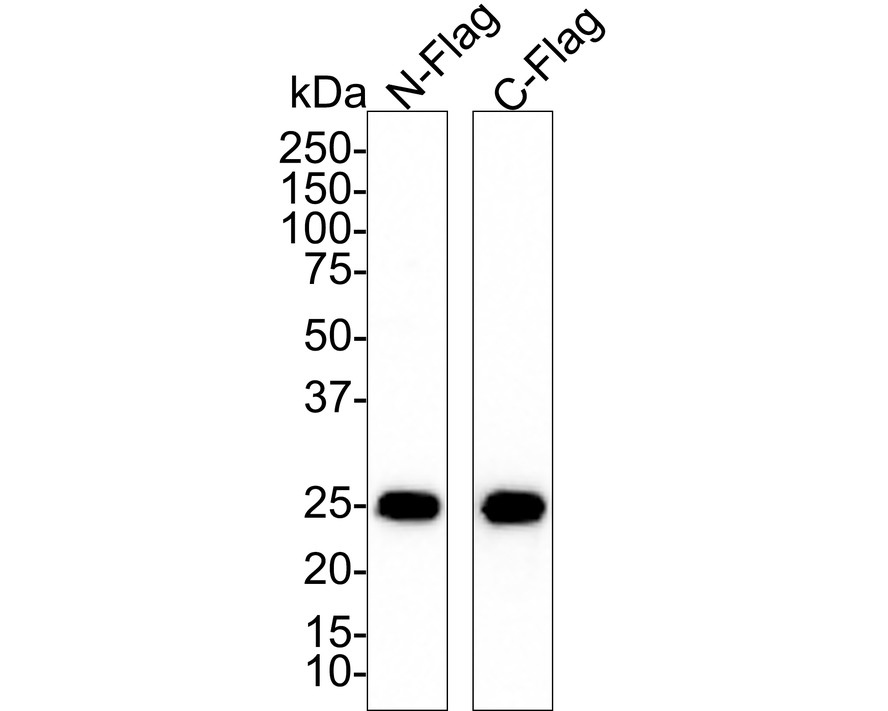
Western blot analysis of DYKDDDDK Tag (FLAG) on different lysates with Rabbit anti-DYKDDDDK Tag (FLAG) antibody at different dilutions. Lane 1: N-Flag at 1/1,000 dilution Lane 2: C-Flag at 1/5,000 dilution Lysates/proteins at 50 ng/Lane. Exposure time: 43 seconds; 4-20% SDS-PAGE gel. Proteins were transferred to a PVDF membrane and blocked with 5% NFDM/TBST for 1 hour at room temperature. The primary antibody at different dilutions were used in 5% NFDM/TBST at room temperature for 2 hours.| Product Name | HRP Conjugated Anti-DYKDDDDK Tag (FLAG) Recombinant Antibody - Rabbit IgG (Chimeric) |
|---|---|
| Antibody Type | Primary Antibodies |
| Immunogen | Synthetic peptide immune sequence is N-DYKDDDDK-C. |
| Conjugation | HRP |
| Clonality | monoclonal |
|---|---|
| Isotype | IgG |
| Host Species | Rabbit |
| Tested Applications | WB |
| WB:1:200-1:2000 |
|
| Species Reactivity | All |
| Concentration | 1mg/ml |
| Purification | Protein A |
| Alternative Names | DDDDK epitope tag antibody DDDK antibody ddk antibody DYKDDDDK antibody DYKDDDDK epitope tag antibody DYKDDDDK tag antibody ECS epitope tag antibody ECS tag antibody Enterokinase Cleavage Site epitope tag antibody Enterokinase Cleavage Site tag antibody DDDDK epitope tag antibody DDDK antibody ddk antibody DYKDDDDK antibody DYKDDDDK epitope tag antibody DYKDDDDK tag antibody ECS epitope tag antibody ECS tag antibody Enterokinase Cleavage Site epitope tag antibody Enterokinase Cleavage Site tag antibody FLAG antibody FLAG tag antibody |
|---|---|
| Function | FLAG-tag, or FLAG octapeptide, or FLAG epitope, is a polypeptide protein tag that can be added to a protein using recombinant DNA technology, having the sequence motif DYKDDDDK (where D=aspartic acid, Y=tyrosine, and K=lysine). It is one of the most specific tags and it is an artificial antigen to which specific, high affinity monoclonal antibodies have been developed and hence can be used for protein purification by affinity chromatography and also can be used for locating proteins within living cells. It has been used to separate recombinant, overexpressed protein from wild-type protein expressed by the host organism. It can also be used in the isolation of protein complexes with multiple subunits, because its mild purification procedure tends not to disrupt such complexes. It has been used to obtain proteins of sufficient purity and quality to carry out 3D structure determination by x-ray crystallography. A FLAG-tag can be used in many different assays that require recognition by an antibody. If there is no antibody against a given protein, adding a FLAG-tag to a protein allows the protein to be studied with an antibody against the FLAG sequence. Examples are cellular localization studies by immunofluorescence, immunoprecipitation or detection by SDS PAGE protein electrophoresis and Western blotting. The peptide sequence of the FLAG-tag from the N-terminus to the C-terminus is: DYKDDDDK (1012 Da). Additionally, it may be used in tandem, commonly the 3xFLAG peptide: DYKDHD-G-DYKDHD-I-DYKDDDDK (with the final tag encoding an enterokinase cleavage site). It can be fused to the C-terminus or the N-terminus of a protein, or inserted within a protein. The tyrosine residue in the FLAG-tag can be sulfated, which can affect antibody recognition of the FLAG epitope. The FLAG-tag can be used in conjunction with other affinity tags, for example a polyhistidine tag (His-tag), HA-tag or myc-tag. |
WB
Western blot analysis of DYKDDDDK Tag (FLAG) on different lysates with Rabbit anti-DYKDDDDK Tag (FLAG) antibody at different dilutions. Lane 1: N-Flag at 1/1,000 dilution Lane 2: C-Flag at 1/5,000 dilution Lysates/proteins at 50 ng/Lane. Exposure time: 43 seconds; 4-20% SDS-PAGE gel. Proteins were transferred to a PVDF membrane and blocked with 5% NFDM/TBST for 1 hour at room temperature. The primary antibody at different dilutions were used in 5% NFDM/TBST at room temperature for 2 hours.| Application Notes | WB:1:200-1:2000 |
|---|
| Form | Liquid |
|---|---|
| Storage Instructions | Store at +4℃ after thawing. Aliquot store at -20℃. Avoid repeated freeze / thaw cycles. |
| Storage Buffer | PBS (pH7.4), 0.05% BSA, 40% Glycerol. |


