WB
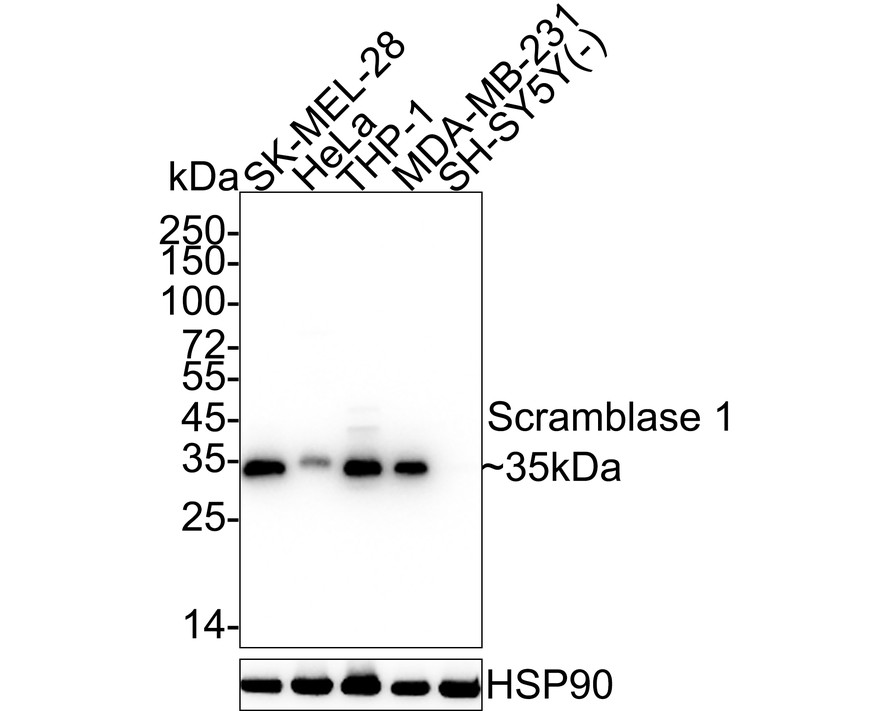
Western blot analysis of Scramblase 1 on different lysates with Rabbit anti-Scramblase 1 antibody at 1/1,000 dilution.Lysates/proteins at 20 µg/Lane.Exposure time: 9 seconds;4-20% SDS-PAGE gel.Proteins were transferred to a PVDF membrane and blocked with 5% NFDM/TBST for 1 hour at room temperature. The primary antibody at 1/1,000 dilution was used in 5% NFDM/TBST at 4℃ overnight. Goat Anti-Rabbit IgG - HRP Secondary Antibody at 1/50,000 dilution was used for 1 hour at room temperature.ICC/IF
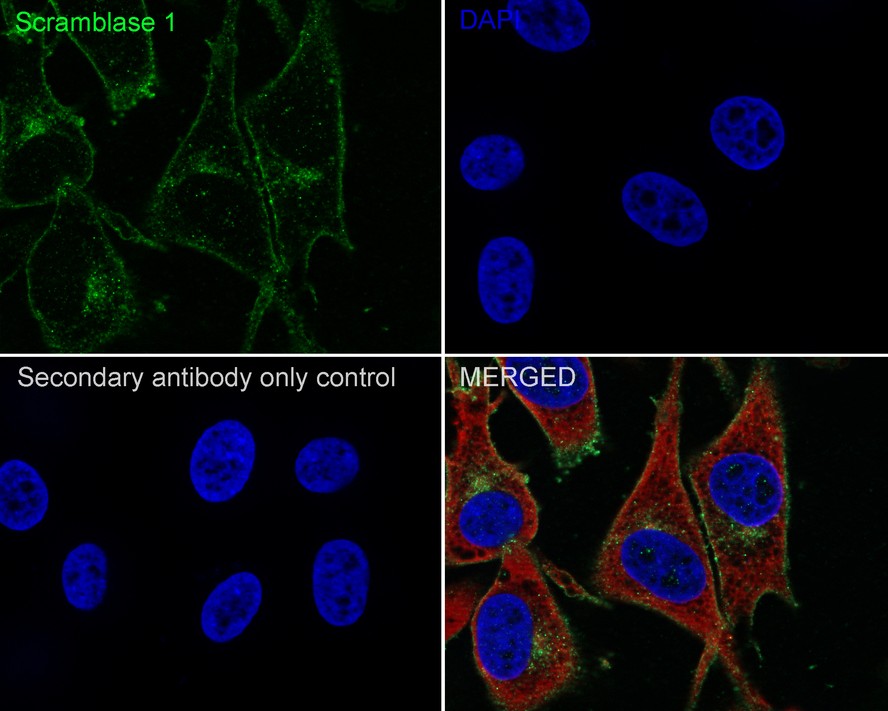
Immunocytochemistry analysis of SK-MEL-28 cells labeling Scramblase 1 with Rabbit anti-Scramblase 1 antibody at 1/100 dilution.Cells were fixed in 4% paraformaldehyde for 20 minutes at room temperature, permeabilized with 0.1% Triton X-100 in PBS for 5 minutes at room temperature, then blocked with 1% BSA in 10% negative goat serum for 1 hour at room temperature. Cells were then incubated with Rabbit anti-Scramblase 1 antibody at 1/100 dilution in 1% BSA in PBST overnight at 4 ℃. Goat Anti-Rabbit IgG H&L (488) was used as the secondary antibody at 1/1,000 dilution. PBS instead of the primary antibody was used as the secondary antibody only control. Nuclear DNA was labelled in blue with DAPI.Beta tubulin (red) was stained at 1/100 dilution overnight at +4℃. Goat Anti-Mouse IgG H&L (594) was used as the secondary antibody at 1/1,000 dilution.IHC
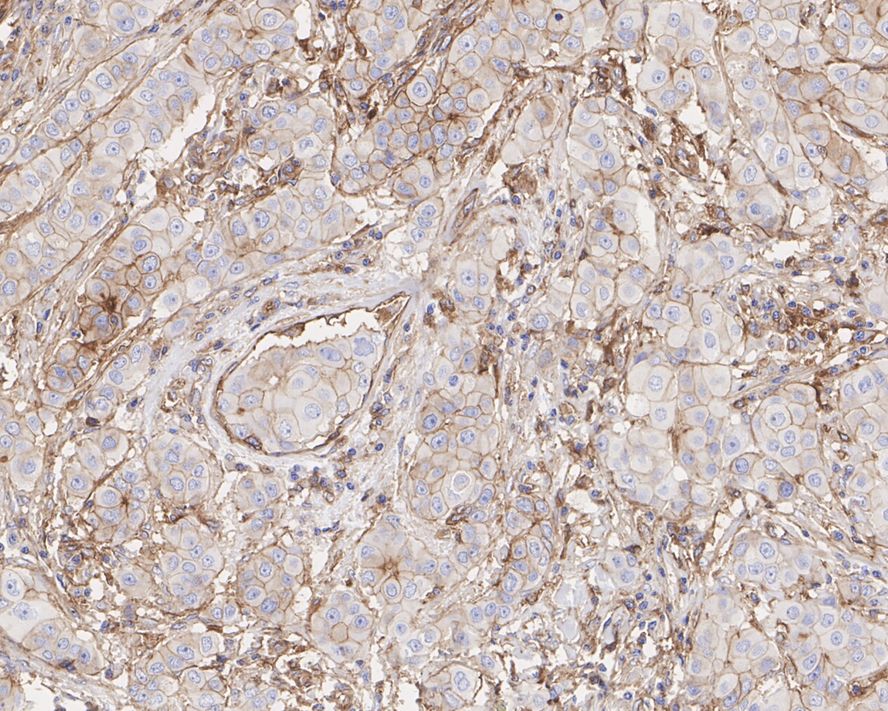
Immunohistochemical analysis of paraffin-embedded human breast cancer tissue with Rabbit anti-Scramblase 1 antibody at 1/200 dilution.The section was pre-treated using heat mediated antigen retrieval with Tris-EDTA buffer (pH 9.0) for 20 minutes. The tissues were blocked in 1% BSA for 20 minutes at room temperature, washed with ddH2O and PBS, and then probed with the primary antibody at 1/200 dilution for 1 hour at room temperature. The detection was performed using an HRP conjugated compact polymer system. DAB was used as the chromogen. Tissues were counterstained with hematoxylin and mounted with DPX.IHC
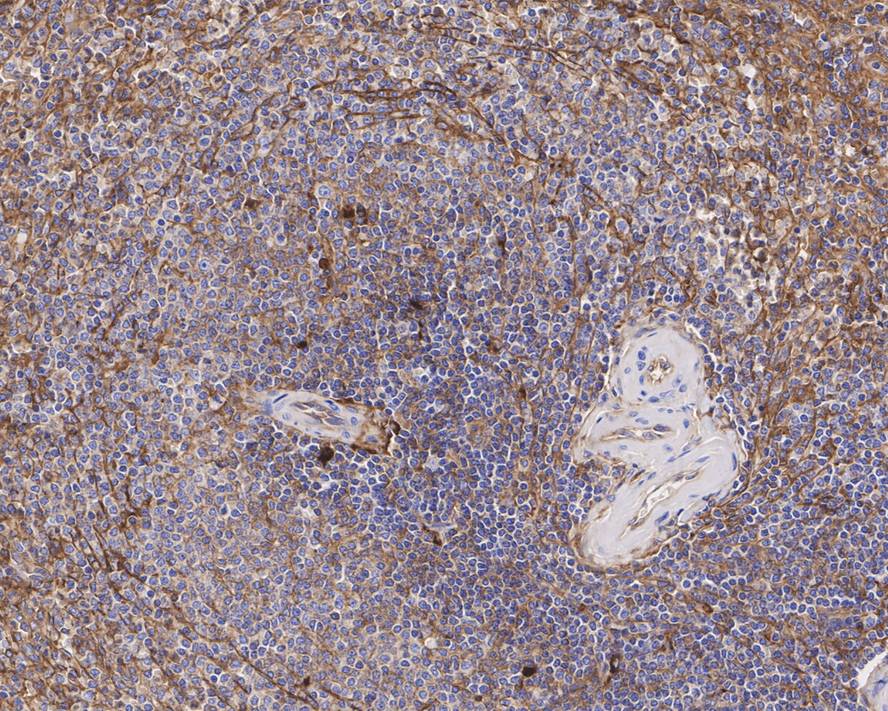
Immunohistochemical analysis of paraffin-embedded human spleen tissue with Rabbit anti-Scramblase 1 antibody at 1/200 dilution.The section was pre-treated using heat mediated antigen retrieval with Tris-EDTA buffer (pH 9.0) for 20 minutes. The tissues were blocked in 1% BSA for 20 minutes at room temperature, washed with ddH2O and PBS, and then probed with the primary antibody at 1/200 dilution for 1 hour at room temperature. The detection was performed using an HRP conjugated compact polymer system. DAB was used as the chromogen. Tissues were counterstained with hematoxylin and mounted with DPX.FC
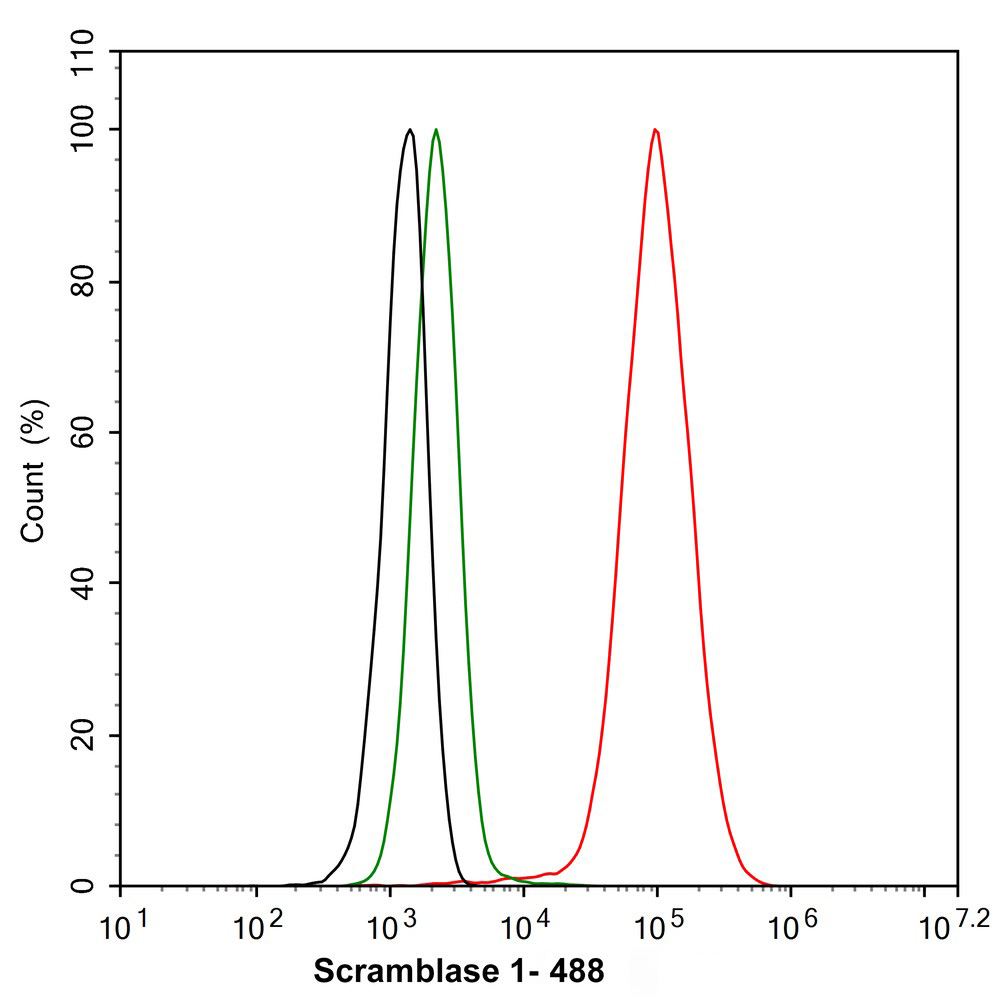
Flow cytometric analysis of SK-MEL-28 cells labeling Scramblase 1.Cells were fixed and permeabilized. Then stained with the primary antibody (1/1,000) (red) compared with Rabbit IgG Isotype Control (green). After incubation of the primary antibody at +4℃ for an hour, the cells were stained with a 488 conjugate-Goat anti-Rabbit IgG Secondary antibody at 1/1,000 dilution for 30 minutes at +4℃. Unlabelled sample was used as a control (cells without incubation with primary antibody; black).IP
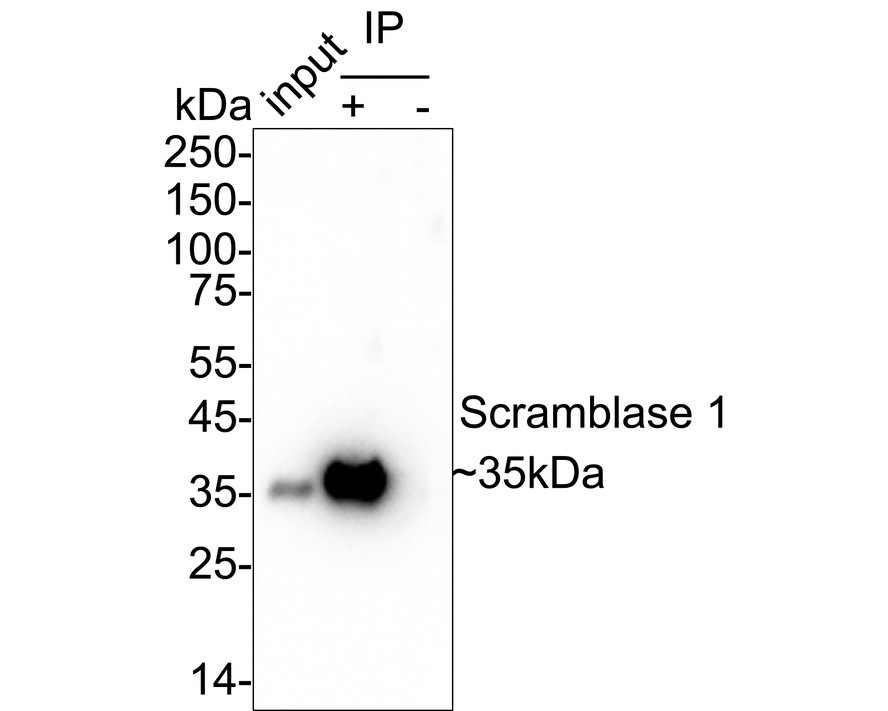
Scramblase 1 was immunoprecipitated from 0.2 mg SK-MEL-28 cell lysate with Rabbit anti-Scramblase 1 antibody at 2 µg/10 µl beads. Western blot was performed from the immunoprecipitate using Rabbit anti-Scramblase 1 antibody at 1/1,000 dilution. Anti-Rabbit IgG for IP Nano-secondary antibody (NBI01H) at 1/5,000 dilution was used for 1 hour at room temperature. Blocking/Dilution buffer: 5% NFDM/TBST Exposure time: 14 seconds;| Product Name | Scramblase 1 Recombinant Rabbit Monoclonal Antibody |
|---|---|
| Antibody Type | Primary Antibodies |
| Immunogen | Synthetic peptide within Human Scramblase 1 aa 11-60 / 318. |
| Clonality | Monoclonal |
|---|---|
| Isotype | IgG |
| Host Species | Rabbit |
| Tested Applications | FCICC/IFIHCIPWB |
| WB:1:1000 ICC/IF:1:100 IHC:1:200 FC:1:1000 IP:1-2μg/sample |
|
| Species Reactivity | Human |
| Concentration | 1mg/ml |
| Purification | Protein A |
| Gene Symbol | PLSCR1 |
|---|---|
| Gene Synonyms | MMTRA1B |
| Gene Full Name | phospholipid scramblase 1 |
| Gene Summary | This gene encodes a phospholipid scramblase family member. The encoded protein is involved in disruption of the asymmetrical distribution of phospholipids between the inner and outer leaflets of the plasma membrane, resulting in externalization of phosphatidylserine. This cell membrane disruption plays an important role in the blood coagulation cascade as well as macrophage clearing of apoptotic cells. The encoded protein has additionally been implicated in gene regulation and interferon-induced antiviral responses. [provided by RefSeq, May 2022] |
| Alternative Names | Ca(2+) dependent phospholipid scramblase 1 antibody Ca(2+)-dependent phospholipid scramblase 1 antibody Erythrocyte phospholipid scramblase antibody MM1 cell-derived transplantability-associated gene 1b mouse homolog of antibody MmTRA1a antibody MmTRA1b antibody Nor1 antibody Phospholipid scramblase 1 antibody PL scramblase 1 antibody PLS1_HUMAN antibody Ca(2+) dependent phospholipid scramblase 1 antibody Ca(2+)-dependent phospholipid scramblase 1 antibody Erythrocyte phospholipid scramblase antibody MM1 cell-derived transplantability-associated gene 1b mouse homolog of antibody MmTRA1a antibody MmTRA1b antibody Nor1 antibody Phospholipid scramblase 1 antibody PL scramblase 1 antibody PLS1_HUMAN antibody PLSCR 1 antibody Plscr1 antibody Scramblase1 antibody Tra1 antibody Tra1a antibody Tra1b antibody Transplantability-associated protein 1 antibody Tras1 antibody Tras2 antibody |
| Molecular Weight(MW) | 35 kDa |
| Cellular Localization | Cell membrane, Nucleus, Membrane, Cytoplasm, perinuclear region. |
WB
Western blot analysis of Scramblase 1 on different lysates with Rabbit anti-Scramblase 1 antibody at 1/1,000 dilution.Lysates/proteins at 20 µg/Lane.Exposure time: 9 seconds;4-20% SDS-PAGE gel.Proteins were transferred to a PVDF membrane and blocked with 5% NFDM/TBST for 1 hour at room temperature. The primary antibody at 1/1,000 dilution was used in 5% NFDM/TBST at 4℃ overnight. Goat Anti-Rabbit IgG - HRP Secondary Antibody at 1/50,000 dilution was used for 1 hour at room temperature.
ICC/IF
Immunocytochemistry analysis of SK-MEL-28 cells labeling Scramblase 1 with Rabbit anti-Scramblase 1 antibody at 1/100 dilution.Cells were fixed in 4% paraformaldehyde for 20 minutes at room temperature, permeabilized with 0.1% Triton X-100 in PBS for 5 minutes at room temperature, then blocked with 1% BSA in 10% negative goat serum for 1 hour at room temperature. Cells were then incubated with Rabbit anti-Scramblase 1 antibody at 1/100 dilution in 1% BSA in PBST overnight at 4 ℃. Goat Anti-Rabbit IgG H&L (488) was used as the secondary antibody at 1/1,000 dilution. PBS instead of the primary antibody was used as the secondary antibody only control. Nuclear DNA was labelled in blue with DAPI.Beta tubulin (red) was stained at 1/100 dilution overnight at +4℃. Goat Anti-Mouse IgG H&L (594) was used as the secondary antibody at 1/1,000 dilution.
IHC
Immunohistochemical analysis of paraffin-embedded human breast cancer tissue with Rabbit anti-Scramblase 1 antibody at 1/200 dilution.The section was pre-treated using heat mediated antigen retrieval with Tris-EDTA buffer (pH 9.0) for 20 minutes. The tissues were blocked in 1% BSA for 20 minutes at room temperature, washed with ddH2O and PBS, and then probed with the primary antibody at 1/200 dilution for 1 hour at room temperature. The detection was performed using an HRP conjugated compact polymer system. DAB was used as the chromogen. Tissues were counterstained with hematoxylin and mounted with DPX.
IHC
Immunohistochemical analysis of paraffin-embedded human spleen tissue with Rabbit anti-Scramblase 1 antibody at 1/200 dilution.The section was pre-treated using heat mediated antigen retrieval with Tris-EDTA buffer (pH 9.0) for 20 minutes. The tissues were blocked in 1% BSA for 20 minutes at room temperature, washed with ddH2O and PBS, and then probed with the primary antibody at 1/200 dilution for 1 hour at room temperature. The detection was performed using an HRP conjugated compact polymer system. DAB was used as the chromogen. Tissues were counterstained with hematoxylin and mounted with DPX.
FC
Flow cytometric analysis of SK-MEL-28 cells labeling Scramblase 1.Cells were fixed and permeabilized. Then stained with the primary antibody (1/1,000) (red) compared with Rabbit IgG Isotype Control (green). After incubation of the primary antibody at +4℃ for an hour, the cells were stained with a 488 conjugate-Goat anti-Rabbit IgG Secondary antibody at 1/1,000 dilution for 30 minutes at +4℃. Unlabelled sample was used as a control (cells without incubation with primary antibody; black).
IP
Scramblase 1 was immunoprecipitated from 0.2 mg SK-MEL-28 cell lysate with Rabbit anti-Scramblase 1 antibody at 2 µg/10 µl beads. Western blot was performed from the immunoprecipitate using Rabbit anti-Scramblase 1 antibody at 1/1,000 dilution. Anti-Rabbit IgG for IP Nano-secondary antibody (NBI01H) at 1/5,000 dilution was used for 1 hour at room temperature. Blocking/Dilution buffer: 5% NFDM/TBST Exposure time: 14 seconds;| Application Notes | WB:1:1000 ICC/IF:1:100 IHC:1:200 FC:1:1000 IP:1-2μg/sample |
|---|
| Form | Liquid |
|---|---|
| Storage Instructions | Shipped at 4℃. Store at +4℃ short term (1-2 weeks). It is recommended to aliquot into single-use upon delivery. Store at -20℃ long term. |
| Storage Buffer | TBS (pH7.4), 0.05% BSA, 40% Glycerol. Preservative: 0.05% Sodium Azide. |


