ELISA
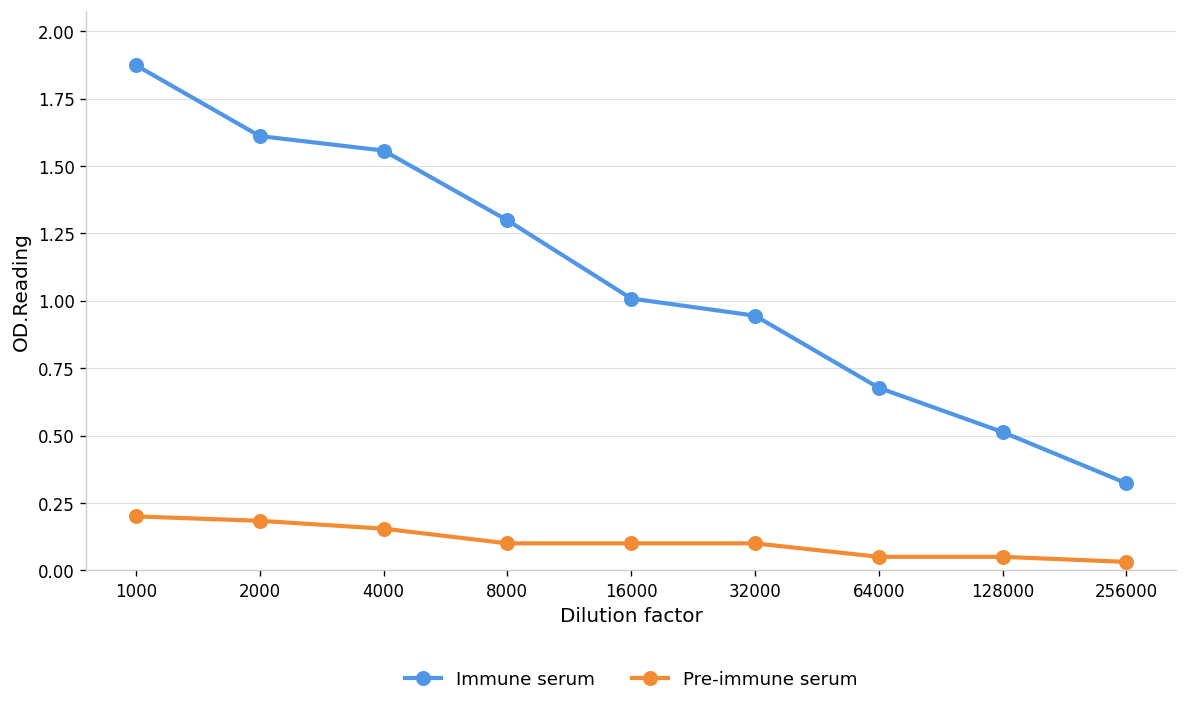
Coat the plate with immunizing antigen.Blue line: Immune serum; Orange line: Pre-immune serum.| Product Name | Anti-MUC1(NT) antibody |
|---|---|
| Antibody Type | Primary Antibodies |
| Immunogen | Polypeptide |
| Clonality | Polyclonal |
|---|---|
| Isotype | IgG |
| Host Species | Rabbit |
| Tested Applications | ELISA |
| ELISA:1:1000-10000 |
|
| Species Reactivity | HumanMouseRat |
| Concentration | 1mg/ml |
| Purification | Protein A |
| Gene Symbol | MUC1 |
|---|---|
| Gene Synonyms | ADMCKD ADMCKD1 ADTKD2 CA 15-3 Ca15-3 CD227 EMA H23AG KL-6 MAM6 MCD MCKD MCKD1 MUC-1 MUC-1/SEC MUC-1/X MUC1/ZD PEM PEMT PUM |
| Gene Full Name | mucin 1, cell surface associated |
| Gene Summary | This gene encodes a membrane-bound protein that is a member of the mucin family. Mucins are O-glycosylated proteins that play an essential role in forming protective mucous barriers on epithelial surfaces. These proteins also play a role in intracellular signaling. This protein is expressed on the apical surface of epithelial cells that line the mucosal surfaces of many different tissues including lung, breast stomach and pancreas. This protein is proteolytically cleaved into alpha and beta subunits that form a heterodimeric complex. The N-terminal alpha subunit functions in cell-adhesion and the C-terminal beta subunit is involved in cell signaling. Overexpression, aberrant intracellular localization, and changes in glycosylation of this protein have been associated with carcinomas. This gene is known to contain a highly polymorphic variable number tandem repeats (VNTR) domain. Alternate splicing results in multiple transcript variants.[provided by RefSeq, Feb 2011] |
| Alternative Names | breast carcinoma-associated antigen DF3 cancer antigen 15-3 carcinoma-associated mucin cell membrane protein cytoplasmic domain DF3 antigen episialin H23 antigen J19 krebs von den Lungen-6 MUC1 MUC1-alpha MUC1/E1 transmembrane devoid of tandem repeats MUC1/E2 transmembrane devoid of tandem repeats longer signal peptide MUC1/F transmembrane MUC1/G transmembrane devoid of tandem repeats MUC1/PC1 MUC1/PC2 MUC1/S1 potential secreted protein MUC1/S2 potential secreted protein MUC1/S potential secreted protein with no tandem repeats MUC1/SV1 MUC1/SV10 MUC1/SV2 MUC1/SV3 MUC1/SV4 MUC1/SV7 MUC1/SV8 MUC1/SV9 mucin 1 transmembrane mucin glycoprotein mucin short variant Y transmembrane devoid of tandem repeats Mucin1 peanut-reactive urinary mucin polymorphic epithelial mucin short variant tumor associated epithelial mucin tumor-associated epithelial membrane antigen Unknown |
| Molecular Weight(MW) | 122kDa |
| Cellular Localization | Apical cell membrane |
| SwissProt ID | P15941 |
|---|
ELISA
Coat the plate with immunizing antigen.Blue line: Immune serum; Orange line: Pre-immune serum.| Application Notes | ELISA:1:1000-10000 |
|---|
| Form | Liquid |
|---|---|
| Storage Instructions | Shipped at 4°C. Store at +4°C short term (1-2 weeks). Store at -20°C long term. Avoid freeze / thaw cycle. |
| Storage Buffer | Purified antibody in PBS with 0.05% PC300,40% Glycerol. |


