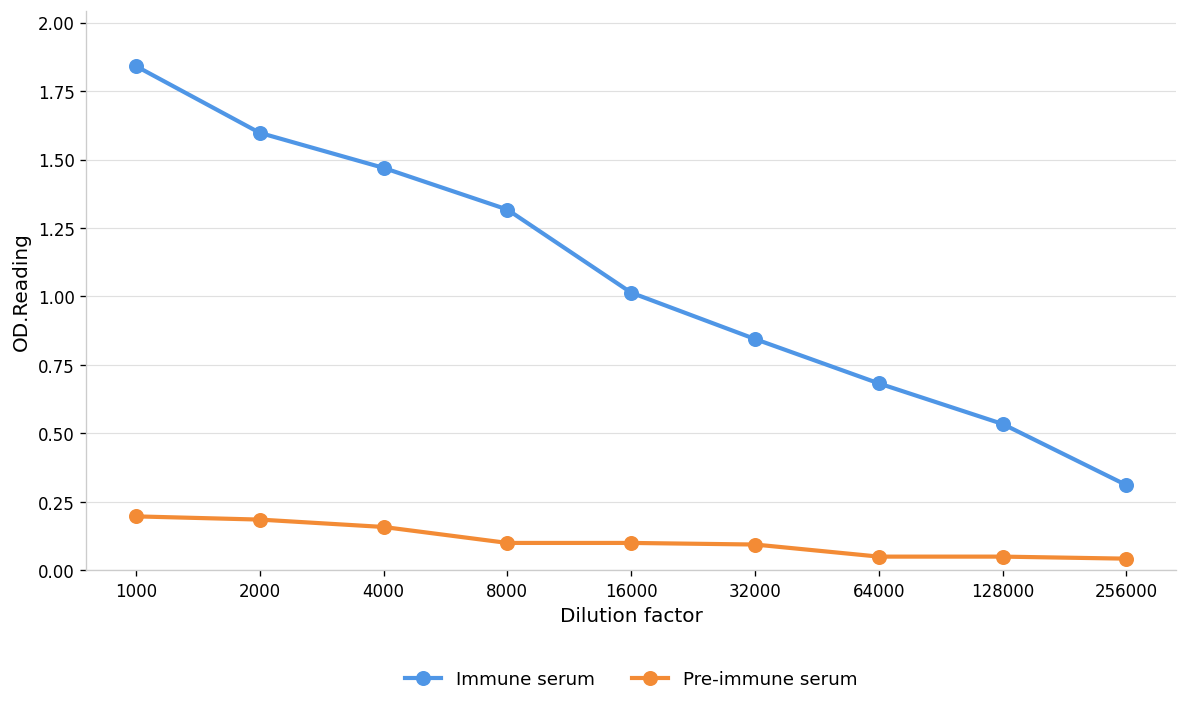
ELISA
Coat the plate with immunizing antigen.Blue line: Immune serum; Orange line: Pre-immune serum.| Product Name | Anti-Plasminogen/PLG antibody |
|---|---|
| Antibody Type | Primary Antibodies |
| Product description |
|
| Immunogen | Polypeptide |
| Clonality | Polyclonal |
|---|---|
| Isotype | IgG |
| Host Species | Rabbit |
| Tested Applications | ELISA |
| ELISA:1:1000-1:10000 |
|
| Species Reactivity | HumanMouseRat |
| Concentration | 1mg/ml |
| Purification | Protein A |
| Gene Symbol | PLG |
|---|---|
| Gene Synonyms | Ab1-346 HAE4 Pg |
| Gene Full Name | plasminogen |
| Gene Summary | The plasminogen protein encoded by this gene is a serine protease that circulates in blood plasma as an inactive zymogen and is converted to the active protease, plasmin, by several plasminogen activators such as tissue plasminogen activator (tPA), urokinase plasminogen activator (uPA), kallikrein, and factor XII (Hageman factor). The conversion of plasminogen to plasmin involves the cleavage of the peptide bond between Arg-561 and Val-562. Plasmin cleavage also releases the angiostatin protein which inhibits angiogenesis. Plasmin degrades many blood plasma proteins, including fibrin-containing blood clots. As a serine protease, plasmin cleaves many products in addition to fibrin such as fibronectin, thrombospondin, laminin, and von Willebrand factor. Plasmin is inactivated by proteins such as alpha-2-macroglobulin and alpha-2-antiplasmin in addition to inhibitors of the various plasminogen activators. Plasminogen also interacts with plasminogen receptors which results in the retention of plasmin on cell surfaces and in plasmin-induced cell signaling. The localization of plasminogen on cell surfaces plays a role in the degradation of extracellular matrices, cell migration, inflamation, wound healing, oncogenesis, metastasis, myogenesis, muscle regeneration, neurite outgrowth, and fibrinolysis. This protein may also play a role in acute respiratory distress syndrome (ARDS) which, in part, is caused by enhanced clot formation and the suppression of fibrinolysis. Compared to other mammals, the cluster of plasminogen-like genes to which this gene belongs has been rearranged in catarrhine primates. [provided by RefSeq, May 2020] |
| Alternative Names | angiostatin DKFZp779M0222 liver regeneration-related protein LRRG051 plasmin plasmin heavy chain A plasmin light chain B plasminogen RP1-81D8.1 |
| Molecular Weight(MW) | 92kDa |
| Source | Rabbit |
| Cellular Localization | Secreted |
| SwissProt ID | A6PVI2 |
|---|
ELISA
Coat the plate with immunizing antigen.Blue line: Immune serum; Orange line: Pre-immune serum.| Application Notes | ELISA:1:1000-1:10000 |
|---|
| Form | Liquid |
|---|---|
| Storage Instructions | Shipped at 4°C. Store at +4°C short term (1-2 weeks). Store at -20°C long term. Avoid freeze / thaw cycle. |
| Storage Buffer | Purified antibody in PBS with 0.05% PC300,40% Glycerol. |


