WB
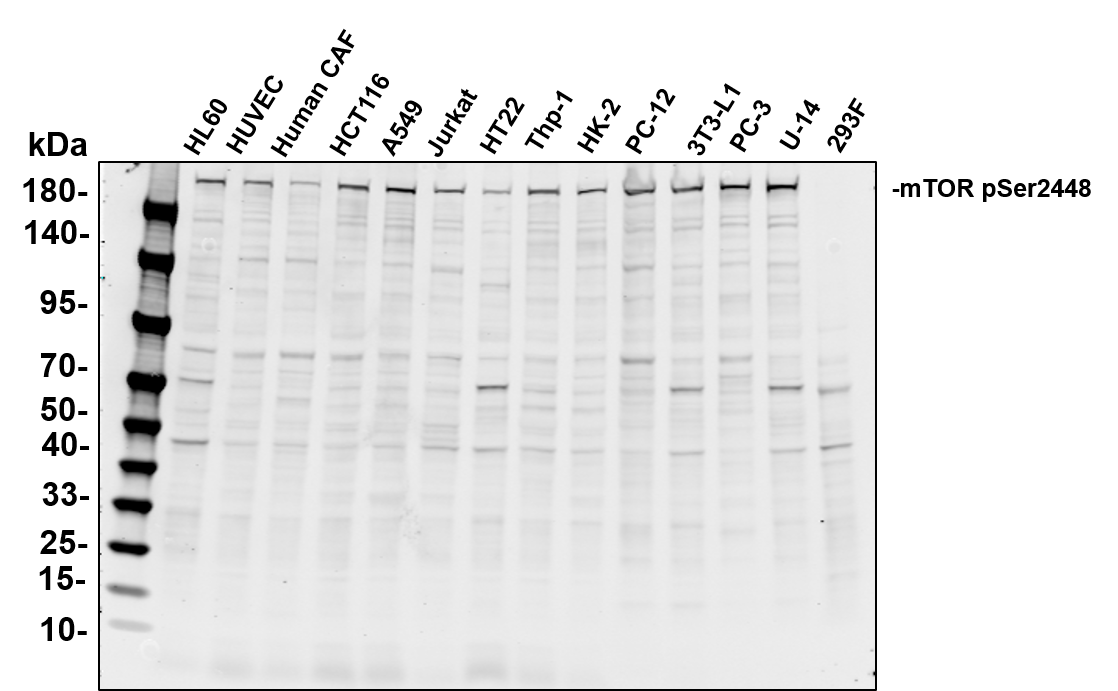
Various whole cell lysates were separated by 4-20% SDS-PAGE, and the primary antibody was used at 4℃, over night with a 1:5000 dilution . The Dylight 800-conjugated Goat anti-Rabbit antibody was used to detect the antibody. Lane1: HL60 - Human promyelocytic leukemia cell Lane2: HUVEC - Human umbilical vein endothelial cell Lane3: Human CAF - Human cancer-associated fibroblast Lane4: HCT116 - Human colorectal carcinoma Lane5: A549 - Human lung carcinoma Lane6: Jurkat - Human T lymphocyte leukemia Lane7: HT22 - Mouse hippocampal neuronal Lane8: Thp-1 - Human monocytic leukemia Lane9: HK-2 - Human proximal tubular epithelial Lane10: PC-12 - Rat adrenal pheochromocytoma Lane11: 3T3-L1 - Mouse embryonic fibroblast Lane12: PC-3 - Human prostate adenocarcinoma Lane13: U-14 - Mouse cervical carcinoma Lane14: 293F - HEK293 derivative, adapted for suspension culture.WB
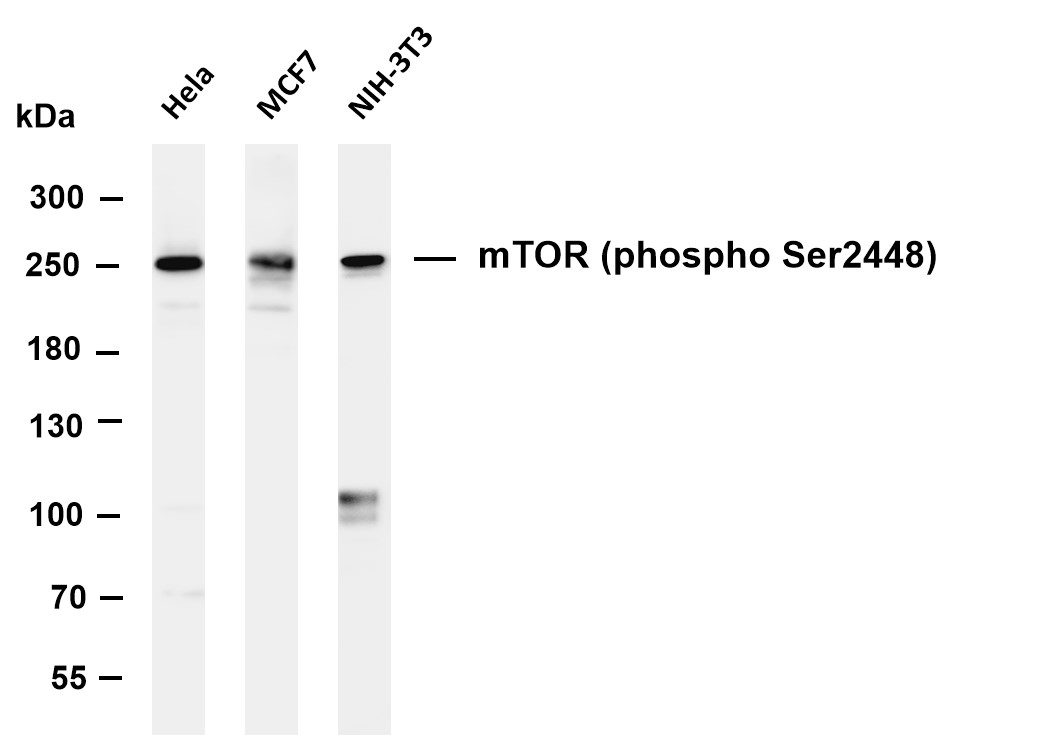
Various whole cell lysates were separated by 4-8% SDS-PAGE, and the membrane was blotted with anti-mTOR (phospho Ser2448) antibody. The HRP-conjugated Goat anti-Rabbit IgG(H + L) antibody was used to detect the antibody. Lane 1: Hela Lane 2: MCF7 Lane 3: NIH-3T3.WB
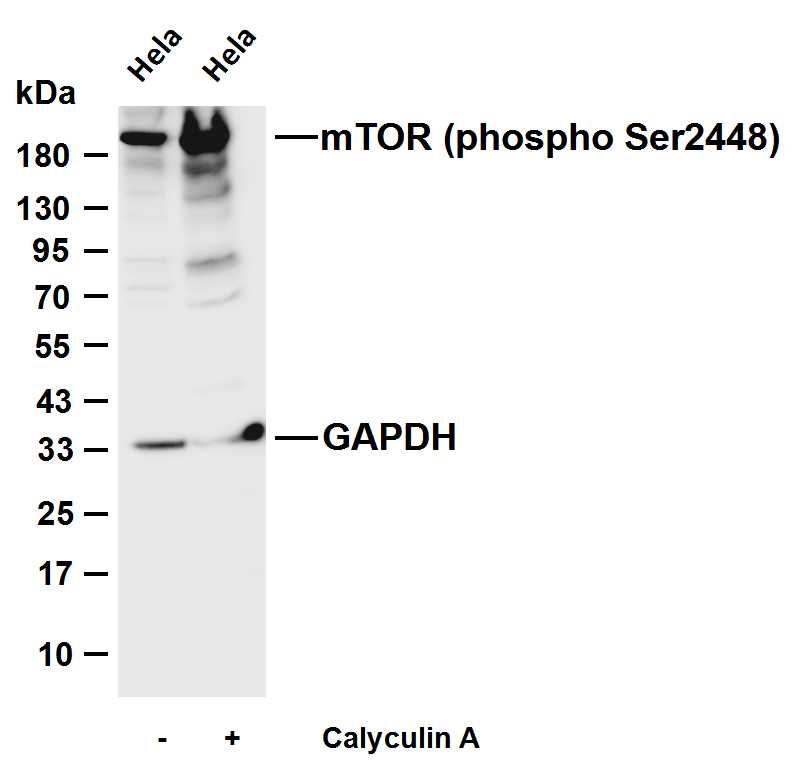
Various whole cell lysates were separated by 4-20% SDS-PAGE, and the membrane was blotted with anti-mTOR (phospho Ser2448) antibody. The HRP-conjugated Goat anti-Rabbit IgG (H + L) antibody was used to detect the antibody. Lane 1: Hela Lane 2: Hela was treated with Calyculin A (100nM) for 30 minutes .IHC
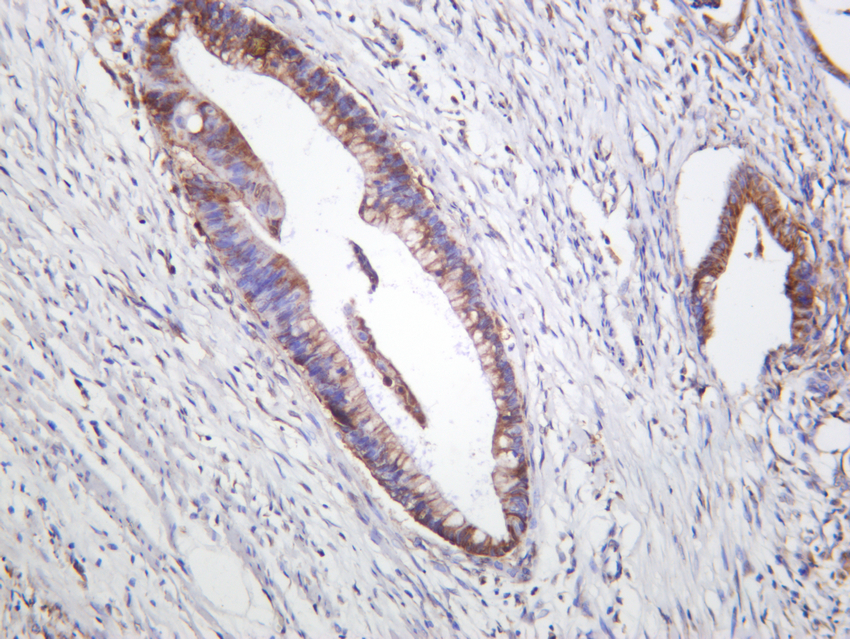
Human colon carcinoma was stained with anti-mTOR (phospho Ser2448) rabbit antibody.ICC/IF
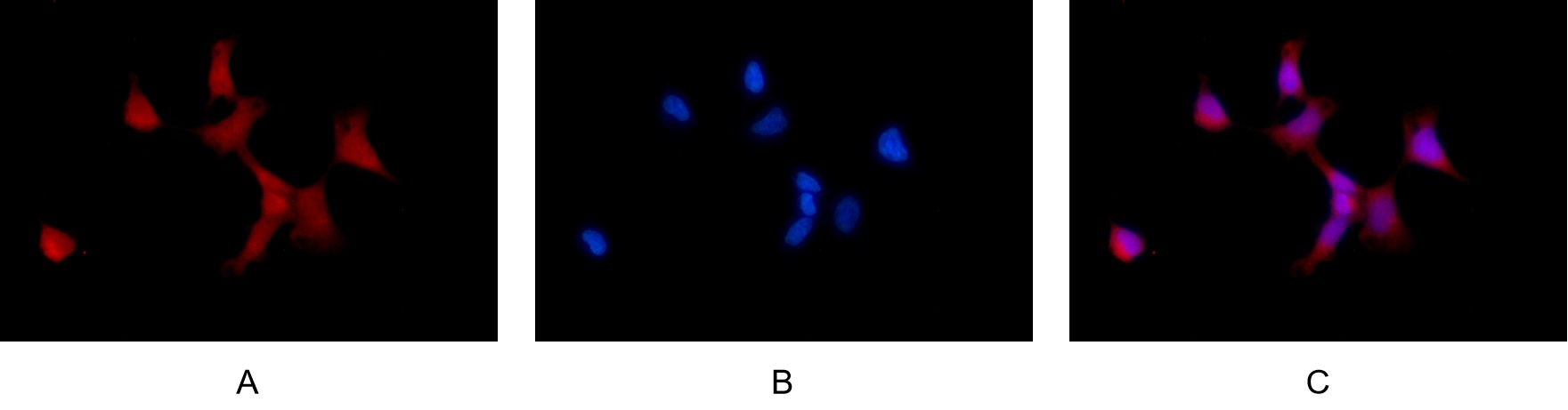
Immunofluorescence analysis of HEK293. Picture A: mTOR antibody (red). Picture B: DAPI (blue). Picture C: Merge of A+B.| Product Name | mTOR (Phospho Ser2448) Rabbit mAb |
|---|---|
| Antibody Type | Primary Antibodies |
| Clonality | monoclonal |
|---|---|
| Isotype | IgG,K |
| Host Species | Rabbit |
| Tested Applications | ICC/IFIHCWB |
| WB:1:2000-1:10000 IHC:1:500-1:2000 ICC/IF:1:200-1:1000 |
|
| Species Reactivity | BovineHumanMousePigRat |
| Concentration | 1mg/ml |
| Purification | Protein A |
| Gene Symbol | MTOR |
|---|---|
| Gene Synonyms | SKS FRAP FRAP1 FRAP2 RAFT1 RAPT1 |
| Gene Full Name | mechanistic target of rapamycin kinase |
| Gene Summary | The protein encoded by this gene belongs to a family of phosphatidylinositol kinase-related kinases. These kinases mediate cellular responses to stresses such as DNA damage and nutrient deprivation. This kinase is a component of two distinct complexes, mTORC1, which controls protein synthesis, cell growth and proliferation, and mTORC2, which is a regulator of the actin cytoskeleton, and promotes cell survival and cell cycle progression. This protein acts as the target for the cell-cycle arrest and immunosuppressive effects of the FKBP12-rapamycin complex. Inhibitors of mTOR are used in organ transplants as immunosuppressants, and are being evaluated for their therapeutic potential in SARS-CoV-2 infections. Mutations in this gene are associated with Smith-Kingsmore syndrome and somatic focal cortical dysplasia type II. The ANGPTL7 gene is located in an intron of this gene. [provided by RefSeq, Aug 2020] |
| Alternative Names | MTOR FRAP FRAP1 FRAP2 RAFT1 RAPT1 Serine/threonine-protein kinase mTOR FK506-binding protein 12-rapamycin complex-associated protein 1 FKBP12-rapamycin complex-associated protein Mammalian target of rapamycin mTOR Mechanistic tar |
| Molecular Weight(MW) | 289kDa(Observed MW 250kDa) |
| Cellular Localization | Cytoplasm |
WB
Various whole cell lysates were separated by 4-20% SDS-PAGE, and the primary antibody was used at 4℃, over night with a 1:5000 dilution . The Dylight 800-conjugated Goat anti-Rabbit antibody was used to detect the antibody. Lane1: HL60 - Human promyelocytic leukemia cell Lane2: HUVEC - Human umbilical vein endothelial cell Lane3: Human CAF - Human cancer-associated fibroblast Lane4: HCT116 - Human colorectal carcinoma Lane5: A549 - Human lung carcinoma Lane6: Jurkat - Human T lymphocyte leukemia Lane7: HT22 - Mouse hippocampal neuronal Lane8: Thp-1 - Human monocytic leukemia Lane9: HK-2 - Human proximal tubular epithelial Lane10: PC-12 - Rat adrenal pheochromocytoma Lane11: 3T3-L1 - Mouse embryonic fibroblast Lane12: PC-3 - Human prostate adenocarcinoma Lane13: U-14 - Mouse cervical carcinoma Lane14: 293F - HEK293 derivative, adapted for suspension culture.
WB
Various whole cell lysates were separated by 4-8% SDS-PAGE, and the membrane was blotted with anti-mTOR (phospho Ser2448) antibody. The HRP-conjugated Goat anti-Rabbit IgG(H + L) antibody was used to detect the antibody. Lane 1: Hela Lane 2: MCF7 Lane 3: NIH-3T3.
WB
Various whole cell lysates were separated by 4-20% SDS-PAGE, and the membrane was blotted with anti-mTOR (phospho Ser2448) antibody. The HRP-conjugated Goat anti-Rabbit IgG (H + L) antibody was used to detect the antibody. Lane 1: Hela Lane 2: Hela was treated with Calyculin A (100nM) for 30 minutes .
IHC
Human colon carcinoma was stained with anti-mTOR (phospho Ser2448) rabbit antibody.
ICC/IF
Immunofluorescence analysis of HEK293. Picture A: mTOR antibody (red). Picture B: DAPI (blue). Picture C: Merge of A+B.| Application Notes | WB:1:2000-1:10000 IHC:1:500-1:2000 ICC/IF:1:200-1:1000 |
|---|
| Form | Liquid |
|---|---|
| Storage Instructions | -15°C to -25°C/1 year(Do not lower than -25°C) |
| Storage Buffer | PBS, 50% glycerol, 0.05% Proclin 300, 0.05%BSA |


